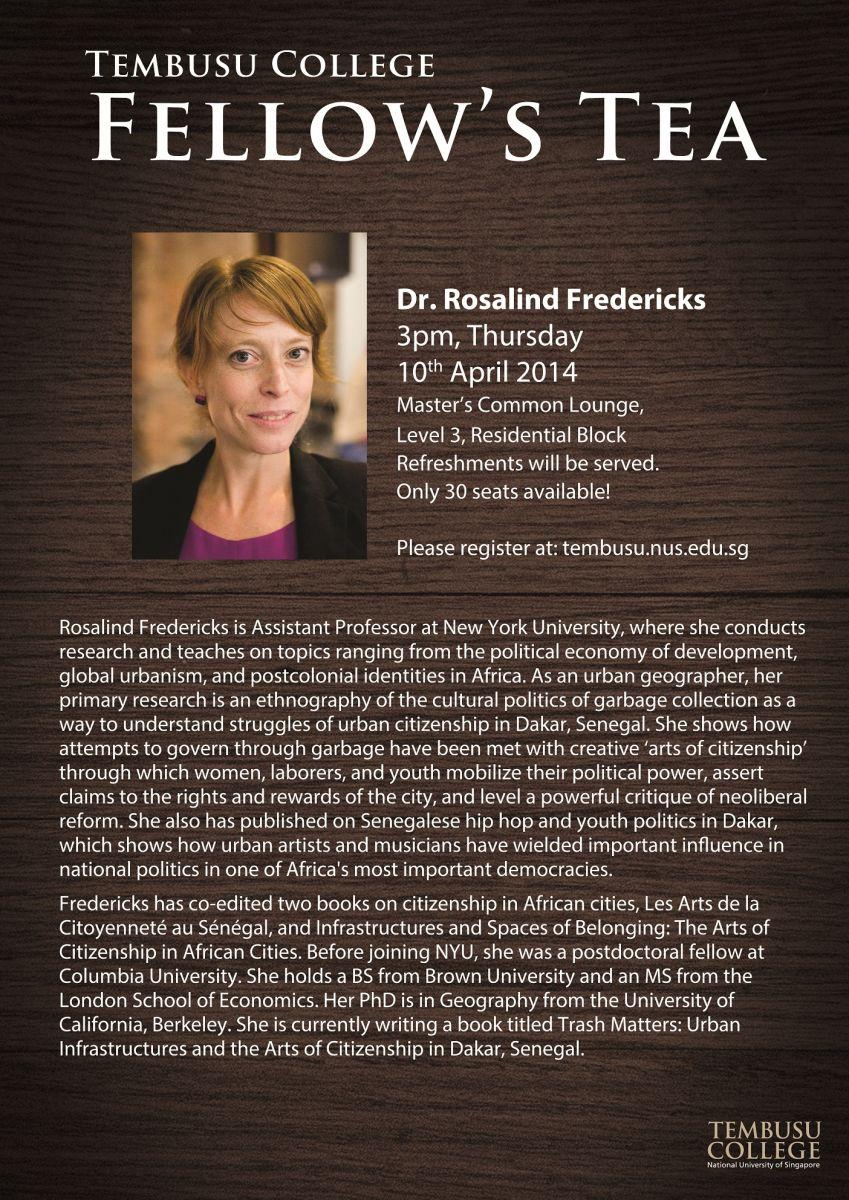
Please register at dev-tembusu-nus.pantheonsite.io
Rosalind Fredericks is Assistant Professor at New York University, where she conducts research and teaches on topics ranging from the political economy of development, global urbanism, and postcolonial identities in Africa. As an urban geographer, her primary research is an ethnography of the culture politics of garbage collection as a way to understand struggles of urban citizenship in Dakar, Senegal. She shows how attempts to govern through garbage have been met with creative ‘arts of citizenship’ through which women, labourers, and youth mobilize their politics in Dakar, which shows how urban artists and musicians have wielded important influence in national politics in one of Africa’s most important democracies.
Fredericks has co-edited two books on citizenship in Africans cities, Les Arts de la Citoyennete au Senegal, and Infrastructures ans Spaces of Belonging: The Arts of Citizenship in African Cities. Before joining NYU, she was a postdoctoral fellow at Columbia University. She holds a BS from Brown University and an MS from the London School of Economics. Her PhD is in Geography from the University of California, Berkeley. She is currently writing a book titled trash Matters: Urban Infrastructures and the Arts of Citizenship in Dakar, Senegal.
Singapore’s national flower: What Science does and does not tell us about the origins of Vanda Miss Joaquim
Dr John Elliot
Associate Professor,
Department of Psychology, NUS
3rd April 2014, 6pm
Vanda Miss Joaquim was reported as a new hybrid orchid in 1893. In 1981 it was selected as the National Flower of Singapore, partly because it was thought to be a natural hybrid, not man-made. Thus, no race or community could claim credit for it, or it would be favoured by choosing it. However, the horticultural records suggest it was a deliberate hybrid, not a natural one, created by the lady for whom it named, Agnes Joaquim. There has been a vigorous debate about this in recent years, in which some scientists have argued that scientific data shows that Miss Joaquim found the orchid, but did not create it. However, I shall argue that science has been misused in this claim; that properly used, science leaves the question open; and that history and horticulture are more likely to provide a clear answer.