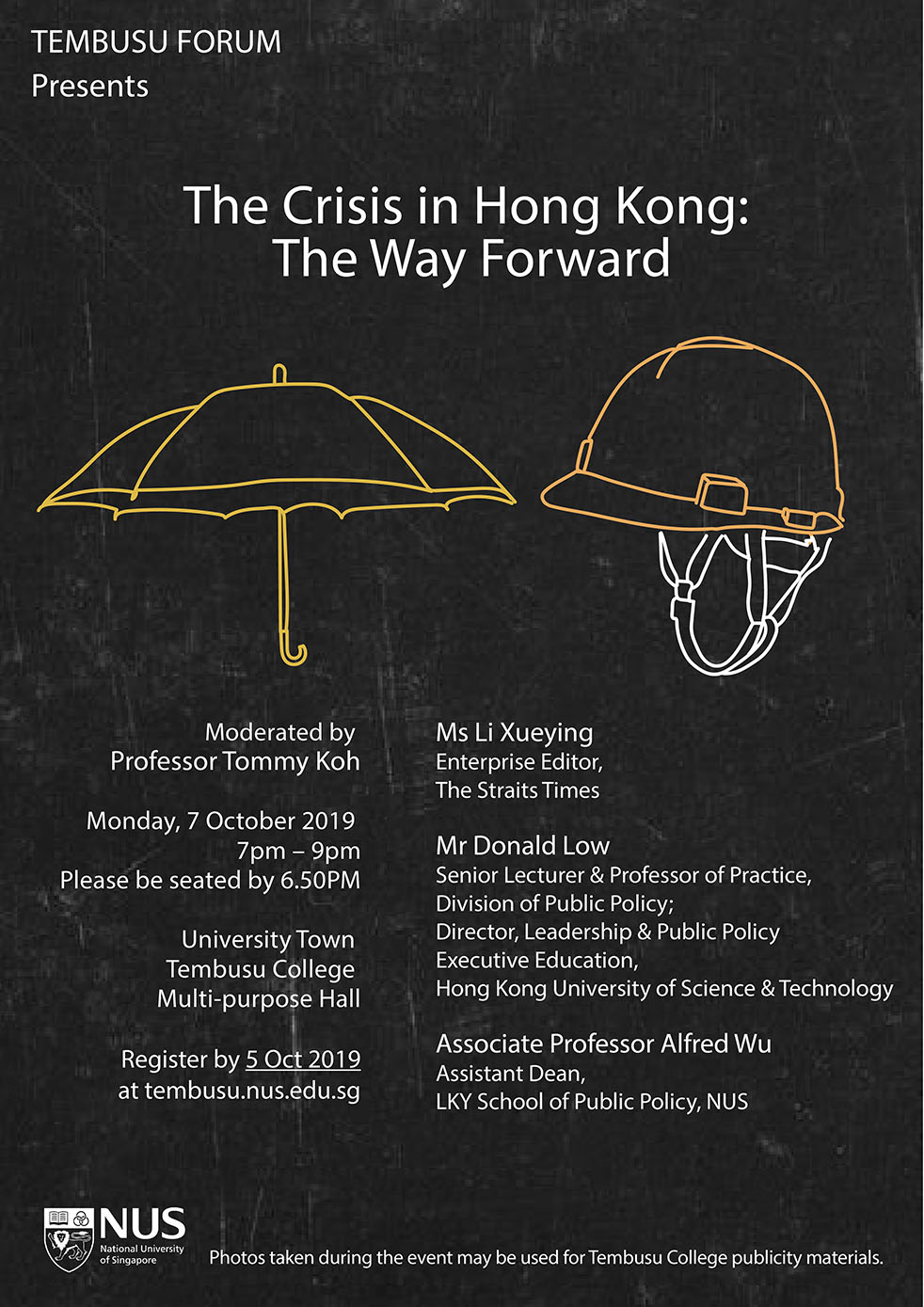
By Professor Tommy Koh: The crisis in Hong Kong: A quest for understanding
Hong Kong has been in turmoil for the past four months. I have tried to understand, in an objective way, the root causes of the crisis. I have identified the following 10 important facts about Hong Kong and about the crisis.
First, the British defeated China in the Opium War of 1839 to 1842. Under the 1824 Treaty of Nanjing, the island of Hong Kong was ceded to the UK in perpetuity.
Second, China was defeated by Japan in the Sino-Japanese War of 1894-1895. A weakened China was forced to lease the New Territories to the British for 99 years. The lease expired in 1997.
Third, in 1984, the governments of China and the UK reached an agreement on the future of Hong Kong. The British agreed to return Hong Kong to China in 1997. The Chinese Government agreed that the people of Hong Kong would enjoy the rights contained in the UN’s International Covenant on Civil and Political Rights.
The text of the covenant is part of the domestic law of Hong Kong. Hong Kong would enjoy autonomy for 50 years under the policy of ‘one country, two systems’. The agreement between China and UK is contained in the 1984 China-UK Joint Declaration. The two principal architects of the agreement were Deng Xiaoping and Margaret Thatcher.
Fourth, the political system in Hong Kong is contained in the Hong Kong Basic Law, which is the equivalent of Hong Kong’s Constitution. The Legislative Council of Hong Kong consists of two types of members. Fifty per cent of the members, 35 of them, are popularly elected. The other half, another 35, are elected by functional constituencies, such as, bankers, lawyers, manufacturers, educationists, etc. The Chief Executive is elected by an election committee consisting of 1,200 persons. Critics claim that the election committee consists mainly of pro-China individuals.
Fifth, under Article 31 of the Constitution of the People’s Republic of China, Hong Kong is a Special Administrative Region (SAR), a status which provides constitutional guarantees for implementing the policy of “one country, two systems”. Hong Kong’s Basic Law was approved by the National People’s Congress, in March 1990, and entered into force on 1 July 1997.
Sixth, in 2003, the HKSAR government proposed to implement Article 23 of the Basic Law, by enacting a law against acts such as treason, subversion, secession and sedition. About 500,000 Hong Kongers protested against the proposal. As a result, the Chief Executive then, Tung Chee Hwa, abandoned the proposal. He resigned as Chief Executive.
Seventh, in 2005, the second Chief Executive, Donald Tsang, proposed that the 2017 election of the Chief Executive, and the 2020 Legislative Council Elections would be based upon universal suffrage. The proposal was, however, not accepted because of the public’s concern that the candidates for the post of Chief Executive, would have to go through a screening process controlled by Beijing.
Eighth, in 2012, the Hong Kong Government tried to push through a patriotic national education programme. The proposal was withdrawn due to strong opposition.
In September 2014, the so-called Umbrella Revolution led by students erupted against a decision by the Standing Committee of the National People’s Congress, on proposed electoral reforms. The students demanded universal suffrage and genuinely free elections. The movement ended peacefully, after occupying Central Hong Kong for 79 days, but with no result.
Ninth, in February 2019, the Legislative Council proposed a bill to amend extradition rights between Hong Kong and other countries. On 9 June and on 16 June, protests that drew an estimated one million and two million respectively took to the streets peacefully to demonstrate against the bill.
On 15 June 2019, Chief Executive Carrie Lam announced that the Bill had been suspended. On 4 Sept 2019, she announced that the Bill would be withdrawn. But the protest movement demanded her acceptance of four other demands, including forming an independent inquiry to look into allegations of police brutality and abuse of power and universal suffrage. She has refused to budge. The movement has been split between the majority, which is peaceful, and a minority, which is increasingly violent.
Tenth, on 5 October 2019, Carrie Lam invoked a colonial-era law and banned the use of face masks in public gatherings. The result has been defiance and more violence.
What Do The Protestors Want?
I think they want to have universal suffrage and the right to choose their leaders in free elections. They do not want China to have the right to screen the candidates for the post of Chief Executive.
They want to preserve their identity as Hong Kongers and their way of life, including the freedom of speech and of peaceful assembly.
They object to China sending agents to Hong Kong to kidnap people they don’t like.
Finally, they want Hong Kong to be a fairer society, with affordable housing, good jobs and a government which is accountable to them.
What does China Want?
China wants the people of Hong Kong to understand that it is part of China and subject to China’s sovereignty. China will not tolerate any attempt to separate Hong Kong from China. China wants the people of Hong Kong to love China as well as Hong Kong. China will not allow Hong Kong to be used to subvert China.
The actions by some protestors to burn China’s flag, deface the portrait of its President and attack the premises of its office are totally unacceptable. China also feels that it has done so much to help Hong Kong and Hong Kongers should be grateful and not hostile.
A Collision Of Two Tendencies
There is misalignment of emphasis by the two sides. China tends to emphasize the importance of one country. The young Hong Kongers tend to emphasize the importance of two systems.
The Chinese complain that the young Hong Kongers are not behaving as Chinese citizens should. The Hong Kongers complain that China has been undermining the integrity of two systems. In Hong Kong, there is a generational difference between the old and the young. The old feel that they are Chinese. The young feel that they are Hong Kongers.
The Use Of Violence
The protest movement in 2019, as in 2015, began peacefully. The majority remains committed to non-violence. There is, however, a minority of violent protesters. Their actions to shut down the airport, to attack the MTR and to vandalise private property, must be condemned.
Such violent behaviour has brought discredit to the protest movement. It has also damaged the economy and Hong Kong’s reputation as a safe and efficient global city. Violence will beget violence and not concessions.
Involvement Of Outside Forces
Is the protest movement in Hong Kong being manipulated by the United States or Taiwan? I don’t know the answer.
But, I don’t think the US has the power to motivate one to two million Hong Kongers to march peacefully against the Extradition Bill.
I think the protest movement is made in Hong Kong and not, in Washington or Taipei.
Conclusion
I want the people of Hong Kong to know that they enjoy the goodwill of the people of Singapore.
We want Hong Kong to succeed. We want the current crisis to be resolved peacefully.
It is unreasonable for the protest movement to expect the Chief Executive to accept all their demands.
The one demand which I think is reasonable is the demand for an independent inquiry. I hope the Chief Executive would consider accepting this demand which could break the current deadlock.