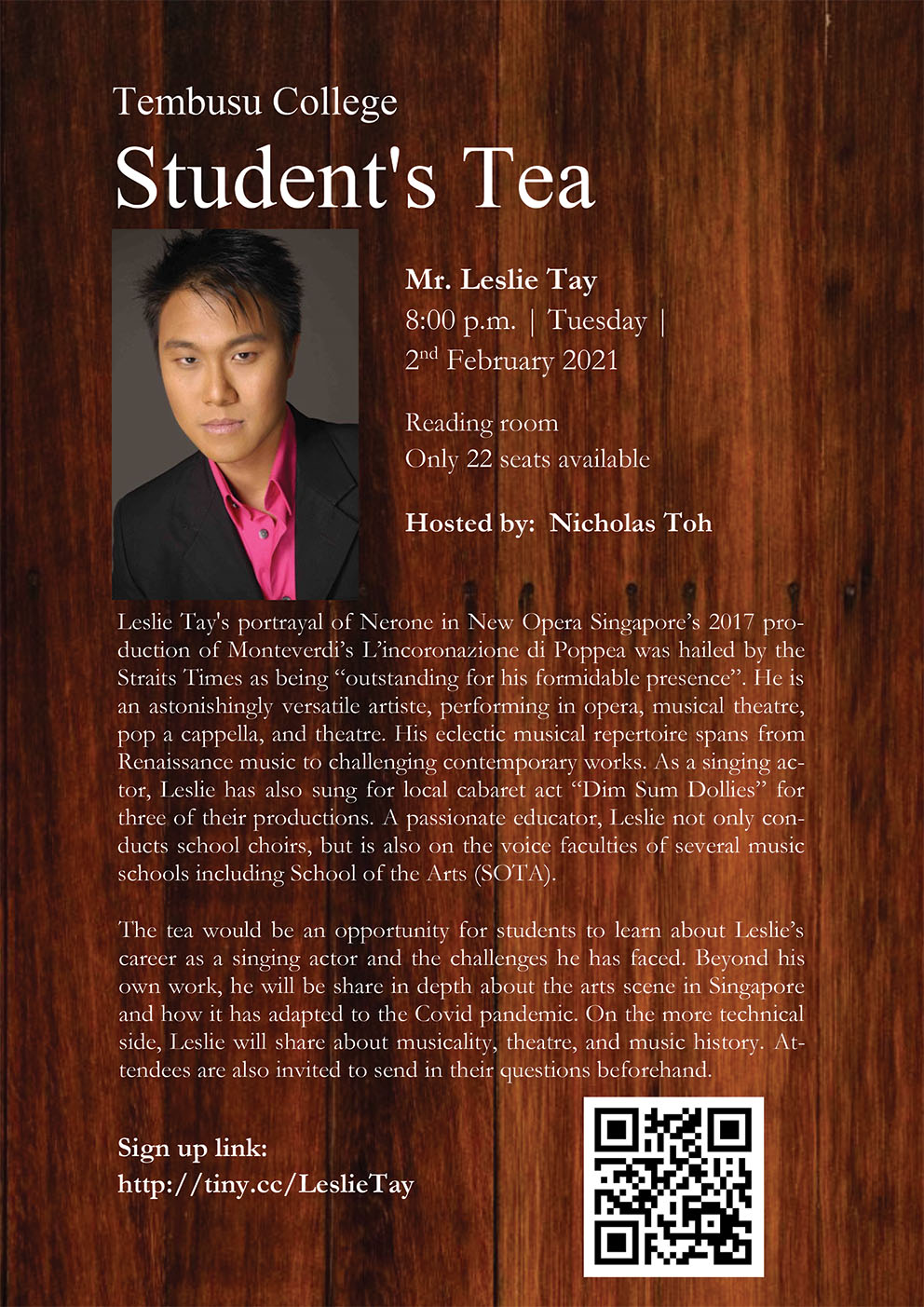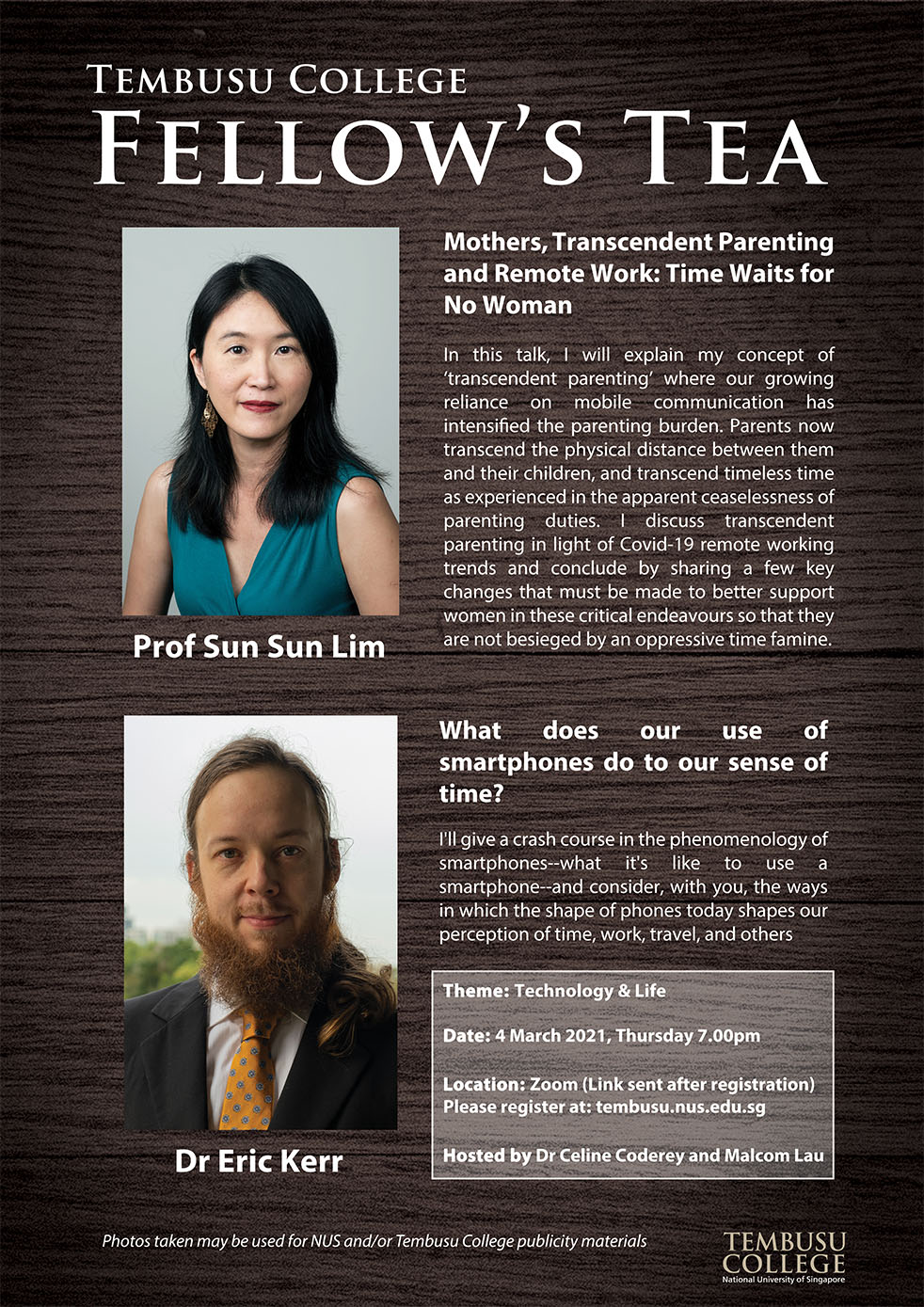
BRIEF BIOGRAPHY OF SPEAKERS:
Professor Lim Sun Sun is Professor of Communication and Technology and Head of Humanities, Arts and Social Sciences at the Singapore University of Technology and Design She has extensively researched the social impact of technology, focusing on technology domestication by families, workplace digital disruptions and public perceptions of smart city technologies She recently authored Transcendent Parenting Raising Children in the Digital Age (Oxford University Press, 2020 and co-edited The Oxford Handbook of Mobile Communication and Society (Oxford University Press, 2020 She serves on the editorial boards of eleven journals and several public bodies including the Social Science Research Council, Singapore Environment Council and Media Literacy Council From 2018 2020 she served as a Nominated Member of the 13th Parliament of Singapore She was named to the inaugural Singapore 100 Women in Tech list in 2020 that recognises and celebrates women who have made significant contributions to the technology sector She frequently offers her expert commentary in international outlets including Nature, Scientific American, Guardian, Channel NewsAsia, Business Times and Straits Times She has won eight awards for excellent teaching.
Dr Eric Kerr is Director of Student Affairs at Tembusu College (and once upon a time taught Time & Life!). His research centres on the ways technologies organize our everyday lives, beliefs, and experiences He has written about a wide variety of topics from digital culture to engineering to climate and the environment He is Associate Editor at the academic journal Social Epistemology and a member of the Social Economic Policies Asia programme with the Konrad Adenauer Stiftung in Tokyo, Japan.
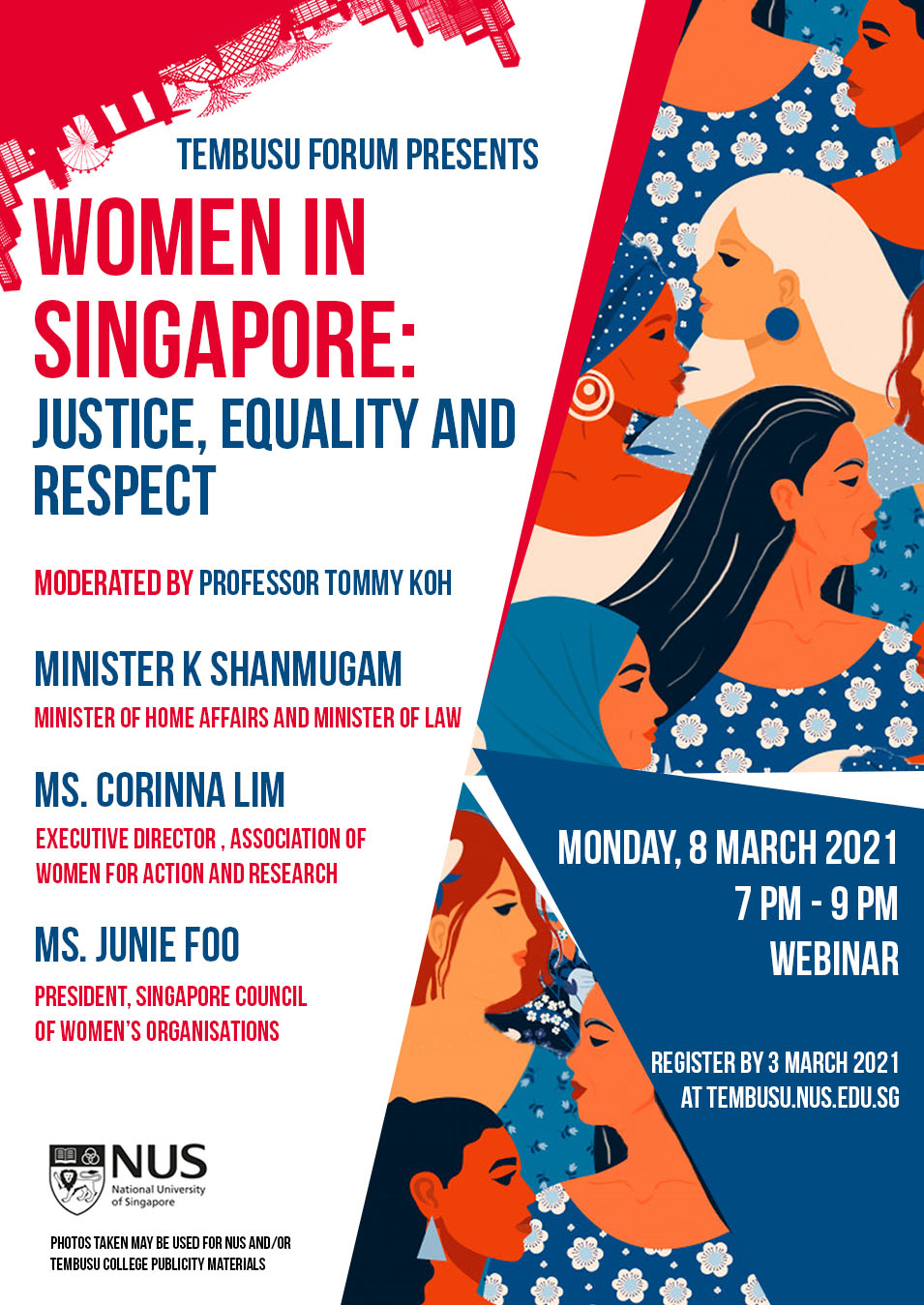
| 6.50pm: | Small group of students to be seated at MPH; Log in to Webinar |
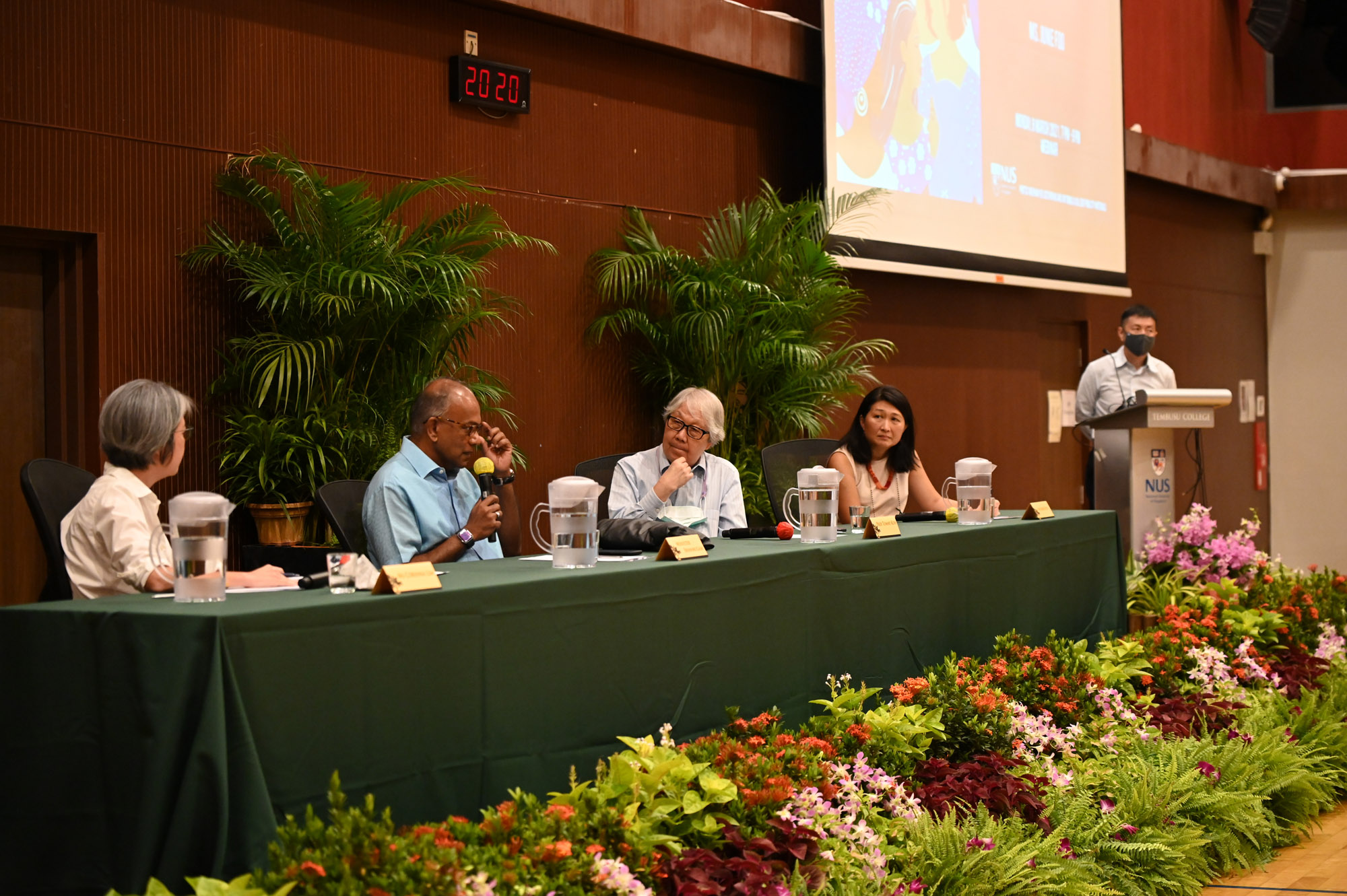
| 7.00pm: | Dr Kelvin Pang, Master of Tembusu College, will introduce the Tembusu Forum |
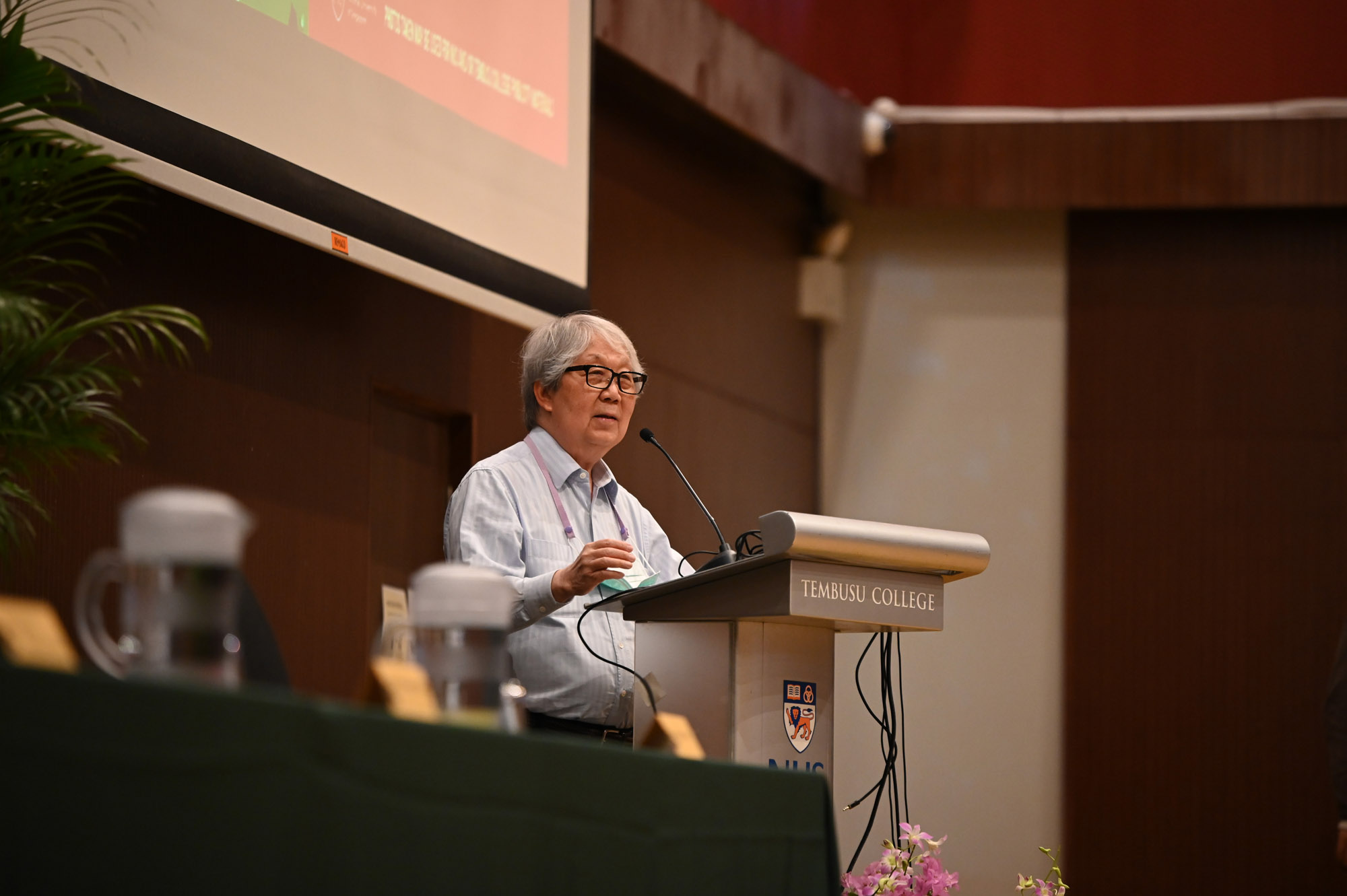
| 7.05pm: | Professor Tommy Koh, Rector of Tembusu College, will introduce the topic and speakers |
| 7.15pm: | Minister Shanmugam |
| 7.30pm: | Ms Junie Foo |
| 7.45pm: | Ms Corinna Lim |
| 8.00pm: | Question & Answer session with students |
| 8.50pm: | Concluding remarks by speakers and Chair |
| 9.00pm: | End of forum |
Ms Junie Foo is the current President of the Singapore Council of Women’s Organisations (SCWO). She is also Chief Executive Officer at the Methodist Welfare Services (MWS), a multi-service charitable organisation in Singapore serving the community with 20 centres and programmes. Effectively trilingual in English, Mandarin Chinese, and Japanese, she is passionate about facilitating opportunities for women to advance into senior leadership roles, and views a focus on gender diversity within organisations to be both a recipe for business success, as well as a socially responsible measure. She is the Founding Chair of BoardAgender, an initiative to create awareness on the economic benefits of having more women on boards, and the necessity of harnessing human capital through building a solid pipeline of senior women in leadership positions. She continues to be a mentor for Young Women in Leadership Connection (YWLC), a role that she has enjoyed since 2013.
Until 2018, Junie was the first non-Japanese in a Japanese financial institution, and the first female in the management of Corporate Banking Division, Asia Oceania. She spent more than 28 years in various financial institutions like Citibank and Standard Chartered Bank in managerial positions. She was on the Institute of Banking and Finance (IBF) Corporate Banking Workgroup to provide guidance on IBF on competencies for the corporate banking segment and on continuous professional development framework.
A Fellow of the Singapore Institute of Directors (SID), she chairs the Board Services and Mentorship Committee on the SID council and curates the annual Nominations Committee Chair conversations. She is currently on the Audit and Risk Committee as a director of SIM GE (Singapore Institute of Management) and the Singapore Art Museum. Her other board roles include being on the advisory board of the NUS Faculty of Arts and Social Sciences.
For the forum, Ms Foo will speak on the topic “All About Respect”:
More than ever, we need to reassure our women that they have rights to their privacy and empower them to speak out when that is violated. We need to work towards a society where mutual respect between the sexes is the expectation and not a privilege.
Laws can change but in order to get there, we need to start at home. We teach our children the importance of respecting another person’s belongings, not to steal or touch other people’s things, but do we emphasise that same messages regarding our bodies?
Just as we teach our daughters that their bodies are private spaces, we should also educate our sons on the important messages of respect and consent. From a young age, we should teach boys that girls are equals, they are people and not objects – it is about respecting people, irrespective of gender.
We must be careful how we speak about women and girls, and let go of seemingly harmless things we say like “if he’s teasing you, it must mean he likes you!”.
That said, we need to also teach our children the importance of accepting personal responsibility for their own conduct. We need to ingrain this in them from young so that when they grow up, they are aware that their actions affect not just themselves, but others as well.
Just as how others are responsible for their own actions, we are responsible for our own bodies, their use and portrayal. I think society as a whole would benefit from having more responsible individuals.
Ms Corinna Lim is the Executive Director of the Association of Women for Action and Research (AWARE), Singapore’s leading gender equality group. She is a Fulbright Scholar and has been appointed as the SR Nathan Fellow for 2021.
Corinna has been a women’s rights activist for close to 30 years and has advocated on issues such as gender-equal workplaces, gender violence, and greater support for single parents, lower income women and caregivers of the elderly.
Prior to joining the NGO sector, Corinna practised law and founded a technology start-up which transformed into an IT company providing IT solutions for the legal industry.
For the forum, Ms Lim will provide a perspective on how Singapore has approached the issue of gender equality since its independence till today, the incredible progress we have made in some areas, and the areas that need more work, and new approaches. She will discuss family and work issues, gender based violence, and making gender equality a fundamental value.
Mr K Shanmugam is the Minister for Home Affairs and Minister for Law. He was first appointed to the Singapore Cabinet in May 2008.
As Minister for Home Affairs since September 2015, Mr Shanmugam has overseen several programmes and initiatives including: the transformation of the Singapore Police Force’s counter-terrorism capabilities; the introduction of rapid response forces; and the launch of SGSecure, a community-based national movement to strengthen community resilience and emergency preparedness. He has overseen the greater integration and use of technology to transform the operations of the 10 agencies of the Ministry through the establishment of the Home Team Science and Technology Agency.
There has been a comprehensive overhaul of the Penal Code to modernise Singapore’s criminal laws and confer greater protections for the vulnerable in society, including women and children. The Misuse of Drugs Act was also amended to strengthen Singapore’s drug rehabilitation regime, and assist drug abusers on their road to recovery and reintegration through community and family support. Mr Shanmugam has also made clear, the Government’s resolve against religious extremism and actions which harm racial harmony, by articulating the Government’s philosophy and amending the Maintenance of Religious Harmony Act.
As Minister for Law, Mr Shanmugam has overseen changes to Singapore’s legal profession, to build a more vibrant legal sector. These include: reforming the arbitration regime in Singapore, leading to Singapore’s development as one of the leading arbitral seats in the world and the leader in Asia; encouraging international law practices to anchor regional work in Singapore; and facilitating collaboration between Singapore and international law practices. The Singapore International Commercial Court and the Singapore International Mediation Centre were also established, further consolidating Singapore’s position as a premier dispute resolution hub.
For the forum, Minister Shanmugam will discuss the approach that needs to be taken to ensure Equality, Justice & Respect for Women in Singapore.



A look at international law governing riparian states and what Asian countries can learn from Europe in managing their international watercourses
There are two kinds of rivers in the world: national and international.
An international river is one that flows through the territory of more than one country. Instead of “international river”, the United Nations uses the term “international watercourse”, which is broader and includes all interconnected waters, including rivers, tributaries, lakes, glaciers and underground aquifers.
There are 310 international rivers, as listed under the Register of International River Basins. A state through which an international river flows is called a riparian state.
An international river can be a river of peace if all the riparian states agree to cooperate in managing the river, to keep it clean, navigable and sustainable. An international river can be a river of conflict if the riparian states act unilaterally and do not cooperate in managing the river.
Lessons from Europe
The successful manner in which Europe manages its international rivers contains some lessons for Asia.
The Danube River
The river Danube is the second-longest river in Europe. It has 10 riparian states, namely Germany, Austria, Slovakia, Hungary, Romania, Croatia, Serbia, Bulgaria, Moldova and Ukraine. All of them are parties to the 1994 Danube River Protection Convention. The convention’s objectives are:
Although the convention contains a dispute settlement mechanism, it has never been used. Differences between the riparian states have always been settled by consensus.
The Rhine River
The Rhine is an important river in Europe. Its riparian states are: Switzerland, Austria, Germany, France and the Netherlands. The five riparian states, as well as Luxembourg and the European Union, are parties to the 2000 Convention on the Protection of the Rhine.
The convention has eight objectives. These include maintaining and improving the quality of the Rhine’s waters through the prevention, reduction, or elimination of pollution caused by industry, agriculture and shipping – essential, as another objective is the production of safe drinking water from the Rhine. Yet another objective is to take ecological requirements into account when developing projects, such as hydroelectric power.
Decisions by the parties are taken by consensus. Disputes between the parties are to be referred to arbitration.
What lessons can we learn from the Danube and the Rhine?
First, all the riparian states are parties to a legally binding agreement. Second, the riparian states accept that they share a community of interests. Third, they accept the duty to cooperate. Fourth, they have refrained from taking unilateral action. Fifth, they agree to take decisions by consensus. Sixth, they agree to be bound by the dispute settlement mechanism prescribed by the respective conventions.
Asia’s international rivers
Asia has many international rivers. These include the Indus, which is shared by India, China and Pakistan; the Ganges, which is shared by India and Bangladesh; the Brahmaputra, which is shared by China, India and Bangladesh; the Salween, which is shared by China, Thailand and Myanmar; and the Mekong, which is shared by China, Myanmar, Laos, Thailand, Cambodia and Vietnam.
The Indus and the Ganges
In 1960, when relations between India and Pakistan were very fragile, the two countries still managed to conclude the 1960 Indus Waters Treaty. The agreement is in force and is effective in settling disputes between them. A recent complaint by Pakistan against India under the Treaty was settled by arbitration in 2013.
In 1996, India and Bangladesh concluded the Agreement On Sharing Of The Ganges Waters at Farakka. This agreement does not create a community of interests in the shared management of the Ganges. It has left Bangladesh with numerous concerns and unresolved issues.
The international law of international rivers
There are two kinds of international law: treaty law and customary law. A treaty is binding only on its parties.
An example would be the 1997 UN Convention on the Law of the Non-Navigational Uses of International Watercourses which, among other things, commits its members in utilising a river’s resources within its territory to “take all appropriate measures to prevent the causing of significant harm to other watercourse states”.
The convention has come into force and has 37 parties, including Vietnam. As China and Laos are not parties to this convention, they are not bound by it.
Unlike treaty law, customary international law is binding on all states. The International Court of Justice ruled in the 1997 Gabcikovo-Nagymaros case that the riparian states of an international river share a community of interests. This means that the riparian states are bound by the principle of equitable and reasonable use of the river.
In other words, an upper riparian state’s use of the river, in its territory, must be “equitable” and “reasonable”. It would not be equitable or reasonable for an upper riparian state to ignore the legitimate interests of other riparian states.
The Mekong River
The Mekong River is not only one of the world’s longest rivers, but it has also been referred to as the world’s most productive river as it cuts its way through China, Myanmar, Laos, Thailand, Cambodia and Vietnam – over 60 million people depend on the river for their living.
In Cambodia, the Tonle Sap and the Mekong flood plains cover the entire country. The river provides people with fish, agriculture and navigation.
The Vietnam Delta, which is the country’s rice bowl, produces 60 per cent of Vietnam’s rice and fish.
The Mekong has come in for greater international attention in recent times because of concerns over developments that pose a threat to the food security of the lower riparian states.
China has built 11 dams on the river. Laos, which hopes to generate revenue from hydropower, has built more than 50 dams over the past 15 years, with more under construction in rivers and streams around the country. Together, the dams have had a devastating impact on the lower riparian states.
A study by the Mekong River Commission shows that fish stocks could fall by as much as 40 per cent. It also states that there could be a 97 per cent reduction of sediments flowing downstream. This could lower soil fertility and affect agricultural productivity.
Are the six riparian states of the Mekong parties to a legally binding agreement? The answer is no.
Four of them, namely Cambodia, Laos, Thailand and Vietnam, are parties to the 1995 Mekong Agreement.
Article 1 of the Agreement commits its members to “cooperate in all fields of sustainable development, utilisation, management and conservation of the water and related resources of the Mekong River Basin… in a manner to optimise the multiple-use and mutual benefits of all riparians and to minimise the harmful effects that might result from natural occurrences and man-made activities”.
The first imperative is to persuade China and Myanmar to join this Agreement. The lesson from Europe is that all the riparian states should be parties to a legally binding agreement.
We should point out that under the Mekong Agreement, no country can veto another country’s dam projects. There is an obligation to consult, but a riparian state like Laos has insisted that it has a right to use its water resources. Laos wants to build 100 dams by 2030, to become the “battery” of South-east Asia.
The second imperative is to persuade China and Laos, the upper riparian states, that they do not have absolute sovereignty over the river in their territories.
Their sovereignty is balanced by the community of interests they share with the lower riparian states. Their exercise of sovereignty is limited by the obligation to ensure that their actions do not cause significant harm to other states.
This applies to the building of dams by China and Laos. The law does not prevent them from building dams. However, before they build a new dam, they have a legal obligation to undertake an environmental impact assessment and to notify the lower riparian states of their plans. The law also requires them to ensure that the new dam does not cause significant harm to the lower riparian states.
Existing institutions
Apart from the 1995 Mekong Agreement and its well-regarded secretariat, the Mekong River Commission, there are many other institutions relating to the Mekong. In 1992, the Asian Development Bank brought together all six riparian states in the Greater Mekong Subregion Economic Cooperation Programme. The agenda of the programme is to promote connectivity, competitiveness and community.
In 1996, Asean established the Asean Mekong Basin Development Cooperation to engage China. The programme’s main achievement so far is a plan to build a railway connecting Kunming and Singapore.
In 2015, China launched the Lancang-Mekong Cooperation, which includes all six riparian states. This is the platform that China uses to engage the five Asean riparian states. Many meetings are held annually and at all levels. However, the issue of dam building by China and Laos is not on the forum’s agenda.
A river of peace and cooperation
Our ambition is to make the Mekong River a river of peace and cooperation. Towards this end, we respectfully urge China and Myanmar to consider joining the 1995 Mekong Agreement.
Our second plea to China and Laos, the two upper riparian states, is to accept the rule of customary international law governing international rivers, which is, that they share a community of interests with the lower riparian states.
We want to conclude by appealing to all Asian riparian states: Let us show the world that we can manage our international rivers as well as the European.
Tembusu College Office University Town, NUS 28 College Avenue East, #B1-01 Singapore 138598
tembusu@nus.edu.sg
+65 6601 2150