Reading Professor Tommy Koh

Humility, generosity, compassion and a fierce, tireless commitment to service. These were just some of the descriptors that came up in repeated references to Professor Tommy Koh – Rector of Tembusu College – on the evening of 30th October.

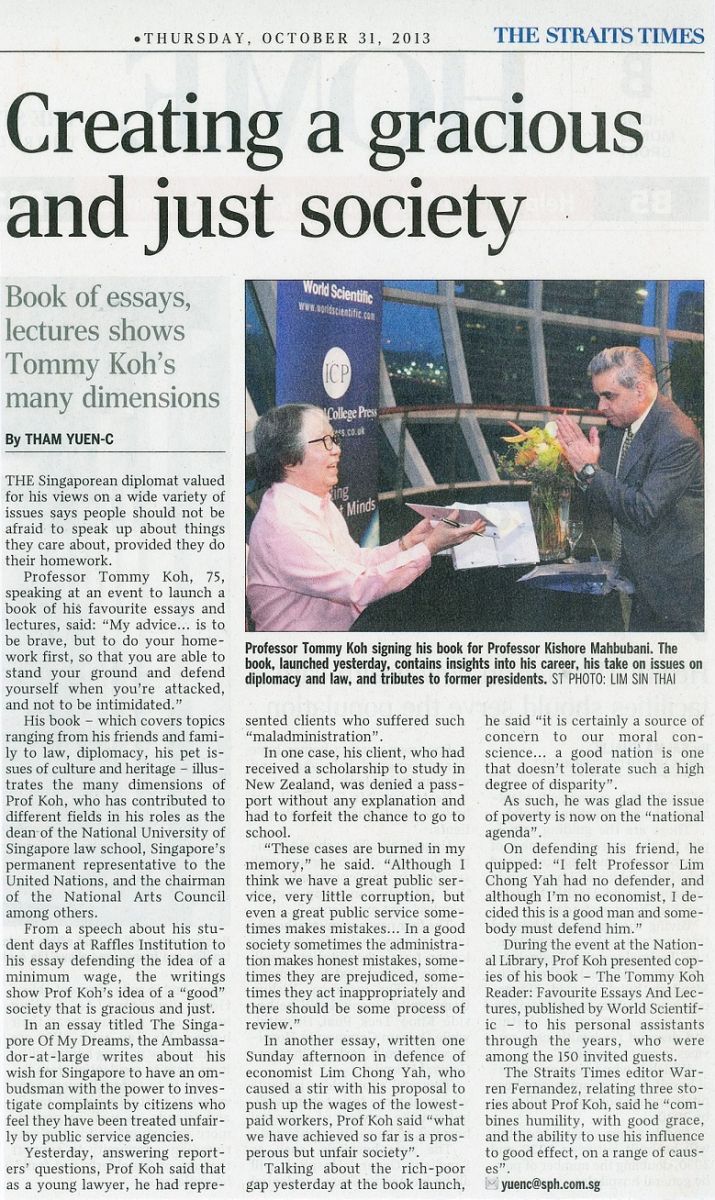
The occasion was the launch of Prof Koh’s latest book at the National Library. Entitled The Tommy Koh Reader: Favourite Essays and Lectures, the book features a selection of essays speeches, and lectures – personally handpicked and assembled by him – from across his five-decade long career.
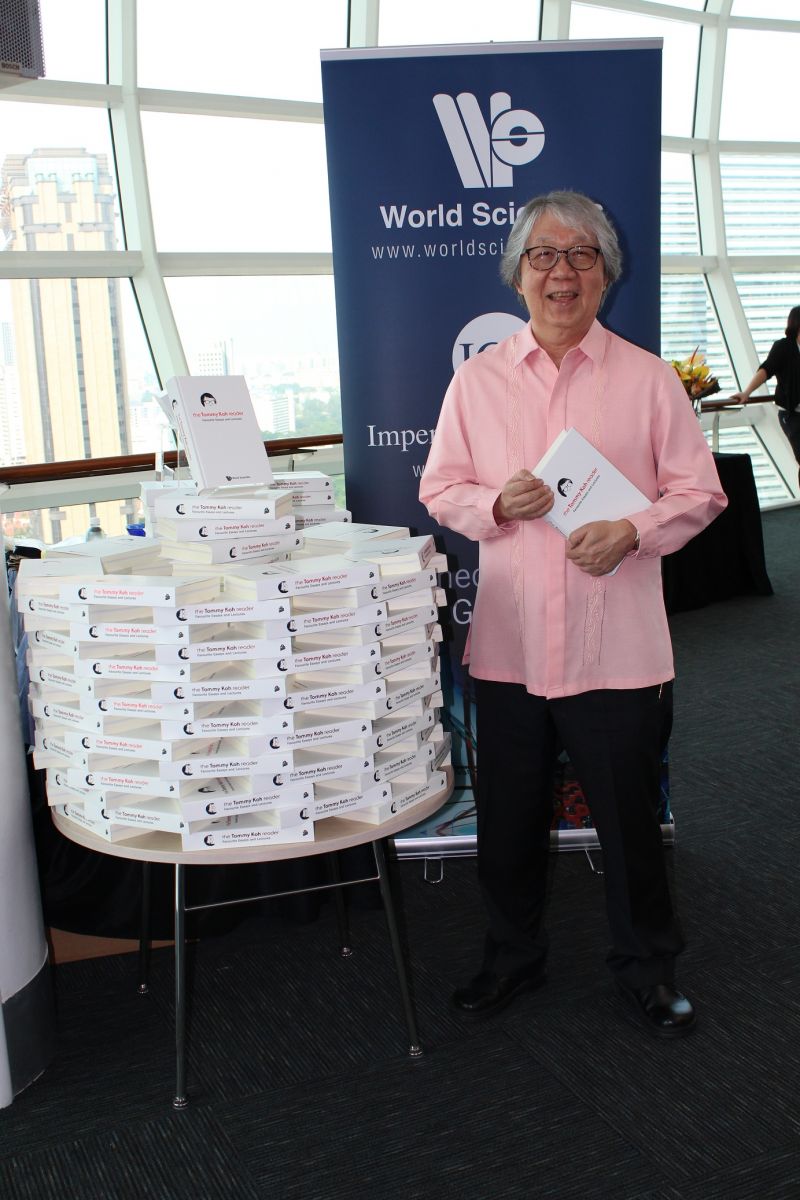
Another recurring refrain during the launch was the multiple hats that Prof Koh has skillfully worn over the course of his career: esteemed academic, respected lawyer, illustrious diplomat, august advocate of the arts, spirited champion of the environment and – throughout it all – staunchly proud Singaporean. Fittingly then, the contents of the book are divided into distinct sections pertaining to diplomacy, culture and heritage, law, the environment, and – naturally – his thoughts on Singapore and her future.

In the book’s foreword, NUS President Professor Tan Chorh Chuan writes that the book is “more than just a collection of written works and speeches” and that it offers the reader “a rare glimpse into the values and beliefs he holds most dearly”. With characteristic intellectual precision and clarity, Prof Koh voices his frank, informed opinions on contentious yet relevant topics like inequality, a minimum wage, ageism and immigration.

Speaking at the book launch was the CEO of the National Library Board (NLB) Mrs Elaine Ng, who described Prof Koh as both a “man of letters” and a “man of warmth”. Highlighting his love for books, Mrs Ng recounted how he has served as an active Patron of the decade-old “READ! Singapore” campaign, and had proactively and successfully sought to bring the “International Summit of the Book” to Singapore earlier this year.

Prof Koh’s relentless passion for his pet causes was also alluded to by Guest-of-Honour Mr Warren Fernandez, Editor of the Straits Times. Mr Fernandez referred to the book as having best captured the essence of Prof Koh: his humility, his diplomacy and his “ability to use his influence to good effect”. In response to a later question on what younger generations of Singaporeans could learn from Prof Koh, he commented that key lessons would include how to stay grounded and have “a strong sense of purpose”.

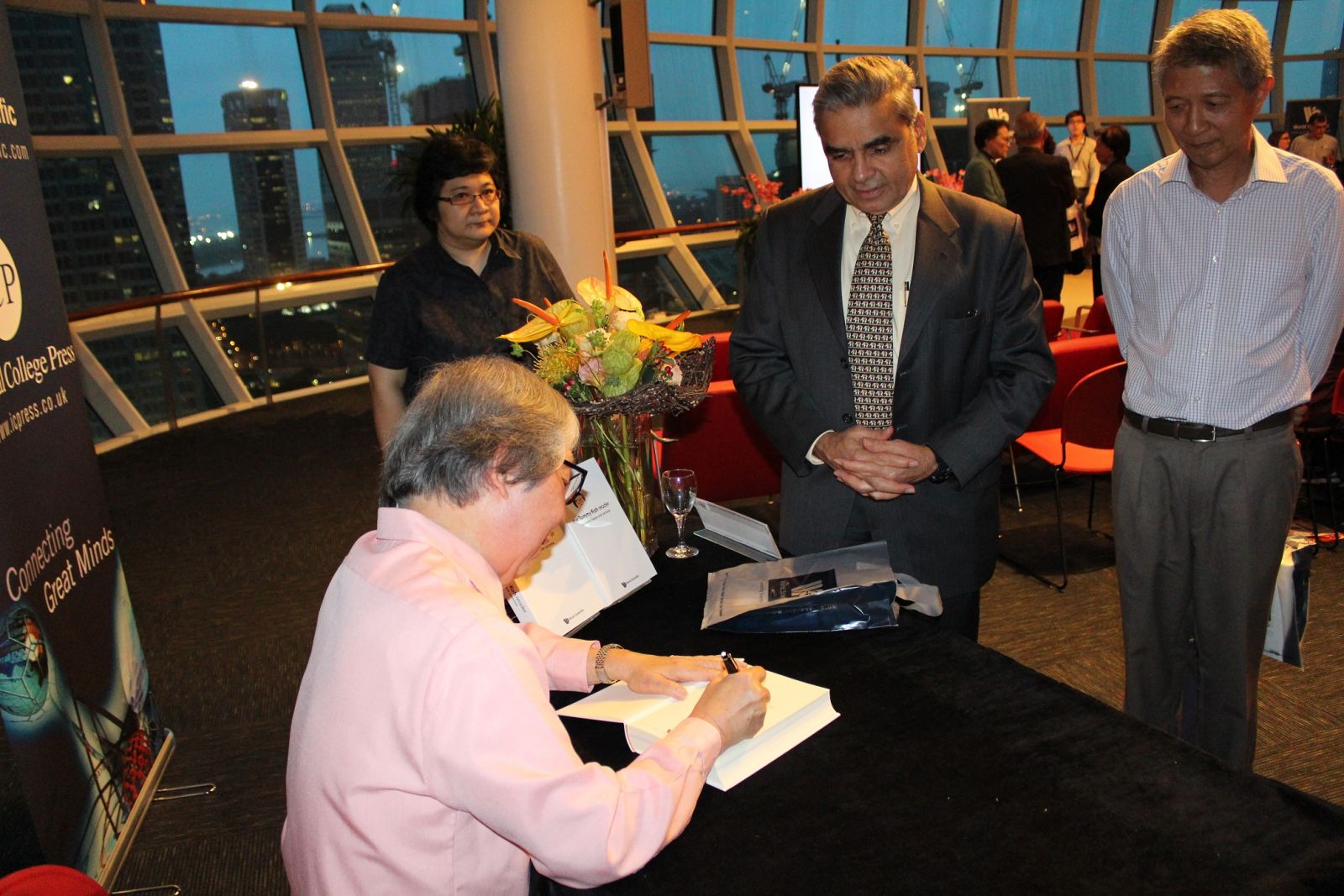
Prof Koh proceeded to round out the occasion in true Tommy Koh style: not by making a speech of his own but by presenting signed copies of the book to the invited speakers and creative minds behind the publication, as well as to the many personal assistants who had worked for and with him over the course of his career.
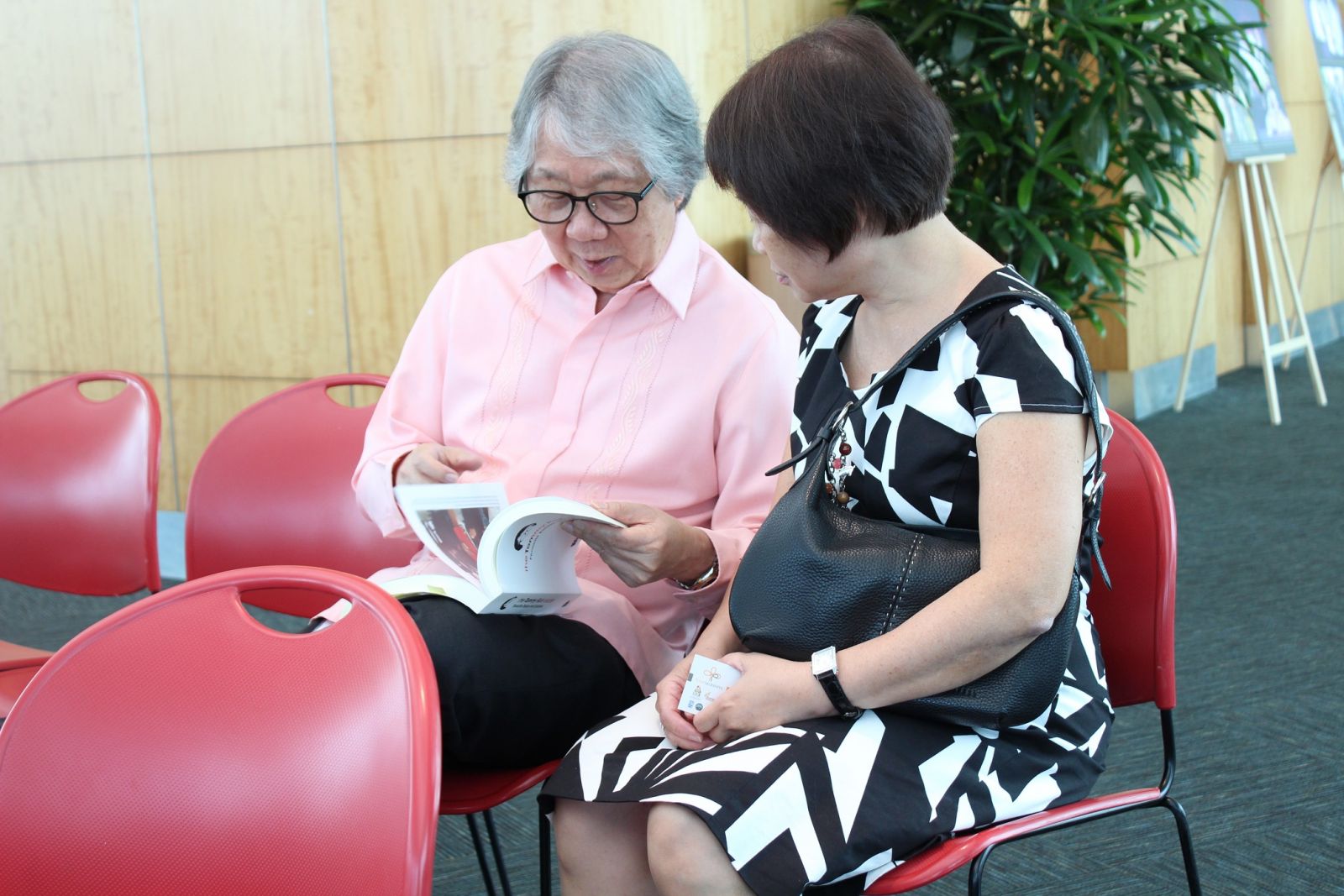
Among those who were in attendance at the book launch were family, friends and colleagues both past and present; the international composition of the audience speaking to his global recognition and appeal. Prominent personalities present included former President of Singapore S. R. Nathan, Member of Parliament Irene Ng, Dean of the Lee Kuan Yew School of Public Policy Professor Kishore Mahbubani, Dean of the S. Rajaratnam School of International Studies Ambassador Barry Desker, and the Rector of Cinnamon College Professor Wang Gungwu.

Prof Mahbubani singled out Prof Koh as “probably one of the top ten diplomats anywhere in the world” and remarked on how he served as an example to other Singaporeans that hailing from a small country should not impede aspirations to be among the best in the world in their respective fields. Recalling how he had to step into the shoes of a “giant, towering figure” when he replaced Prof Koh as Singapore’s Permanent Representative at the United Nations (UN) in 1984, he also pointed to the latter’s generosity, commenting on how he “bent over backwards” to help him succeed in his tenure at the UN.

His willingness to take the extra step to help other people was similarly echoed by former President Nathan – Prof Koh’s successor as the Republic’s Ambassador to the United States in 1990 – who further praised him for remaining unchanged despite his storied, illustrious career. When asked what she hoped readers would takeaway from the book, NLB’s Mrs Ng also remarked that she hoped people would walk away with “his generosity of spirit”.
Prof’s Koh generosity was further affirmed by Associate Professor Gregory Clancey – Master of Tembusu College – who commented that the College was “very proud” to have him as its Rector and that “he’s always very generous with the time he gives to students despite his many commitments”.

“The Tommy Koh Reader: Favourite Essays and Lectures” is published by World Scientific Publishing and is available now at major bookstores including Kinokuniya and BookHaven.

Article written by: Vinod Ashvin Ravi (Year 3, FASS, Student of Tembusu College)
Remembering Gandhi

Today, the second of October, is Mahatma Gandhi’s 144th birthday.  I shall honour him by remembering his legacy and reflecting on its relevance to India and to the world. I will focus on what I consider to be his three most important legacies.


                    The Legacy of Satyagraha

                    First, satyagraha or non-violent opposition to injustice.  India had been ruled by the British for nearly 200 years.  Given its size and natural resources, India was considered to be the crown jewel of the British empire.  The British tried to indoctrinate the Indians into believing that the white man was superior to the Indian and the British rule of India was part of the natural order of things in the world.  Gandhi was one of the Indian nationalists who rejected the status quo.  Using satyagraha as his weapon, Gandhi led the Indian struggle for independence.

                   The British empire was, at one time, the greatest empire in the world. The British used to boast that the sun never sets on the British empire.   The British ruled their empire with intelligence, cunning and ruthlessness.  When faced with opposition, the British did not hesitate to use force to suppress the opposition.  The British had, however, never met an adversary like Gandhi.  Some British leaders, such as Churchill, grossly under-estimated him and dismissed him as that “half naked fakir”.  Churchill was a warrior and did not understand the power of an idea whose time had come.  He  would have preferred an enemy like Subash Chandra Bose so that he could meet force with force. 


                   The Salt March

                   Gandhi’s genius was his ability to pick a cause which would resonate with the people of India and the world, such as the Salt March.  His 390 kilometre walk from the Satyagraha Ashram to Dandi, on the Gujarati coast, to collect salt from the sea, attracted the attention and sympathy of the world.  His greatest achievement was, however, his ability to persuade his followers to abstain from violence when faced with imprisonment, physical abuse and even death. Gandhi’s commitment to Satyagraha was tested many times but he never wavered, not even when confronted by the massacre of peaceful demonstrators at Jallianwala Bagh, in Amritsar, by General Dyer.  Gandhi used to say that the policy of an eye for an eye would make us all blind. 


                   The Legacy of Religious Harmony

                   Second, Gandhi believed deeply in inter-faith dialogue and harmony.  He believed that Hindus and Muslims are brothers and that they should live in harmony and fraternity.  He opposed the partition of India.  In order to avert partition, he offered the prime ministership of independent India to Mohamed Ali Jinnah.  Jinnah, however, rejected the offer and insisted on the creation of Pakistan.  Following the partition, when India was consumed by mass violence between Hindus and Muslims, Gandhi went on a fast to the death, until the violence stopped. The violence did stop. A few days later, Gandhi was assassinated by a Hindu extremist. We could say that he gave his life for his belief in peace and mutual respect among the followers of different faiths.  This legacy is constantly under challenge, in India, as well as in other multi-religious countries of the world.  Religious harmony is one of Gandhi’s most precious gifts to the world.


                   The Legacy of Non-Discrimination

                   Third, Gandhi campaigned for women and for the Untouchables.  A new biographer of Gandhi, Ramachandra Guha, has written that Gandhi’s coreideas were formed during his twenty years sojourn in South Africa, especially during the ten years when he lived in Johannesburg.  According to Guha, Gandhi’s views on women, were influenced by his housemates, Henry Polak and his wife, Millie Graham and by Gandhi’s secretary, Sonja Schlesin, who was a feminist.  Gandhi’s mission to empower women in India has not made sufficient progress.  For example, over 40 per cent of Indian women are illiterate.  Women in both in urban and rural India are not treated with sufficient respect or equity.  The sad truth is that in many countries, in different parts of the world, women are still treated as second class citizens.  Let us honour Gandhi by making women first class citizens throughout the world.


                   The Untouchables

                  Gandhi also campaigned against the Hindu prejudice against Untouchability.  He said:  “I believe that if Untouchability is genuinely rooted out, not only will Hinduism be cleansed of a terrible stain, but the repercussions of such an action will be felt worldwide.  My struggle against Untouchability is a struggle against all that is impure in humanity”.  Gandhi admitted the Untouchables, whom he called “Harijan” or “Children of God” to his ashrams.  In spite of his wife’s initial opposition, he insisted that all members of his ashrams, irrespective of caste or rank, should take turns cleaning the toilets.

                   In the past 60 years, India has made substantial progress in reducing the discrimination against the Untouchables and other Indians of the lower castes.  This mission is, however, incomplete.  I recently read a report which shocked me.  The report is about a 14 year-old girl who was sold by her parents to a brothel in Mumbai.  She had been brainwashed into believing that, being born into the Badi caste, she was fated to work as a prostitute.  She did not know that the rules were made by man and not by God.  We must unite with the spirit of Gandhi in opposing all forms of discrimination, based on race, colour, religion, caste, gender and sexual orientation.


                   Conclusion

                   One hundred and forty four years after his death, Gandhi is revered in India and throughout the world.  Without resorting to violence, Gandhi succeeded in mobilising the people of India in a moral crusade to end the British rule of India.  In the United States, satyagraha was used by a young preacher, Martin Luther King, to mobilise the support of the American  people, both black and white, to end segregation. Without Martin Luther King, there would be no Barack Obama.  Closer to home, in Myanmar, we have Aung San Su Kyii.  Her satyagraha to end military rule and to open a new chapter of democracy in Myanmar has been vindicated after decades of persecution and house arrest.   We should, on this auspicious day, reflect on Gandhi's legacies to India and the world and do what we can to fulfil his dream of a more peaceful, just and tolerant world.


Tommy Koh named the Great Negotiator of 2014

Source NUS News Hub


Prof Koh has been named the recipient of the 2014 Great Negotiator Award

Professor Tommy Koh, Ambassador-At-Large at Singapore’s Ministry of Foreign Affairs and Rector of Tembusu College at NUS, has been named the recipient of the 2014 Great Negotiator Award by the Program on Negotiation – an inter-university consortium of Harvard University, Massachusetts Institute of Technology and Tufts University – and the Future Diplomacy Project at Harvard Kennedy School.


Prof Koh is recognised for his outstanding contributions to the fields of negotiation and dispute resolution, especially his leading roles in challenging settings, including the Law of the Sea, the “Rio” Earth Summit, the ASEAN Charter and the Singapore-US Free Trade Agreement.


Prof Koh said: “I thank Harvard University for this great honour. I accept this award on behalf of all my colleagues who have been members of the various teams I have led, in both bilateral and multilateral negotiations.”


The Great Negotiator Award honours individuals whose lifetime achievements in the field of negotiation and dispute resolution have made a significant and lasting impact. Previous Award recipients include former US Secretary of State James A Baker, III; Martti Ahtisaari, Nobel Peace Prize Recipient and former President of Finland; Sadako Ogata, former United Nations High Commissioner for Refugees; and Lakhdar Brahimi, United Nations Secretary General’s Special Envoy to Afghanistan.


NUS President Professor Tan Chorh Chuan said: “Professor Tommy Koh is an outstanding lawyer, professor and diplomat who played a pivotal role in shaping Singapore’s foreign policy. The Great Negotiator Award is indeed a strong and timely recognition of Prof Koh’s distinguished career as well as his contributions towards international affairs and diplomacy.”


Prof Tan added that NUS’ faculty, staff and students have also benefitted from Prof Koh’s deep insights and vast experience through his involvement in the University’s activities.


Prof Koh, who is Chairman of the Centre for International Law of NUS, Special Adviser of the Institute of Policy within the Lee Kuan Yew School of Public Policy at NUS, and Chairman of the National Heritage Board, will be honoured at a series of public events at Harvard University on 10 April 2014.

Film Screening

21 Sept 4 pm

The Day My God Died

Documentary, Nepal and India

Directed by Andrew Levine

Duration: 60 min

The Day My God Died is a feature-length documentary that presents the stories of young girls whose lives have been shattered by the child sex trade. They describe the day they were abducted from their village and sold into sexual servitude as “The Day My God Died”. Filmed in Nepal and India this documentary provides actual footage from inside the brothels of Bombay, a world seldom seen by outsiders known as “The Cages,” captured with spy camera technology. The documentary also features Anuradha Koirala, 62, CNN Hero of the year, for her fight against the trafficking of Nepali women and children since 1993, who remind us that, “these are our daughters.”

28 Sept 4 pm

The Price of Sex NC16

Documentary, Eastern European

Produced by Mimi Chakarova

Duration: 73 min

The Price of Sex is a feature-length documentary about young Eastern European women who’ve been drawn into a world of sex trafficking and abuse. Intimate, harrowing and revealing, it is a story told by the young women who were supposed to be silenced by shame, fear and violence. Photojournalist Mimi Chakarova, who grew up in Bulgaria, takes us on a personal investigative journey, exposing the shadowy world of sex trafficking from Eastern Europe to the Middle East and Western Europe. Filming undercover and gaining extraordinary access, Chakarova illuminates how even though some women escape to tell their stories, sex trafficking thrives. Winner of two awards in 2011.

Please join us to learn about human trafficking or modern day slavery, a global business of US$32 bln per year, after arms and drugs. Almost every country is involved either as a supply or destination country, including Singapore. It is a heinous crime against humanity involving 27 million victims. Film is a powerful medium which conveys audio and visual messages which are better retained and creates emotional and long lasting impact which helps to shape personal and social attitudes. Learn about what it is, how it affects you and what you can do to help to combat this social injustice.

For more info, please visit http://www.emancipasia.org/films/.

Contact : contact@emancipAsia.org; +65 97588859

REACH Event with Dr. Vivian Balakrishnan

Source NUS Newshub

Students from the Tembusu College at NUS were privileged to hear from Singapore’s Minister for the Environment and Water Resources Dr Vivian Balakrishan on the topic of redefining education in the 21st century on 14 August 2013. 


“The purpose of education is to maximise human potential so as to lead a meaningful life,” the former NUS medical student told the more than 50 attendees. 


Sharing about his personal education journey, Dr Balakrishnan elaborated on his experiences related to competition, relationships and choices to be made. By competition, he meant the need to vie for places at secondary school, junior college and later at university and medical school.  


As an NUS student, Dr Balakrishnan, who was awarded the President’s Scholarship, chose to seek out opportunities for extra-curricular activities such as participating in the NUS Students’ Union (NUSSU) and joining the debating team to build relationships. He was elected NUSSU President from 1981 to 1983 and Chairman from 1984 to 1985.  


Dr Balakrishnan found, however, that his experience is vastly different from those of current students. Today’s students face greater challenges due to increasing competition, technology and its impact and urbanisation. 


Against this backdrop, education has to be redefined. Given the local and international scale of the competition, students will have to work harder and smarter. Owing to advances in technology, white-collar work will be increasingly commoditised, affecting future jobs. With increasing urbanisation, there will be implications for Singapore’s relevance to the world and the types of jobs in cities. 


Responding to the question on the opportunities and threats to Singapore’s current education model, Dr Balakrishnan said that there is now a wider spectrum of avenues made available to students. At NUS, he cited the options of studying at University Town, the Yale-NUS College and the Duke-NUS Graduate Medical School Singapore. 


However, Dr Balakrishnan noted that the concept of the university is no longer about getting certification and presuming thereby that “life is set” with the attainment of a degree. Instead, re-learning, re-certification and re-tooling are necessary. 


During the lively exchange of ideas that ensued, Dr Balakrishnan fielded many questions posed by the student audience. The topics raised included the character of Singapore’s economic evolution and the pragmatic approach to education in Singapore, morality in education, the weight of curriculum at the primary and secondary school levels.

Exploring The Last Frontier

Exploring The Last Frontier

By Tommy Koh

                   Seventy percent of the Earth’s surface is covered by sea and ocean.  However, we seem to know less about ocean space than we do about outer space.  On the 26th of March 2012, the award-winning American movie director, James Cameron, descended alone, in a submersible called “Deepsea Challenger”, to the bottom of Mariana Trench.  It is 11 kilometres or 6.8 miles below the surface and is the deepest part of the ocean floor.  Cameron took pictures and collected samples from the ocean floor.  He commented that the ocean was “the last frontier for science and exploration on this planet.”

Mineral Deposits on Ocean Floor

                   I agree with Cameron that the ocean space is our last frontier.  One of mysteries of the deep seabed and ocean floor is the discovery that it contains deposits of polymetallic nodules, polymetallic sulphides, and cobalt-rich ferromanganese crusts.  The polymetallic nodules contain precious metals such as manganese, cobalt, nickel, copper and rare earth elements.

                   As the supply of these precious metals from land begin to diminish, as the demand for them continue to increase and as metal prices remain high, interest in recovering the nodules and exploiting the sulphides and crusts has increased.

Technological Challenge

                   There are, however, many challenges.  The polymetallic nodules, which are black in colour and resemble potatoes and golf balls, lie on top of the floor of the seabed in very deep waters.  The depth ranges from 4,000 metres to 5,000 metres.  The industry has not yet perfected the technology to harvest them in a way that is commercially viable and environmentally benign.  The good thing is that as the nodules lie on the seabed, they only need to be recovered, and there is no need for digging or dredging like conventional land mines. The three methods being considered are to use nets, claws and suction to bring them up to the mother ship.

Prospects of Deep Sea Mining

                   Whether deep sea mining will become feasible will depend partly on the technology and partly on whether the costs of recovering the metals from ocean space can compete with the costs of recovering them from land mines.  The industry is, however, optimistic about the future.  It believes that the technological problem will be solved especially by leveraging on established offshore drilling technology in the oil and gas industry, which has ventured into very deep waters.  It believes that, given our insatiable demand for these precious metals, it is a matter of time before deep sea mining becomes a reality.

Who Owns the Minerals

                   This leads us to the legal question, to whom do these resources belong.  The answer is that it depends on where the resources are located.  The Government of Papua New Guinea has granted a concession to a private company to recover the polymetallic nodules located within its Territorial Sea.  The government of the Cook Islands has announced that it has rich deposits of polymetallic nodules within its Exclusive Economic Zone and Continental Shelf and intends to tender out the exploration licences.  These resources belong to the Cook Islands.  If the resources are located within a coastal country’s Territorial Sea, Contiguous Zone, Exclusive Economic Zone or Continental Shelf, they belong to the coastal country.

The Common Heritage of Mankind

                   What about the resources which lie on the bottom of the seabed and ocean floor beyond the national jurisdiction of coastal states?  The answer is that they belong to all of us.  The 1982 UN Convention on the Law of the Sea calls them, “the common heritage of mankind”.  The convention has established an institution to act on behalf of mankind and to regulate seabed mining.  It is called the International Seabed Authority (ISA) and it is located in Kingston, Jamaica.  Any state or company which wishes to mine the seabed has to apply to the ISA for a contract to do so.  In the case of an application by a company, it must be sponsored by a state which is a party to the convention. Without this contract, it would be difficult to raise the financing for a seabed mining project.  To date, ISA has signed 13 contracts of exploration for polymetallic nodules, 4 contracts of exploration for polymetallic sulphides and will sign 2 contracts of exploration for cobalt-rich ferromanganese crusts.

Keppel and OMS

                   One of Singapore’s companies with a sterling reputation and track record in the offshore and marine sector is Keppel.  It has incorporated a subsidiary company, called Ocean Mineral Singapore Private Ltd (OMS), to venture into deep sea mining. The Singapore Government agreed to sponsor the application of OMS because it has the resources and relevant technology and expertise. OMS is 78.1% owned by Keppel, while UK Seabed Resources Ltd (UKSRL) and Lion City Capital Partners Pte Ltd are minority shareholders, holding the remaining shares of OMS.  OMS is effectively controlled by Keppel.

Application to ISA

                   In July, I led a Singapore delegation to the 19th annual session of the ISA.  The delegation consisted of the representatives of the Ministries of Foreign Affairs and Trade and Industry, the Attorney-General’s Chambers, and Keppel.  We submitted an application to the Legal and Technical Commission for a contract of exploration for a mine site which is located in the deep seabed, east of Hawaii and west of Mexico.  It is between the Clarion Fracture Zone, in the north and the Clipperton Fracture Zone, in the south.  The Clarion-Clipperton Zone contains one of the richest known deposits of polymetallic nodules.

Reserved Areas

                   The mine site which OMS has applied for, was originally half of a larger mine site which UKSRL had applied for.  Under the Convention, UKSRL was obliged to give up half the mine site to ISA as a “reserved area” for the benefit of developing countries. As a developing country, Singapore is therefore entitled to apply for a “reserved area”.

Happy News in 2014?

                   The Legal and Technical Commission unfortunately ran out of time at its meeting in July.  As a result, the applications of Russia, UK, India and Singapore were deferred to its next meeting in February 2014.  If the applications are approved, the commission’s recommendations will be considered by the council of ISA, at its next meeting in July 2014.  I am optimistic that the application of OMS will be successful.  The contract of exploration will give to the company 15 years to conduct its research and prospecting.  At the same time, the ISA is starting work to develop an exploitation code for deep sea mining. If everything turns out well, Singapore, through OMS, will join four other Asian countries, China, India, Japan and South Korea in exploring the deep seabed and ocean floor.  A new era is about to begin.

. . . . .


[1]The author was President of the UN conference on the Law of the Sea.  He presided over the final session of the conference in Montego Bay, Jamaica, in December 1982, where the convention was signed.

Attempts to reinstate Wallace as the working class hero who discovered evolution before Darwin have no basis in fact

This year is the centenary of the death of Victorian naturalist and co-discoverer of evolution by natural selection, Alfred Russel Wallace. So we have heard a lot about him recently, including the BBC Two series Bill Bailey's Jungle Hero, an episode of BBC Radio 4's In Our Time, two episodes of The Infinite Monkey Cage and scores of articles, talks and exhibitions.

Wallace deserves more attention but much of what you will have heard about him in the last few months is factually incorrect – and amounts to a misguided campaign to reinstate the reputation of a genius who (according to his fans) has been wronged by history and robbed of his rightful fame.

Since the 1970s, the story of Wallace has become something like this:

While Charles Darwin sat on his revolutionary theory for 20 years, terrified of his conservative contemporaries, Wallace boldly set out to solve the great problem of the origin of species. Not afraid to announce unorthodox views, Wallace published a radically innovative theory of evolution (minus only natural selection) in an 1855 paper.

Then, while on the island of Gilolo and prompted by thoughts about the local races, Wallace hit on the idea of the struggle for existence and natural selection. He immediately wrote up his theory and posted it to Darwin on the next mail steamer.

Darwin, however, withheld the paper for perhaps two weeks before he let it become known. During this time, according to some, Darwin stole some ideas to use in his own otherwise identical theory.

Rather than having Wallace's paper published immediately on its own, which was normal practice at the time, Darwin's friends cooked up a scheme to rob the working-class Wallace of his priority and instead put their friend Darwin first. Papers by both men were read at a scientific meeting in 1858, but Darwin is remembered as the discoverer of the theory because his contribution was placed first.

Swept under the carpet of history

The new shelf of sympathetically written books about Wallace tells a pretty consistent story. He is now "forgotten" because he has been unfairly swept under the carpet of history. Why? Because the wealthy and privileged Darwin basks in all the glory of revolutionising our understanding of life on Earth. (Not to mention the back of the £10 note, although Jane Austen is about to boot him off that pedestal).

Darwin's life and works have been meticulously studied by many scholars for over a century. But while some very able scholars have studied Wallace, he by contrast has remained mostly the preserve of amateurs and enthusiasts.

There has not been enough progress with our understanding of Wallace because some of the important research projects that have unveiled a treasure trove of new findings about Darwin had never been done for Wallace: his complete works had not been assembled on one scholarly website, his Malay archipelago expedition correspondence had not been collected and edited and his notebooks and journals had not been edited and their contents made intelligible.

All of these have recently been done, the latter two not yet published. These new sources have shown us that every substantive claim in the popular narrative about Wallace turns out to be incorrect.

• Wallace was not working class but the son of a gentleman and attended a public school.

• He thought of natural selection on the island of Ternate, not Gilolo. Hence the races there did not inspire his theory.

• He did not send his essay to Darwin on the next steamer, but replied on the following monthly steamer. So Darwin received Wallace's essay exactly when he said he did.

• Darwin and his friends were not obliged to publish Wallace's paper, as he had not requested this, but it was acceptable practice at the time for Wallace's essay to be published without seeking his explicit permission first.

• Darwin did not borrow any idea on evolutionary divergence from Wallace – who in fact had no such theory of his own. And in any case, at the time scientific priority was not settled only by publication, but also by sharing one's views with colleagues privately.

• Darwin did not keep his belief in evolution secret and he did not postpone publishing because of any fears. But ironically Wallace was afraid to reveal his evolutionary beliefs and carefully concealed them in his published papers. His famous 1855 paper never mentions evolution.

What inspired Wallace's eureka moment?

Wallace's notebooks reveal the gradual development of most of his evolutionary ideas. Far from the story that he set out to discover a mechanism for evolution, Wallace showed no interest in the causes of adaptations. On the contrary, he privately ridiculed traditional ideas of adaptation as evidence of divine design.

All this makes his essay proposing natural selection all the more mysterious. For Darwin we have a detailed paper trail revealing the development of his conception of natural selection. For Wallace we only have his published essay. What inspired Wallace's famous eureka moment in the midst of a malarial fever?

There is only one contemporary clue. In a letter written about two weeks later, Wallace mentioned that over the past four years he had found differently coloured tiger beetles on different islands which exactly matched the colour of the sand or mud where they lived. "Such facts as these puzzled me for a long time, but I have lately worked out a theory which accounts for them naturally."

Wallace already believed that new varieties of animals appeared randomly and frequently, the offspring of their parent species. If lots of varieties of various shades are constantly appearing, how does one come to perfectly match the colour of the environment? He remembered the idea of the struggle for existence. The varieties best suited to survive would be those that happened to be the right colour.

If the environment slowly changed colour, the parent species might go extinct. One of its daughter varieties could then be well adapted and replace it as the species. It could never revert back to the colour of its parent as that was now inferior. Thus through a struggle for existence, randomly generated variants would be sifted to form new species. It was a brilliant breakthrough.

But the real story of Wallace's contribution is far from the myth of the wronged working class hero. The differences between the Wallace of his modern admirers and the historical Wallace are in fact like the differences between the Jesus of pious Christians and the historical Jesus.

Darwin gained nothing from having his paper printed ahead of Wallace's. Darwin's fame and reputation, and Wallace's comparative obscurity, stem from the impact of Darwin's Origin of Species. As Wallace himself wrote: "this vast, this totally unprecedented change in public opinion has been the result of the work of one man, and was brought about in the short space of twenty years!"

Dr John van Wyhe is a historian of science at the National University of Singapore and director of Darwin Online and Wallace Online. His bookDispelling the Darkness: Voyage in the Malay Archipelago and the Discovery of Evolution by Wallace and Darwin is published this month