By Professor Tommy Koh: Are Art Workers Non-essential?

The Sunday Times (14/6/2020) last weekend published results of a survey it commissioned which asked 1,000 respondents, which are the jobs that are most crucial in keeping Singapore going.

The result is very interesting.

The survey includes a definition of an essential worker  as someone who is engaged in work deemed necessary to meet basic needs of human survival and well-being, such as food, health, safety and cleaning.

When asked to identify the jobs that are essential and not essential from a list of 20 jobs based on this definition,  respondents’ top five picks for essential jobs were: doctor and nurse; cleaner; garbage collector; hawker; deliveryman.

Their five picks for not essential jobs were: artist (71 percent of the respondents); telemarketer: social media manager or PR specialist; business consultant; human resource manager. The survey was conducted by consumer research firm Milieu Insight.

This finding with artists topping the list of not essential jobs has caused pain and consternation to the arts community. I would like to comfort them by reminding them that the survey was conducted during a global public health crisis when many respondents’ minds are understandably on health and their basic needs such as food. This might be why they consider artists less essential.

It does not necessarily mean respondents do not value the work of artists in normal times. On the contrary, many people in Singapore appreciate and enjoy the work of artists. In this article I will explain why I think art workers play an important role in Singapore.

Who Are The Art Workers?

I will define the term “artist” to mean the art workers.

Who are the art workers? In literary art, they are our poets, novelists, non-fiction writers, translators, editors and book designers. In the visual art, they are our painters, sculptors, potters, ceramic artists, printers, photographers, multi-media artists, performance artist, and new media artists. In the performing arts, we have all the workers in music, theatre and film. I would also include the people working in our museums and galleries. As a general rule, the art workers are poorly paid. They deserve our approval and not our disapproval.

Singapore Without Music

Without musicians we would have no music. If we have no composers we would not have had Zubir Said, the composer of our national anthem.

Music touches our hearts and it can evoke strong feelings, including, the love of country. When Singaporeans sing Majulah Singapura together, they feel united and committed to the onward march of the nation. Dick Lee’s song, Home, touches the hearts of all Singaporeans. It has become our most popular national song.

I cannot imagine Singapore without the Singapore Symphony Orchestra, the Singapore Chinese Orchestra, the Singapore Jazz Orchestras, the Singapore Dance Theatre, the Singapore Lyric Opera, the Esplanade and many others. Making music, singing and dancing are three of the things which make us human.

The Value of Literature

Literature is under-valued in Singapore. Most Singapore schools no longer require their students to study literature as a compulsory subject. Most Singaporean parents feel that literature is not a useful subject for their children to study.

I hold the contrary view. I feel that it is “useful” to read literature because it will improve our ability to write clearly, it will enhance our understanding of the human condition, it will increase our empathy for others, and it will help unlock our understanding of another country or another civilisation.

When our young diplomats call on me before their departure for our Embassy in Washington, DC, I always give them two lists of books to read. The first list contains 10 books of non-fiction. The second list consists of 10 books of fiction. To understand America, you need to read both types of book.

To understand Singapore, it is not enough to read reports and non-fiction books. We should also read the poetry, short stories and novels of our writers. The non-fiction books give us the facts and numbers. The other writings give life and blood to the facts and numbers. The poems of Edwin Thumboo, Lee Tzu Pheng, Boey Kim Cheng and Leong Liew Geok, the short stories of S Rajaratnam, Catherine Lim, Claire Tham and Simon Tay, the novels of Goh Poh Seng, Suchen Christine Lim, Meira Chand, Rex Shelley, Isa Kamari and Ovidia Yu, the plays of Kuo Pao Kun, Haresh Sharma, Robert Yeo and Lim Chor Pee are among my favourites. I am happy to say that there is a new generation of talented young poets and writers in Singapore.

The Value of Visual Art

What is the value of visual art? Why do I collect the paintings of Singaporean artists and the pots of Iskandar Jalil? Why do I enjoy visiting our museums and galleries?

I collect a painting or pot, not for its commercial value, but for its beauty. It gives me joy to look at it, again and again. Sometimes, a painting has sentimental value, because it is a painting of my childhood home or because it brings back happy memories of an event, a place or a friend. Sometimes, a painting provokes us to leave our comfort zone and look at reality from a different perspective.

Some paintings can evoke much deeper emotions. Picasso’s painting of the Spanish Civil War, Guernica, is such a painting. I have seen people shedding tears before it. I have also seen people weeping before the abstract paintings of Mark Rothko. Obviously, those paintings speak to their viewers and evoke their feelings. It is the aspiration of every artist to produce art which speaks to the viewers. Our lives are enriched by beautiful art and design.

The Magic Of Theatre

I love going to the theatre. I regard the theatre as a magical place. When you sit in a darkened theatre, you are transported to another world. For the next two hours, you are entertained and inspired, provoked and challenged and made to laugh and cry. I thank Wild Rice, Pangdemonium, the Necessary Stage, TheatreWorks, The Theatre Practice and the Singapore Repertory Theatre for the many happy hours I have spent watching their productions.

Our playwrights, directors, actors and theatre companies have excelled in staging plays, musicals and pantomimes. Haresh Sharma’s plays deal with or social issues. His play, Off-Centre, has become a Singapore classic. Kuo Pao Kun’s plays, The coffin is Too Big For the Hole, Lao Jiu and Descendants of the Eunuch Admiral, are three of my favourites. Stella Kon’s Emily of Emerald Hill, and Michael Chiang’s Army Daze and Beauty World, Robert Yeo’s Are You There, Singapore?, Tan Tarn How’s The Lady of Soul and Her Ultimate ‘S’ Machine, Alfian Sa’at’s Cooling Off Day are some of our most important plays.

The Power of Film

Film is a very powerful medium. A successful film can transcend barriers of language, culture, and geography. A successful film can highlight a national or international issue, in an entertaining way. In 2019, the US Academy of Motion Picture Arts and Sciences, made two extraordinary awards.

For the first time in its history, the Oscar for Best Picture, was given to an Asian film, Parasite, that deals with social and economic inequality in South Korea. The brilliant film by Bong Joon-ho, revolves around two families, the Kims who are poor and the Parks who are rich. Inequality is, of course, a global issue and this could be one of the reasons for its choice.

The Oscar for Best Foreign Language Film was given to a Mexican film called Roma. The film is about a domestic helper, Cleo, an indigenous woman. The indigenous people of Mexico are marginalized and discriminated against.

By casting an indigenous woman, Yalitza Aparicio, to play the role of Cleo, the director of the film, Alfonso Cuaron, wanted to tell the story of the Mixtec women who work as maids in Mexico.

The success of Roma has brought about changes in Mexico. The Mexican Congress has approved a law to grant the two million domestic workers, labour rights such as social protection, written contacts and paid vacations. The National Domestic Workers Alliance in the United States has urged the US Congress to adopt a National Domestic Workers Bill Rights.

In Singapore, nothing so dramatic has taken place yet in our film industry. Our two most successful film makers, Eric Khoo and Jack Neo, have been joined by a new generation of talented young film makers, such as, Royston Tan, Anthony Chen, Boo Junfeng, K Rajagopal and Kirsten Tan. They are making good films and winning international recognition. I hope one day a Singapore film will win an Oscar or a Palme D’or.

Conclusion

Singaporeans today enjoy a rich cultural life. There are many performances of music, dance, theatre and film all year round. We have world class museums and galleries. Our artists have produced outstanding works. Singaporeans should remember that the high quality of cultural life they enjoy is made possible by our art workers. During the Circuit Breaker, many Singaporeans kept themselves sane by reading books, listening to music, watching film and television shows and concerts online.

It is not right to regard our art workers as non-essential. Without them, Singapore would be a cultural desert.
By Professor Tommy Koh: ASEAN’S Response to COVID-19: A Report Card

The focus of this essay is on Asean, the regional organisation.

First, I want to find out whether Asean was prepared for the pandemic. Second, has Asean responded, in a timely and effectively manner to the pandemic? Third, did Asean try and coordinate its efforts with those of its Dialogue Partners? Fourth, was the doctrine of Asean solidarity reflected in the behaviour of the Asean member states? Fifth, what is Asean’s attitude towards the World Health Organisation (WHO)?

1: Was Asean prepared?

In 2003, the region was hit by the severe acute respiratory syndrome Sars. Learning from that and other health emergencies, Asean set up five things to prepare itself.

These are: a Network for Public Health Emergencies, led by Malaysia; Sa Biodiaspora Regional Virtual Centre, led by the Philippines; a Regional Public Health Laboratories Network, led by Thailand; the Asean Risk Assessment and Risk Communication Centre, and; a rice stockpile, co-organised with China, Japan and South Korea.

Asean should consider having a stockpile of essential medical products.

With these five assets in place, Asean was not unprepared when Covid-19 arrived.

2: Was Asean’s response prompt and effective?

Asean’s health ministers reacted promptly to the growing threat of Covid-19. They met on January 30.

This was followed by the meetings of Asean ministers for defence, economy, agriculture and forestry, foreign affairs, tourism and labour. The most important meeting was the Asean Summit, held via video conference on April 14.

What are the most important outcomes of the Asean meetings?

First, Asean will not turn inward and become protectionist. Instead, Asean will remain open and continue to support a rules-based international trading system.

Second, Asean will keep its markets open. It will facilitate, not hinder, the flow of food and essential goods, especially medical products. Third, Asean will maintain its productive capacity and seek to minimise any disruption to the region’s supply chains. Fourth, Asean will exchange timely information and best practices and cooperate to fight the virus.

3: Did Asean try and coordinate its efforts with its dialogue partners?

Asean was proactive in seeking to coordinate its efforts with them. The most important initiative was the special summit between Asean and China, Japan and South Korea (Asean+3) on April 14.
Asean Ministers also held bilateral meetings with the ministers of the European Union and Japan.
Relations between China and the United States have become increasingly hostile. Asean foreign ministers held a physical meeting with Foreign Minister Wang Yi of China on February 20 and a virtual meeting with US Secretary of State Mike Pompeo on April 23.

Asean’s policy is to be on good terms with the two rival powers and not to take sides in their disputes.

4: Was the doctrine of Asean solidarity reflected in the conduct of member states?

Solidarity and cooperation are two of the most important values of the Asean family. Have the Asean countries lived up to their own professed values?

I find many examples of Asean solidarity in practice. Brunei and Vietnam have donated test kits to other Asean countries. Vietnam has donated personal protective equipment (PPE) to Laos. Singapore has donated test kits to Malaysia, the Philippines, Brunei, Indonesia and Laos.

Singapore has also donated ventilators and polymerase chain reaction (PCR) machines to the Philippines, Vietnam, Brunei, Indonesia and Laos. Singapore has looked after the Malaysia workers stranded in Singapore. Malaysia has, in turn, helped Singapore to bring its citizens home from various countries, including, Egypt.

5: What is Asean’s attitude towards the WHO?

Asean has a favourable attitude towards the WHO. All 10 Asean members are members. It is, however, illogical for the WHO to assign three of them – Indonesia, Myanmar and Thailand – to the South-east Asia region, and the remaining seven countries to the Western Pacific region. My plea to the WHO is to locate all 10 Asean countries in the South-east Asia region.

Asean invited the Director-General of WHO, Dr Tedros Adhanom Ghebreyesus, to participate in the Asean+3 Special Summit, on April 14. This is a vote of confidence in him and WHO.

Conclusion

In conclusion, I think that Asean led ably by Vietnam, has responded quite well to the pandemics. I want to make three additional comments.

First, Asean is an inter-governmental organisation. It is not a supranational institution. The response of the region to Covid-19 depends less on Asean than on the member states themselves.

The response of the member states has been uneven, given the disparities among them. Some member states like Singapore have world-class healthcare systems. Others do not.

Some member states, like Vietnam, responded promptly and decisively to Covid-19. Others did not. Some member states have the financial means to procure masks, test kits, PPEs, ventilators. Others did not have such means. For an excellent review of how the 10 Asean countries have responded to Covid-19, see this by Mr Choi Shing Kwok, “Covid-19 battle: How have the South-east Asian nations fared?” in The Straits Times(9/5/2020).

Second, I refer to an article, written by my good friend, Nicholas Robinson and Christian Walzer, “How Do We Prevent the Next Outbreak”, in the Scientific American (25/3/2020).

The authors wrote: “The health of all life on the planet is connected. The Covid-19 outbreaks starkly remind us of a basic fact that cannot be ignored: human, animal, plant and environmental health and well-being are all intrinsically connected and profoundly influenced by human activities.”
Third, I refer to a paper written by Sharon Seah, the Coordinator of the Asean Studies Centre at the Yusof Ishak Institute of South-east Asian Studies: “Asean Covid-19 Pandemic Response: Practical Next Steps”, May 18.

In her paper, Ms Seah calls on Indonesia to ratify the Asean agreement on the establishment of a Coordinating Centre on Animal Health and Zoonoses. With Indonesia’s ratification, the agreement will come into force.

Why is the agreement important? Because it will facilitate cooperation among Asean member states and between Asean and such international organisations as the WHO, the Food and Agriculture Organisation and the World Organisation for Animal Health.

It will also speed up regional coordination for the prevention and control of zoonotic diseases (which can be transmitted from animals to people). Covid-19 is not the first, nor will it be the last zoonotic disease.

By Professor Tommy Koh: 7 Silver Linings in COVID-19 Dark Cloud

The Covid-19 pandemic is like a big black cloud which has descended on earth, bringing with it death and destruction. However, without minimising the seriousness of the situation we are in, I see some silver linings in the black cloud.

First Silver Lining

It is hard to believe that COVID-19 began as an animal virus. Scientists believe that it was probably a bat virus. It succeeded in infecting a human.  There are different theories about its origin, but the disease was first reported in the city of Wuhan, in the province of Hubei, in China. The Chinese, as well as some other Asians, have the bad habit of eating the meat of wild animals. I recall that the virus which caused severe acute respiratory syndrome or Sars, in 2003, was believed by scientists, to have jumped from a civet cat to a human in the city of Guangzhou. As a result of COVID-19, the Chinese government has decided to ban the trade of wild animals for consumption, and the eating of the meat of wild animals. This is the first silver lining I see. I hope that other Asian governments, especially those of Vietnam and Indonesia, will emulate the example of China.  It is time for all Asians to stop eating the meat of wild animals as well as cats and dogs.

Second Silver Lining

The second silver lining I see is the elevation of the importance of international organisations, such as, the World Health Organization (WHO) and the International Monetary Fund (IMF). There is a misguided attempt by some countries in the West to degrade such multilateral institutions. The WHO is one such victim. Its budget has been progressively cut during the past decade. This has reduced its capacity to intervene in an emergency, such as the Ebola outbreak in West Africa in 2014. The current pandemic is a good reminder of the indispensable role played by the WHO in maintaining international public health. In the absence of US leadership, Dr Tedros Adhanom Ghebreyesus, the Director-General of WHO, is leading the global battle against the pandemic. The economic impact of the pandemic is global and devastating, as countries around the world close borders and quarantine entire cities to avoid infections, leading to closures of businesses. Many workers have lost their jobs.  Whole industries, in some sectors like aviation and tourism, have been shut down, as leisure travel drops to near zero. As a result, many countries are in financial difficulties. The Director-General of IMF, Kristalina Georgieva, has warned that we are faced with a global recession which is worse than the 2008-2009 Global Financial Crisis. She also said that over 80 countries have applied to the IMF for help. I think the pandemic has given the world a wake-up call. The message is that we truly live in one inter-connected world. What happens in one country, such as China, will inevitably affect other countries. In this situation, international cooperation is an imperative. There is therefore no alternative to multilateralism and to multilateral institutions, such as, WHO and IMF.

Third Silver Lining

The third silver lining I see is a reminder to us of the importance of public health and of the need by every country to develop a comprehensive, affordable and effective healthcare system. Hong Kong, Taiwan, Singapore and South Korea, have high standards of public health. They also have good healthcare systems. This is one of the reasons for their effective response to the pandemic.

Fourth Silver Lining

The fourth silver lining I see is the lesson that we need political leaders who are rational and who listen to expert advice. The countries which have done better than others in this pandemic are led by leaders who make their decisions, based on facts, science and reason. An example of an irrational decision is the abandoned policy of the British government to allow for the community spread of the virus so that the British people would develop “herd immunity”  against the virus. According to experts at the Imperial College, such a policy could result in 250,000 fatalists. The British government later changed its mind and tried to contain the spread of the virus – but it was too little, too late. Some countries have done badly in the pandemic because they are led by irrational leaders, who do not listen to expert advice and who are primarily interested in their own popularity and political survival. We also need leaders who are honest and who will not cover up bad news. Honesty and transparency engender trust. Without trust, the people will not comply with the advice and instructions of their governments.

Fifth Silver Lining

The fifth silver lining I see is the importance of social capital. Social capital means people having a shared sense of identity and solidarity. It means having shared values, such as, trust, cooperation and reciprocity. I see many examples of social capital at work in Singapore and other countries affected by the pandemic. In Singapore, doctors and nurses have volunteered to work at the National Centre for Infectious Diseases, in spite of the danger to themselves. Many Singaporeans have volunteered to work at frontline jobs. Workers in frontline jobs have put in very long hours without complaint. I see neighbours looking out for one another. I see Singaporeans doing acts of kindness to strangers, such as looking for Malaysian workers who are stranded in Singapore, without accommodation, and bringing them to hostels. I see students volunteering to deliver food to people under quarantine.  I see a group of restaurants delivering free food to healthcare workers.  I see Singaporeans complying willingly with the social distancing rule. I see that most Singaporeans have refrained from panic buying at our supermarkets. For me, these are all examples of our social capital. It is just as important for a country to develop its social capital, as its economic capital, cultural capital and natural capital.

Sixth Silver Lining

The sixth silver lining I see is a reminder for each country to examine its food security. No country should depend on a single source for its rice, wheat, meat, fish, egg and vegetables. There is a Global Food Security Index, developed by the Economist Intelligence Unit and Corteva Agriscience. The Index analyses 113 countries for: (a) how affordable food is; (b) whether people have physical access to food; and (c) how safe and nutritious the available food is. I am pleasantly surprised that, for the second consecutive year, Singapore is ranked first, in the index.

Seventh Silver Lining

The seventh and final silver lining is the fact that, because of international trade and globalisation, we have become deeply inter-dependent economically. Manufacturers locate their plants and procure components from different locations, to benefit from the law of comparative economic advantage. In an emergency, such as the present, borders are shut and supply chains are disrupted. I fear that the prophets of economic nationalism and protectionism, will take advantage of the current situation, to attack free trade and globalisation. I am not sure whether the post-Covid-19 world will be more insular or open and more free or more protectionist. We must however not lose faith in our beliefs. To borrow an analogy from Star Wars, we must fight against the Dark Side. The world will have a bleak future if it retreats from free trade and globalisation.

Conclusion

Every dark cloud has a silver lining. In the dark cloud of COVID-19, I see seven silver linings. We must work hard and intelligently to save lives and our economies. We must stay strong. We must keep faith with our ideals and beliefs. We must help the vulnerable in our countries. We must also help the less developed countries, especially those in Africa. The truth is that no one is safe unless the whole world is safe.

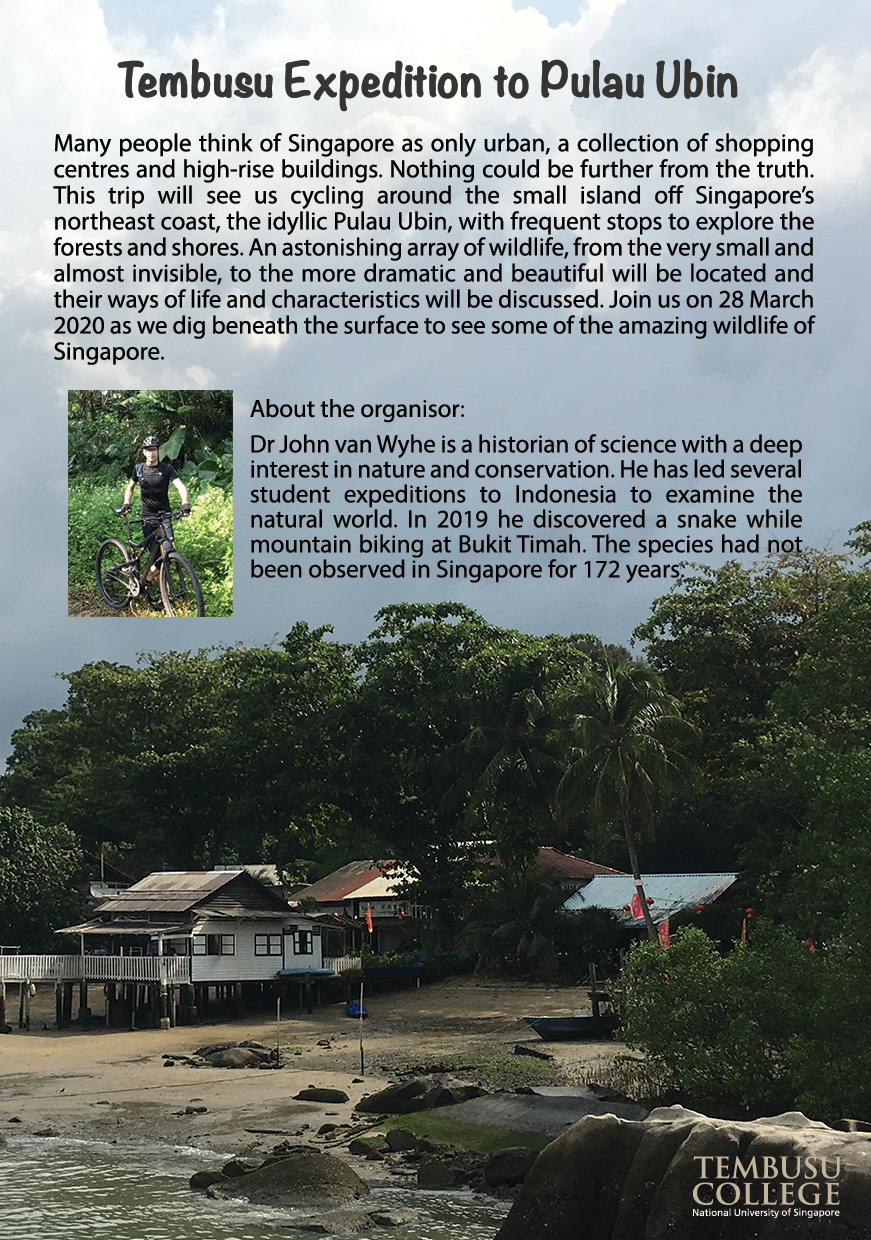
Tembusu Expedition To Explore The Natural History Of Pulau Ubin

About the Trip **Full Subscribed**

Date of the Expedition 28 March 2020, Saturday
Meeting Time (duration) 8.30am (All day)
Meeting Point Tembusu Drop Off Point
Cost Covered by the College
– Transport from Tembusu to Jetty
– Boat ride to and from Pulau Ubin
– Bike Rental
What to wear/bring – Wear covered shoes
– Bring a bottle of water
Number of Participants Maximum 20
(Tembusu Students only)
Application Deadline 18 March 2020
(You will be contacted via email to confirm your registration and to complete an indemnity form.)

Please write to tembusu@nus.edu.sg if you have any queries.

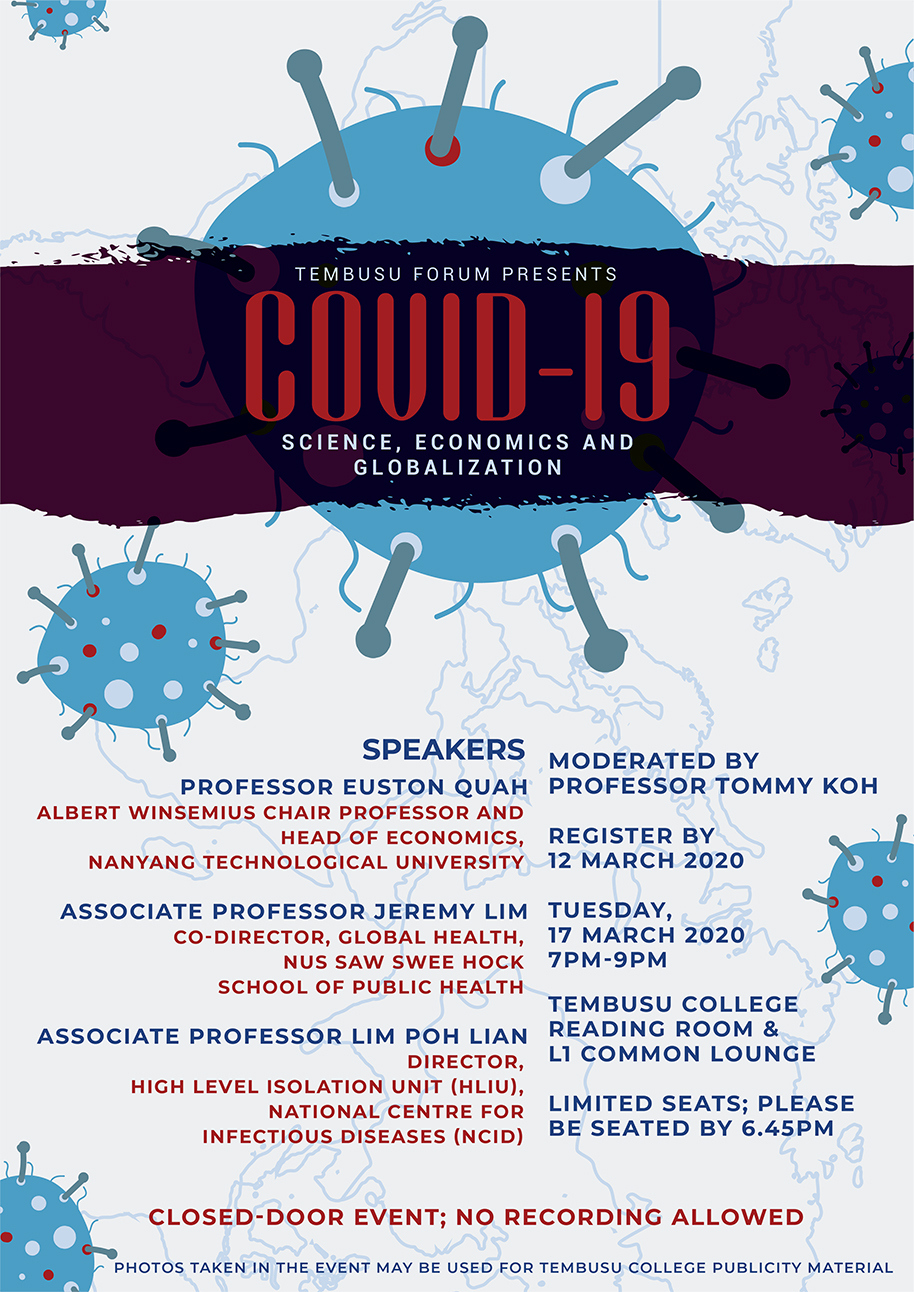
Covid-19: Science, Economics And Globalization

Click to enlarge
PROGRAMME:
6.50pm: All to be seated in Tembusu College Reading Room (streamed live to Common Lounge)
7.00pm: Dr Kelvin Pang, Master of Tembusu College, will introduce the Tembusu Forum
7.05pm: Professor Tommy Koh, Rector of Tembusu College, will introduce the topic and speakers
7.15pm: Associate Professor Lim Poh Lian
7.30pm: Associate Professor Jeremy Lim
7.45pm: Professor Euston Quah
8.00pm: Question & Answer session with students
8.50pm: Concluding remarks by speakers and Chair
9.00pm: End of forum
BRIEF BIOGRAPHY OF SPEAKERS:

Associate Professor Jeremy Lim is the Co-founder and CEO of AMiLi, the first dedicated gut microbiome full service company in Southeast Asia. He is also Co-director of Global Health at the National University of Singapore (NUS) Saw Swee Hock School of Public Health, where he works to enhance cooperation, capacity building and knowledge sharing across the region. Prior to AMiLi, he was the founding partner of global consultancy Oliver Wyman’s Asia health and life sciences practice (2013).

Trained in surgery and public health, A/Prof Lim attained various post-graduate qualifications, including membership in the Royal College of Surgeons (Edinburgh), Masters of Medicine (NUS) and Masters of Public Health (Johns Hopkins, as a Fulbright scholarship awardee). He was an inaugural fellow of the Asia Society A21 young leaders programme in 2006.

A/Prof Lim has a special interest in ways that technology can increase health equity and access to care. He advises a number of health technology companies and programmes in the region and globally. He also serves on the boards of and/or advises various charities and social enterprises, including HealthServe, Dover Park Hospice and SNTC. A/Prof Lim has worked in executive roles in both public and private sectors, including time spent as a senior official in the Ministry of Health, Singapore.

A/Prof Lim is a regular commentator on health issues in the region and in 2013, authored Myth or Magic: The Singapore Healthcare System. He is currently working on a book on health innovation.

For the forum, A/Prof Lim will speak on the topic Globalisation and Pandemics: Risks, Opportunities and Preparedness. He will discuss the current COVID-19 outbreak through the lens of globalisation and the unique risks Singapore faces, as well as the supra-national structures and processes Singapore has to encourage and nurture for our own protection and safety.

Associate Professor Lim Poh Lian is Director for the High-Level Isolation Unit (HLIU) at the National Centre for Infectious Diseases (NCID), and Senior Consultant in the Ministry of Health (MOH), Singapore.

A/Prof Lim grew up in Malaysia, studied biochemistry as an undergraduate at Harvard, medicine at Columbia, and public health at Tulane. She completed her internal medicine residency at Harvard’s Beth Israel Hospital, and infectious diseases (ID) fellowship in New Orleans. She and her family moved to Singapore in 2003, out of a calling to serve Christ in Asia. For her work as a front-line ID physician during the SARS outbreak, she received the Courage Star and National Day Commendation Medal.

A/Prof Lim currently chairs the WHO’s Technical Advisory Group for Health Security Interface, working on preparedness and response for deliberate events. She was appointed to the Global Outbreak Alert and Response Network (GOARN) Steering Committee for a decade, the UN Secretary General’s Global Health Crises Taskforce in 2016, the WHO Advisory Group on Reform of Work in Outbreaks and Health Emergencies in 2015 post-Ebola, as well as various high level MOH taskforces for outbreak preparedness and response. She has been active in outbreak response for COVID-19, dengue, chikungunya, leptospirosis, H1N1 2009, as well as Singapore’s national preparedness for Ebola, MERS, Zika and yellow fever.

A/Prof Lim served as Head of the Department of Infectious Diseases at Tan Tock Seng Hospital from 2012 to 2016, and is Head of the Travellers’ Health & Vaccination Clinic at Tan Tock Seng Hospital. She is on the faculty of LKC and NUS Schools of Medicine and Public Health, and has published extensively including the New England Journal of Medicine, Emerging Infectious Diseases and other journals. Professional interests range from outbreaks, public health strategy and vaccines to travel, tropical and HIV medicine.

For this forum, A/Prof Lim will discuss the biomedical and public health features of the current COVID-19 outbreak.

Professor Euston Quah is the Albert Winsemius Chair Professor and Head of Economics at the Nanyang Technological University (NTU), Singapore, an Adjunct Principal Research Fellow of the Institute of Policy Studies at the National University of Singapore (NUS), and a visiting Hengyi Chair Professor at Zhejiang University, and an Eminent Visiting Professor at University of Brunei Darussalam. He also holds a joint appointment with the Lee Kong Chian School of Medicine at NTU. He is a Distinguished Fellow and Member of the Scientific Committee at University of Economics, Ho Chi Minh City. He was formerly Chair, School of Humanities and Social Sciences, Vice-Chair of the Sustainable Earth Office, Senate Chair on University Policies at NTU; and Vice-Dean, Faculty of Arts and Social Sciences; Deputy Director of the Public Policy Programme (now the Lee Kuan Yew School of Public Policy); and headed the economics department at NUS.

A prolific writer, Professor Quah has published over 100 papers in major internationally refereed journals and opinion pieces. Selected works include an international publication on cost-benefit analysis for Oxford University Press, 2013; a lead journal article in World Economy in 2015; a Commentary in the Asian Economic Policy Review in 2016; an invited paper in the Macroeconomic Review in 2017; and an invited paper in the Asian Development Bank Institute monograph (2020).

Two of Professor Euston Quah’s books on Cost-Benefit Analysis were published by Routledge, UK in 2007 and 2012. His work on Cost-Benefit Analysis (with E.J. Mishan 5th edition, and 6th edition due in 2020) was recommended for reference by the US White House, Office of Management and Budget, for use by government agencies applying for project grants. He regularly teaches courses on Cost-Benefit Analysis (CBA) and Environmental Economics for undergraduates and graduates in NTU, and has previously held CBA workshops for civil servants in the National Environment Agency, and for policy makers in Brunei at the Universiti Brunei Darussalam.

Professor Quah is also the co-author of an Asian Edition of the best-selling Principles of Economics text with Gregory Mankiw of Harvard University, now a second edition in 2013. The Third Edition will be published in 2020. His earlier book on Household Production: Theory and Measurement, published by Ashgate, UK, was selected for inclusion by the International Library of Critical Writings in Economics in 2004, and much of his work on household production valuation had received favourable reviews in reputable journals such as the Journal of Economic Literature, the Economic Journal and the Journal of Labour Economics. Professor Quah was also recognised as an internationally respected environmental economist when in 2005, he was invited by UNESCAP as one of twelve eminent speakers in the Asia-Pacific in the Eminent Environmental Economists Symposium held in Seoul, Korea. Professor Quah’s book, Singapore 2065, published by World Scientific in 2015 celebrating Singapore’s fifty years anniversary, was selected by the Singapore Government among fifty items placed in a time capsule for unearthing in 2065.

Professor Quah advises the Singapore government in various Ministries and was a Member of the Prime Minister’s Economic Strategies Sub-Committee on Energy and the Environment. He had served on the Boards of Energy Market Authority, Fare Review Mechanism Committee of the Ministry of Transport, Board Member of the Energy Studies Institute at NUS; Member of the Board of Trustees, Institute of Southeast Asian Studies, and presently sits on the Government’s Market Compliance and Surveillance Committee; the Singapore Medical Council’s Complaints Committee; the Advisory Panel of the Ministry of Finance, the Resource Advisory Panel of the Prime Minister’s Office, and the Special Committee on Informed Consent of the Ministry of Health.

Professor Quah has also served as the Principal Advisor for Cost-Benefit Analysis and economic valuation projects for the Central Narcotics Bureau; the Singapore Police Force; the National Environment Agency; the Ministry of Environment and Water Resources; the Land Transport Authority; the former Ministry of Community Development, Youth and Sports; and the Competition and Consumer Commission of Singapore.

In 2016, Professor Quah was appointed a Member of the Social Sciences Research Council of Singapore. He is also a Review Panel Member for the Bill and Melinda Gates Foundation project hosted by the Overseas Development Institute, London; and in 2015 was inducted as a Fellow Member of the prestigious learned society, the European Academy of Science and Arts. Professor Quah is the Editor of the Singapore Economic Review since 2002, and the President of the Economic Society of Singapore since 2009. In addition to being External Reviewer for economics schools and invited Eminent Visiting Professorships to a number of Asian universities, he has also been invited by Stanford University, Princeton University, Zhejiang University, Fudan University, the USA Inter-Pacific Bar Association, WWF for Asia, UNESCAP, Earth Institute of Columbia University (Asian Meetings), Asian Development Bank Institute (Tokyo) and Asian Development Bank to speak at their functions and conferences, and he is one of the most highly cited and influential university economists in Singapore.

The following is an abstract of what Professor Quah will touch on during the forum:

The Novel Coronavirus: What do Economists have to say?

Attention on the novel coronavirus (COVID-19) outbreak has been largely centred on its widespread health impacts. It has also weighed heavily on the global economy and stock markets worldwide. However, the economic impacts of the coronavirus extend far beyond the financial world. What measures can economists recommend to the government to deal with such breakouts now and in the future? Understanding the incentives and disincentives in place, marginal costs and trade-offs can help reduce the damage from such outbreaks. Through a series of questions, utilizing the tools and principles of economics, the talk aims to explore topics including: What is the total economic loss of the virus? How is productivity affected? What are the externalities of such epidemics? How will it impact globalization? How does such epidemics compare with other pressing issues, such as climate change, in terms of their importance? How do we allocate resources among these competing needs? Should extra powers or responsibility be given temporarily to governments to deal with fake news in times of such crisis, and where and how to draw the line? Is there an optimal level of information? What are the other public health issues?