

Sunnylands is the name of a 200 acre (about 81ha) home built in the 1960s by one of America’s wealthiest couples, Walter and Leonore Annenberg, in Rancho Mirage, California. Their intention was to offer the estate to the US president for his use as the Camp David of the West.
Camp David is the name of the presidential retreat in the hills of Maryland, a state on the east coast.
Eight US presidents, from Mr Eisenhower to Mr Obama, have used Sunnylands to host foreign dignitaries. In 2013, President Barack Obama held a two-day summit at Sunnylands, with President Xi Jinping of China.
Early next week, on Monday and Tuesday, President Obama will welcome the ten leaders of Asean to a special summit in Sunnylands.
By choosing Sunnylands as the venue, the US President is sending the message that he attaches as much importance to Asean as he does to China.
I would like to take stock of the current state of Asean-United States relations and to anticipate what the leaders will likely focus on.
The Asean-US relationship is comprehensive, substantive, mutually beneficial and trouble-free. The relationship is supported by very substantial economic ties, extensive cooperation in many sectors and common values and objectives.
SUBSTANTIAL ECONOMIC TIES
The US is Asean’s largest foreign investor, with cumulative investments of over US$225 billion (S$313 billion). The US is Asean’s fourth largest trading partner.
The conclusion of the Asean Economic Community will create many new opportunities for US business. The good news is that Asean is growing and integrating. It is the world’s seventh largest economy and is projected to be the fourth largest in the near future. It is a larger recipient of foreign direct investment than China.
I hope the summit in Sunnylands will offer an opportunity for the American and Asean leaders to go beyond their scripted remarks and have a heart-to-heart talk on the pressing issues of our region and of the world. I hope they will also focus their minds on the future direction of Asean-US relations.
The other good news is that the US has transcended the 2008 financial and economic crisis. The US economy is now in the same position as in 2007. It is the most competitive economy in the world. When the recently concluded Trans Pacific Partnership (TPP) comes into force, this will create many new opportunities for both Asean and US businesses.
I therefore foresee significant increases in trade and investment between the US and Asean in the coming years.
EXTENSIVE COOPERATION
The US is an old development partner of Asean. Over the past five decades, the US has educated many of Asean’s leaders.
American foundations, universities and non-governmental organisations have helped the Asean countries to eliminate illiteracy and to educate and train their people.
American initiatives have helped to empower our girls and women.
Other notable initiatives have sought to strengthen the rule of law and democratic institutions in Asean.
Asean and the US have also been cooperating in non-traditional security areas, including counter-terrorism, cybercrime, human trafficking, the smuggling of drugs, emergency preparedness, et cetera.
Both sides are also exploring new areas of cooperation, such as climate change and information and communications technology.
POLITICAL AND SECURITY COOPERATION
Asean and the US are also political and security partners. This partnership is founded on their common objective to promote peace and stability in the region.
They want to uphold the current rules-based regional and international order. They believe that when disputes arise, they should be settled peacefully and in accordance with international law.
The positive track record of the US, in contributing to the region’s stability and prosperity, has made it a trusted partner for many Asean states.
STRATEGIC PARTNERSHIP
When Asean and US leaders met in Kuala Lumpur last November, they decided to elevate their relationship to a strategic level. They recognised that the Asean-US partnership has played a key role in contributing to the stability and prosperity of the Asia-Pacific region.
Both sides will however have to invest energy and resources to nurture and grow the relationship. The challenge is to translate the new relationship into concrete measures which will benefit the peoples of both sides. Otherwise, strategic partnership will remain an empty slogan.
ASEAN’S REGIONAL ROLE
Asean enjoys very good relations with the US. At the same time, Asean also enjoys very good relations with China, Japan, India, the European Union and other powers. Asean’s policy is to be close to all the major powers but to be allied to none.
Asean does not wish to take sides in the disputes between the major powers or in their competition for influence. By being neutral and independent, Asean is trusted by all the major powers. This has enabled Asean to play the role of the region’s convenor and facilitator. This is the reason for the central role which Asean plays in the region’s institutions.
The US understands and supports Asean centrality.
OBAMA’S LEGACY
Asean has never had a better friend in the White House than Mr Obama. Because the President spent part of his childhood in Jakarta and is able to speak Bahasa Indonesia, he has a feel for our region and understands its culture. He has made a paradigm shift in US policy towards Asean.
First, he overcame the reluctance of previous administrations and acceded to the Treaty of Amity and Cooperation in South-east Asia.
Second, President Obama made the unprecedented move of institutionalising an annual Asean-US Summit, committing the US President to meeting all ten Asean leaders every year.
Third, the US was the first non-Asean country to appoint a Permanent Representative to Asean.
Fourth, the US has joined the East Asia Summit and has played a positive role in it.
Fifth, President Obama visited Myanmar and met all the stakeholders to encourage them to make a successful transition to democracy.
Sixth, during the past seven years, the US has never failed to send high-level representatives to the annual East Asia Summit, the Asean Regional Forum and the East Asia Summit Ministerial Meetings.
Seventh, President Obama has promoted people-to-people ties, as can be seen through his personal involvement in the Young South-east Asian Leaders Initiative.
THE FOCUS IN SUNNYLANDS
I hope the summit in Sunnylands will offer an opportunity for the American and Asean leaders to go beyond their scripted remarks and have a heart-to-heart talk on the pressing issues of our region and of the world.
I hope they will also focus their minds on the future direction of Asean-US relations.
Finally, I hope that the summit will succeed in consolidating the achievements of the past seven years and institutionalise them in a way which will endure no matter who is elected as the next president of the United States in November.
Vice & Virtue: 1800s Singapore
From colonial power struggles to government sanctioned drug cartels and prostitution rings, 19th century Singapore is full of fantastic stories of vice and virtue. Academic and history buff, Dr. Farish Noor takes us on a journey to uncover these forgotten stories.
You can watch the video here.
We are inundated with bad news. Every day seems to bring news of a new conflict, disaster or tragedy. And since good news is not news, we seldom hear of happy developments. When I look back on the year which has just passed, I am struck by a number of very positive developments which I will call “The Miracles of 2015”.
MIRACLE NO. 1: The Paris Agreement on Climate Change
Since the advent of the Industrial Revolution, human activities have progressively warmed the earth. For some years, the world’s leading climatologists have warned that unless we curb the increase in the release of carbon dioxide and other greenhouse gases into the atmosphere, the world’s average temperature would continue to rise and would have many negative consequences for humankind. For example, the sea level will rise and low-lying cities and countries will be threatened.
At the 1992 United Nations Conference on Environment and Development (the Earth Summit), which I had the pleasure of chairing, we adopted the UN Framework Convention on Climate Change (UNFCCC). The UNFCCC has 195 parties. This was followed by the Kyoto Protocol. The Protocol was adopted in 1997 and entered into force in 2005. The Protocol was ineffective for several reasons, one of which was that the United States refused to join it.
It became increasingly apparent that without universal participation by all countries, big and small, global efforts on climate change would not be meaningful. The 195 parties to the UNFCCC thus began negotiating the successor agreement to govern climate change cooperation after 2020 when the Kyoto Protocol ends.
The negotiating journey has been arduous and dramatic. It began on an optimistic note in Bali,
Indonesia, in 2007. It stumbled badly in Copenhagen, Denmark, in 2009. The process was put back on track in Cancun, Mexico; in Durban, South Africa; Warsaw, Poland, and in Lima, Peru.
Approaching Paris, disagreements were still so protracted that the negotiators were uncertain whether there would be an agreement and, if so, whether it would be a good agreement. Miraculously, on Dec 12, 2015, the dynamic and skilful Foreign Minister of France, Mr Laurent
Fabius, was able to announce that the Paris Agreement on Climate Change had been adopted by consensus. The agreement is universal and legally binding. It will attempt to limit the rise of global temperature to 1.5 deg C.
I am glad to say that Singapore’s Foreign Minister, Dr Vivian Balakrishnan, and its chief negotiator, Ambassador Kwok Fook Seng, played constructive leadership roles in the negotiations.
MIRACLE NO. 2: Myanmar’s transition to democracy
Myanmar, previously known as Burma, is an important country and a member of Asean. It is strategically located between China and India, is generously endowed with natural resources and has enormous economic potential. From 1962 to 2010, it was ruled by the military.
The West used to treat Myanmar as a pariah state. The West used to urge Asean to expel Myanmar, to isolate her and to impose sanctions against her. Asean preferred to keep Myanmar in the family and to encourage her to undertake reform. Myanmar was treated with respect and dignity. However, when the military opened fire on unarmed Buddhist monks and civilians in
September 2007, the Asean family did not hesitate to condemn this outrage.
Beginning in 2010, Myanmar began a careful transition to democracy under a “Seven Step Road Map” drawn up by the military regime. A general election was held in November 2010. The flawed elections produced a Parliament dominated by the military. Former prime minister Thein Sein was elected by the Parliament as the president in 2011.
He surprised everyone by instituting serious political and economic reforms. He released many political prisoners, including the democracy icon, Ms Aung San Suu Kyi. He welcomed her and her party, the National League for Democracy (NLD), into Parliament in 2012 through by-elections won by the NLD. Myanmar engaged the international community through its chairmanship of Asean in 2014.
The big question was whether the general election in November last year would be free and fair. Would the NLD and Ms Suu Kyi be allowed to contest the elections? And, if the NLD were to win the elections, would President Thein Sein, the military and the former head of state, Senior General Than Shwe, who led the previous government, accept the outcome?
The international community has judged that the elections held on Nov 8, 2015 were free and fair. Supported by the people countrywide seeking peaceful change via the ballot box, the NLD won a sweeping victory, taking 59 per cent of the seats in Parliament: 255 in the Lower House and 135 in the Upper House. Under the Constitution, the military has 25 per cent of the seats in Parliament.
The NLD commands more than the 50 per cent majority needed to elect the president and one of the two vice-presidents in the Presidential Electoral College next month. Ms Suu Kyi, however, is barred by the Constitution from the presidency. If the requisite constitutional amendment is supported by the military MPs and other parties in Parliament, this hurdle will be removed and she can become president.
The results of the historic elections have been accepted by President Thein Sein, the military’s
Commander-in-chief Senior General Min Aung Hlaing, and even by retired Senior General Than Shwe. A new civilian government will take office in April this year after over 50 years of military rule.
Compared with the Middle East, where the Arab Spring has turned into a nightmare, the peaceful and remarkable development in Myanmar appears to be a miracle in its transition to democracy.
MIRACLE NO. 3: The Xi-Ma summit in Singapore
On Nov 7, 2015, China’s President Xi Jinping and Taiwanese President Ma Yingjeou met at the Shangri-La Hotel in Singapore. The 81-second-long handshake was history-making. It was the first time that the leaders of the two sides of the Taiwan Strait have met since the end of the Chinese Civil War in 1949.
Why do I celebrate the Xi-Ma summit as a miracle of 2015?
I do so for the following reason. Peace is not a given in cross-strait relations. We have seen the rise of tensions across the strait on several occasions. Any armed conflict between the mainland and Taiwan will have serious repercussions on the region.
The ruling party of China, the Chinese Communist Party, and the ruling party of Taiwan, the Kuomintang, both hold the view that there is only one China. The two sides agreed tacitly in 1992 in Hong Kong and again, in 1993, at their meeting in Singapore, that each side will interpret the “one China” policy in its own way. This understanding paved the way for a series of constructive meetings and agreements. The Xi-Ma meeting cast this understanding, known as the “1992 Consensus”, in stone, bringing cross-strait relations firmly into the orbit of peace.
We should welcome good relations between the two sides of the Taiwan Strait. The summit meeting between Mr Xi and Mr Ma will help each side to have a better understanding of the other through direct talks. It will help to increase mutual trust and reduce suspicion and misunderstanding.
It took 66 years for the leader of the mainland and the leader of Taiwan to shake hands and talk to each other directly.
We should therefore welcome the summit in Singapore between Mr Xi and Mr Ma as another miracle of 2015.
Read and discuss a book this semester with either a fellow or student of Tembusu College! Now three years in the running, the Reading Pod Book Club is dedicated to encourage reading beyond the curriculum.
Those interested may sign up for not more than two of the following reading pods and pay only S$10 per book at the reception counter at the Tembusu College admin office*. Deadline for registration is 22nd of January (Friday). Each reading pod is limited to five students, so hurry and sign up now.
*You will receive your book(s) directly from the reading pod facilitator.
(1) F. Scott Fitzgerald’s The Great Gatsby led by Dr. Connor Graham

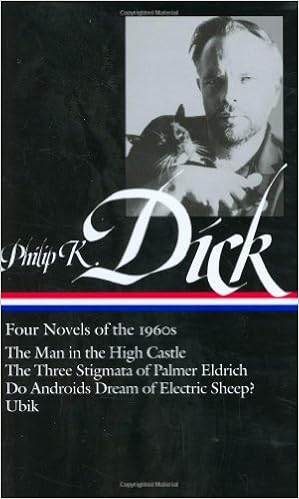
(2) Philip K. Dick’s Four Novels of the 1960s led by Dr. Adam Stanley Groves
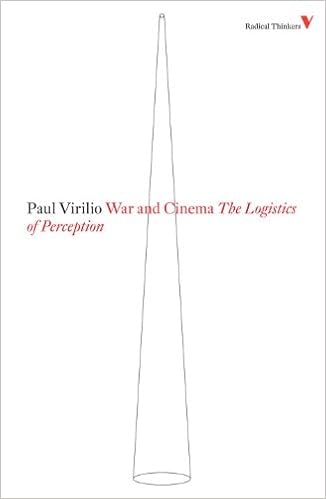
(3) Paul Virilio’s War and Cinema: The Logistics of Perception led by Dr. Jerome Whitington
(4) Virginia Woolf’s The Waves led by Mr Shawn Lim You Hao

(5) Ursula K. Le Guin’s The Dispossessed led by Mr Navin Vijay Wadhwani

(6) Julian Barnes’ The Sense of an Ending led by Mr. Ong Ling Kang

(7) John Boyne’s Boy in Striped Pajamas led by Mr. Pavan Mano

Salutations
Your Excellencies, Professor Tore Henriksen, Director of the Jebsen Centre for International Law, University of Tromso, Norway; Professor Robert Beckman, Director of the CIL; Mr Kamal Vaswani, Director-General for Europe, MFA, Fellow Participants, Distinguished Guests, Ladies and Gentlemen.
Warm Welcome
2. On behalf of the CIL of NUS, one of the two co-organizers of this Conference, I wish to extend a warm welcome to all the participants. I would like to thank all of you for accepting our invitation to join the Conference. Some of you have travelled a long distance to be here and we appreciate it very much.
Thank Norway
3. I would like also to thank our Norwegian colleagues for their collaboration. Last year, Bob Beckman attended the annual meeting convened by the Center for Ocean Law and Policy of the University of Virginia Law School, in Norway. It was at that meeting that Bob met Tore Henriksen and the idea for this Conference emerged from their discussions. In addition to this Conference, a book on the Governance of Arctic Shipping, co-edited by Bob Beckman, Tore Henriksen, Eric Molenaar and Ashley Roach, will be published by Edward Elgar Publishing. I would also like to thank my good friend, the Norwegian Ambassador to Singapore, Tormod Endresen, for hosting the Conference participants to a dinner reception last evening at his residence.
Focus of Conference
4. The focus of this Conference is on the Governance of Arctic Shipping. The sub-theme is the need to balance the rights and interests of the Arctic States and the User States. I will try to stay focused and limit myself to making only three points.
Arctic Ocean and UNCLOS
5. My first point is that the Arctic Ocean is part of our global commons. The 1982 UN Convention on the Law of the Sea governs the Arctic Ocean as it does all the other oceans and seas of the world. In a speech I made on 10 December 1982, exactly 33 years ago today, I described the Convention as a “constitution for the oceans”. Claims by the Arctic littoral states must be consistent with the Convention’s regimes of the Internal Waters, Territorial Sea, Contiguous Zone, Exclusive Economic Zone and Continental Shelf. The rights of coastal states and user states are prescribed by the Convention. In other words, the international law applicable to the Arctic Ocean is the UN Convention on the Law of the Sea. All the Arctic States, including the United States, accept this proposition.
Article 234 of Convention
6. The Convention has, however, taken into account the special ecological characteristics of the Arctic. Although Article 234 of the Convention does not mention the Arctic, it was negotiated by Canada, the US and the former Soviet Union, to apply to the Arctic. The Article empowers the coastal states to adopt and enforce non-discriminatory laws and regulations for the prevention, reduction and control of marine pollution from vessels in ice-covered areas within the limits of the exclusive economic zone.
IMO
7. My second point is that on all matters relating to international shipping, the Convention refers to the IMO as the competent authority. The increased presence of vessels in the Arctic has raised concerns about whether current international rules and standards are sufficient for guiding vessels in this hostile and remote environment. Responding to these concerns, the IMO has included a number of special regulations for ships operating in ice-covered waters into several Conventions and adopted non-binding guidelines to improve the safety of navigation in polar regions. By May 2015, both the safety and environmental requirements of the so-called Polar Code, and the associated SOLAS and MARPOL amendments have been adopted. These amendments will come into force on 1 January 2017.
Arctic Council
8. My third point is to refer to the important work of the Arctic Council. The Council is an inter-governmental forum, established by the 8 Arctic States, in 1996. The purpose of the Council is to foster cooperation and coordination among the Arctic States, “with the involvement of the Arctic indigenous communities and other Arctic inhabitants” as well as contributions from invited experts and observers. Singapore has been accepted as one of the twelve observers.
9. The Arctic Council has developed an agreement among the 8 member states on cooperation in aeronautical and maritime search and rescue in the Arctic region. The agreement was concluded in 2011 and came into force in 2013.
10. In 2009, the Arctic Council adopted the non-binding Offshore Oil and Gas Guidelines. In 2011, a binding agreement was signed to facilitate cooperation on Marine Oil Pollution Preparedness and Response in the Arctic.
Conclusion
11. I shall conclude. I must be one of the few Singaporeans who have been to the Arctic and who has spent a night with an Inuit community. It was a depressing experience because I saw with my own eyes how the arrival of western civilization has destroyed the traditional way of life of this indigenous community. I therefore worry that global warming will exacerbate the problem by changing the ecosystem and threatening the biodiversity and wildlife, such as, the polar bears. It is true that we can’t stop climate change and we can’t stop “progress”. But, let us not forget that the indigenous people of the Arctic has a right to be treated fairly and with respect.
. . . . . .
At midnight, on 15 August 1947, India gained its independence after two centuries of British rule. This had been preceded by three centuries of Mughal rule. The people of India had waited for more than 500 years to be the masters of their own destiny.
Speaking at that midnight hour, India’s founding Prime Minister, Jawaharlal Nehru, declared that India had a “tryst with destiny”. Nehru united the country with his vision, charisma and eloquence. He elevated the status and role of India in the community of nations. He left India with a positive legacy of democracy, rule of law and secularism.
Under Nehru, India did not however achieve great economic progress. This was due to the fact that Nehru had pursued an economic policy which was based on socialism and state planning. The economy was inward-looking, the role of the public sector was emphasised over the private sector and decisions were made by bureaucrats instead of the market. The result was that India grew very slowly, at a rate which came to be known as the “Hindu rate of growth”.
Second Tryst With Destiny
In 1991, India was faced with an economic crisis. Inflation was 13 percent and rising. The current account deficit was running at US$10 billion and the foreign exchange reserves were only enough to fund two weeks of imports. The external debt was 250 percent of exports.
In the face of that crisis, the Congress Party appointed a veteran politician, CV Narasimha Rao, to lead a minority government. He appointed a former Governor of the Reserve Bank of India, Dr Manmohan Singh, as his Finance Minister.
In the next two years, Dr Manmohan Singh dismantled some of the worst features of the Nehruvian economic model. Narasimha Rao and Manmohan Singh saved India from the brink of economic collapse. More importantly, they started India’s second tryst with destiny.
Their legacy of economic reform and opening the Indian economy to the world was accepted and built upon by the subsequent administrations of Prime Minister Vajpayee and Prime Minister Manmohan Singh. However, in the second term of Prime Minister Manmohan Singh, the government’s focus was distracted by a series of corruption scandals and the drive for reform lost momentum. The country cried out for a new leader and a new tryst with destiny.
Third Tryst With Destiny?
The world had come to expect that elections in India would not produce a winner with a majority in the Lok Sabha. Instead, we had become used to the idea that India would be ruled by coalition governments. The results of the elections in 2014 were therefore beyond expectations. Under its charismatic leader, Narendra Modi, the BJP secured a majority of the seats in the Lok Sabha. It could therefore rule India without having to depend on the support of unreliable coalition partners.
Will Prime Minister Narendra Modi be able to rekindle the hopes of 1990s and launch India along a trajectory of sustained high growth for the next decade? Will Prime Minister Modi be able to complete the agenda of economic reform begun by Prime Minister Narasimha Rao? Will he succeed in transforming India into a country which is easy to do business in? Will he succeed in translating the slogan, “Make in India”, into building a competitive manufacturing sector in the Indian economy? Will he succeed in turning his slogan, “100 Smart Cities”, into an urban policy of liveable cities and sustainable urbanisation?
Confidence In Modi
Our confidence in Prime Minister Narendra Modi is based upon three factors. First, it is based on his track record as the Chief Minister of Gujarat. During the thirteen years when he ruled Gujarat as Chief Minister, he was highly successful while remaining non-corrupt. His slogan was “less government more governance”. He reduced taxes and regulations. He invested in roads, irrigation, education and healthcare. He promoted the growth of the manufacturing sector in addition to agriculture. His success in Gujarat can be seen in the reduction of poverty in that state. In 2004-2005, 31.8 percent Gujarat’s population lived below the poverty line. By 2011-2012, the percentage had fallen to 16.6.
Good Governance
Second, our confidence in Prime Minister Modi is based upon his record of integrity and good governance. Corruption is one of India’s challenges. Prime Minister Modi’s personal record of integrity and his demand for good governance are exemplary. Good governance will improve India’s business environment and the confidence of investors. Good governance will improve economic efficiency. Good governance will improve the lives of the people of India.
Ambition For India
Third, we like the Prime Minister’s focus, discipline and ambition for India. In order to galvanise the people of India to believe in themselves, we need an inspiring leader like Prime Minister Modi. We also need an Indian leader who prioritises development over everything else. During the election campaign, he said that India needed development more than deity. He also said that India needed toilets more than temples. This was remarkable coming from a person who has often been described as a Hindu fundamentalist.
Conclusion
Singapore has confidence in Prime Minister Narendra Modi. This confidence is reflected in the fact that, after Mauritius, we are the largest foreign investor in India. We are helping India in skills development and city planning. Our private sector has invested in India’s logistics, energy, industrial estates, water, seaports, airports, manufacturing and services, etc. Our bilateral relations are comprehensive and multi-facetted. Our leaders enjoy a high comfort level based upon mutual trust and confidence. We are confident that during his forthcoming visit, Prime Minister Narendra Modi and his Singapore counterpart, Prime Minister Lee Hsien Loong, will agree to raise our relationship to an even higher level. Singaporeans of all races extend a warm welcome to Prime Minister Narendra Modi.
. . . . . . . .
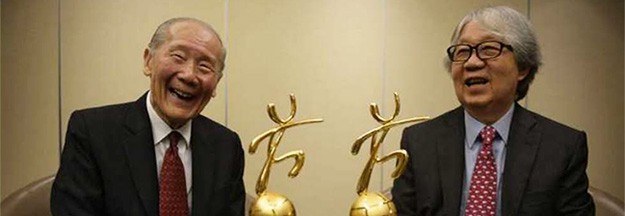
Tembusu College congratulates Prof Koh on his Eminent Alumni Award. For more details, please go to http://news.nus.edu.sg/highlights/9722-notable-alu….
On Tuesday, 17 November, Drs Adam Groves, Connor Graham, and Kelvin Pang were presented with the Residential Colleges Teaching Excellence Award.
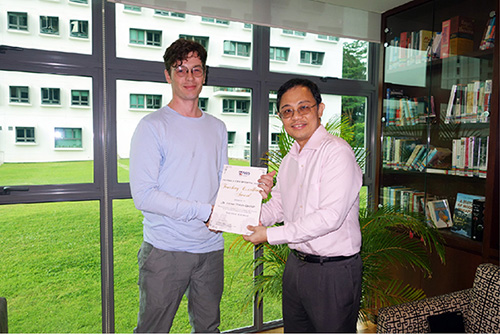
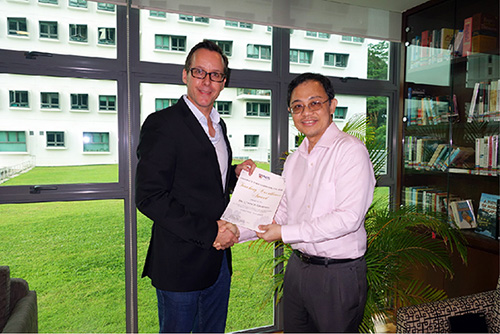
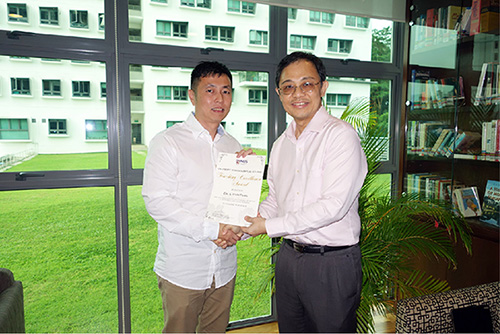
These awards recognise excellence in teaching among faculty at Tembusu and the College of Alice & Peter Tan for the academic year 2014/15. Nominations for these awards are judged annually by the Residential Colleges Teaching Excellence Committee.
This year, the ceremony was presided by Professor Bernard Tan, Vice Provost (Undergraduate Education), and hosted by Tembusu College.
I join Singaporeans of all races in warmly welcoming President Xi Jinping and Madam Peng Liyuan to Singapore. Their State Visit reciprocates the successful visit by President and Mrs Tony Tan to China in July this year. The exchange of visits by the two Presidents is part of our celebration of 25 years of diplomatic relations between China and Singapore.
Honouring Deng Xiaoping
I last met President Xi Jinping in November 2010 in Singapore. He was then Vice-President of China. The National Heritage Board, of which I was the then Chairman, had put up a marker to and a bust of Deng Xiaoping, in front of the Asian Civilizations Museum. We invited our founding Prime Minister, Mr Lee Kuan Yew, a friend and admirer of Mr Deng and Mr Xi, to unveil the marker and the bust at a simple ceremony. We were overjoyed that both Mr Lee and Mr Xi had accepted our invitations. I will always treasure the memory of that happy occasion.
Contact with China
China’s seat at the United Nations had been occupied by the Republic of China from 1945 to 1971. In 1971, the People’s Republic of China (PRC) defeated the Republic of China in a vote at the UN General Assembly. Following that vote, the PRC took over China’s seat at the UN. The first PRC’s Ambassador to the UN was an outstanding diplomat called Huang Hua.
In 1974, I was appointed, for the second time, as Singapore’s Permanent Representative to the UN. I was instructed to begin a dialogue with Ambassador Huang Hua on our bilateral relations. On the 7th of October 1974, I organised a dinner, hosted by our Foreign Minister, Mr S Rajaratnam, in honour of the leader of the Chinese delegation to the UN General Assembly, Mr Qiao Guanhua, the Vice-Minister for Foreign Affairs. The dinner was very successful and Minister Qiao invited Mr Rajaratnam to lead a goodwill delegation to China.
Visits by Raja and Lee
With the help of Amb Huang Hua, I was able to organize the visit of Mr S Rajaratnam to China, from the 13th to the 22nd of March 1975. The high point of the visit was a call on the Chinese Premier, Zhou Enlai.
In the following year, Ambassador Huang Hua and I organised the first visit by our founding Prime Minister, Lee Kuan Yew, to China. The visit took place from the 10th to the 24th of May 1976. The highlight of the visit was a call by Mr Lee on an ailing Chairman Mao.
Lee Kuan Yew and China
Between 1976 and 2015, Mr Lee Kuan Yew had visited China over 30 times. He spent time in cultivating five generations of China’s leaders. He helped Deng Xiaoping’s revolutionary policy of economic reform and opening the Chinese economy to the world, by encouraging Singapore’s public and private sectors to invest in China. He personally took charge of the Suzhou Industrial Park project. He was willing to act as an interlocutor between China and the United States and between Mainland and Taiwan. As a result, China regarded Mr Lee Kuan Yew as an old friend and held him in high esteem. My message to China is that, although Mr Lee Kuan Yew is no longer with us, his friendship and goodwill for China are shared by his successors, Mr Goh Chok Tong and Mr Lee Hsien Loong.
1990 Negotiations with China
Although our relations with China grew steadily after 1976, we did not want to establish formal diplomatic relations until after Indonesia had normalised its relations with China. In August 1990, I was appointed the leader of the Singapore delegation to negotiate an agreement with China for the establishment of diplomatic relations between us.
After three rounds of negotiations, the two sides agreed on the text of a Memorandum of Understanding (MOU) to establish formal diplomatic relations on the evening of 18th September, in the premises of a State Guest House called Diaoyutai. The MOU was signed by Minister Qian Qichen and Minister Wong Kan Seng, at the UN, on 3rdOctober 1990. The Chinese Chief Negotiator, Minister Xu Dunxin and I had a happy reunion at dinner in Beijing last month.
25 Years of Friendship and Progress
The past 25 years have been a remarkable period for China, for Singapore and for our bilateral relations. No one could have foreseen 25 years ago, that China would become Singapore’s largest trading partner or that Singapore would become China’s largest foreign investor. No one could have foreseen that the two Governments would have implemented two iconic projects in Suzhou and Tianjin and are about to embark on a third project in Western China. No one could have foreseen that the two countries would have concluded a free trade agreement, which would soon be upgraded to a higher level of ambition. The current relationship between China and Singapore is warm, comprehensive and substantive and rests on a firm foundation of mutual trust. I am confident that President Xi Jinping and his Singapore counterparts will agree to raise our relationship to an even higher peak.
ASEAN-China Relations
In 2005, I was appointed to represent Singapore in the ASEAN-China Eminent Persons Group. The group was co-chaired by Musa Hitam (Malaysia) and Qian Qichen (China). I believe in the importance of ASEAN-China relationship, both economically and politically. I am happy that Singapore is the Country Coordinator for ASEAN-China Dialogue Relations for the next three years. China can have confidence that Singapore will do its utmost to unite the ASEAN side and will keep the relationship on a positive trajectory. However, in order to achieve this objective, China will have to play its part, in growing our positive agenda and in managing our differences, with wisdom and self-restraint.
. . . . . .