

On Thursday, 30 April
At the Singapore International Foundation
1. First, I would like to thank the Singapore International Foundation for inviting me to participate in this evening’s discussion of Prasenjit’s important new book, The Crisis of Global Modernity.
2. Second, I want to praise Professor Prasenjit Duara, the third Director of the Asian Research Institute (ARI). I have been associated with ARI since its inception as Chairman of its International Advisory Panel. I have enjoyed working with Professor Tony Reid, its founding Director, with Professor Lily Kong and with Prasenjit. Prasenjit is a world class scholar and an inspiring intellectual leader. Under his leadership, ARI has enhanced its reputation in the world and breathed new life into regional studies. I would be very sorry when he leaves us next year for Duke University.
3. Third, I would like to say a few words about the book. In his book, Prasenjit offers us an alternative to nationalist history. His alternative is “circulatory or transnational history”. Prasenjit’s study is framed by 3 developments. They are: (i) the rise of Asia, especially China and India; (ii) the crisis of planetary sustainability; and (iii) the decline of ideals, principles and ethics, once found in religions and political ideologies.
4. The rise of Asia, especially of China, India and ASEAN, is a world-changing development. And yet, in a strange way, it is a return to the past. In his book, When Asia Was The World, Stewart Gordon wrote that for a thousand years, from 500 to 1500, Asia was the world. It had the 5 largest cities of the world, all at the heart of great empires. Three of those cities, Delhi, Beijing and Istanbul still exist today. It was in Asia that mathematicians invented the zero and algebra. Astronomers tracked the stars more accurately than before and invented the astrolabe for navigation. Poets and writers produced literature that still resonates with us.
5. Prasenjit’s second point is indeed true. There is a crisis in planetary sustainability. The 3 environmental challenges we face are: climate change, loss of biodiversity and ecosystems and the degrading of the world’s oceans. The basic cause is the unsustainable patterns of production and consumption which can be described as the Western economic model. The bad news is that Asians have embraced this model with a vengeance. Our factories are carbon copies of those in the west. Our middle class wants to lead the same life style as their counterparts in the West.
6. Prasenjit’s third point is the decline of ideals, principles and ethics once found in religions and political ideologies. Ideology is dead but religion is not. Europe may have become a secular continent but religiosity is on the rise in Asia and in America. However, as a Methodist Bishop observed to me recently, Singaporeans may have become more religious but they have not become more spiritual. In other words, the rise of religiosity can co-exist with materialism. This may explain the popularity of Christian pastors who preach what is sometimes referred to as “prosperity gospel”.
7. What to do? Prasenjit looks for salvation to the traditions of Asia. The Taoist philosophy, for example, has a different way of understanding the relationship between the man, nature and the universal. I am sorry to disappoint Prasenjit when I point out that China’s economic development seems to be inspired, more by Deng’s dictum that it is glorious to be rich than by the Taoist view of man and nature.
8. In his final chapter, “Regions of circulation and Networks of sustainability in Asia”, Prasenjit focuses on ASEAN because of the role it plays in bringing Asia together. “Regional integration in Asia is centred on ASEAN”. “ASEAN has worked to enmesh the larger powers by means of commercial diplomacy that is expected to bring material benefits to both sides but also to tie these powers to the region.” Prasenjit believes that, in spite of all its deficiencies and weaknesses, ASEAN has outlined ways and means to deal with the problem of the commons, environmental degradation and unsustainable development. As a citizen of ASEAN, I thank Prasenjit for highlighting ASEAN’s positive role in region-building.
9. Prasenjit also attaches importance to the “civil society networks” which he believes can serve as watchdogs for inclusivity and transparency.
10. Finally, Prasenjit praises the role of international law because it has rules and principles which affect, “rights and jurisdictions across boundaries of territory, spaces and species, human rights, global finance, the seabed, outer space, Antartica, migratory birds, etc.” Who are the custodians of this space, which Prasenjit calls, “the sacred place”? In his view, it is the “networks of hope constituted by the coalitions of civil society, local communities and their allies”.
11. I have tried to summarise Prasenjit’s thesis. I hope I understood his message and got it right. It is now the turn of Professor Itty Abraham to critique it.
12. Thank you.
Book: Through the lens of Lee Kip Lin, Photographs of Singapore, 1965-1995
Author: Dr Lai Chee Kien
Date and Venue: Tuesday, 28 April 2015 at the National Library
Guest-of-Honour: Professor Tommy Koh
Honorary Chairman,
National Heritage Board
Talking Points
1. First, I would like to thank Mrs Lee Kip Lin also known as Madam Ong Li Ming, for generously donating to the National Library Board, her husband’s legacy of photographs, slides, negatives, maps, prints and books. We are very grateful to you and your family for this precious donation.
2. Second, I would like to praise Lee Kip Lin. He was born in Singapore in 1925 and passed away in 2011, at the ripe old age of 86. He studied architecture in London and returned to Singapore in 1956. He spent his life practising architecture, teaching architectural students, researching and writing. He published three books: (i) Telok Ayer Market: A Historical Account of the Market from the Founding of the Settlement of Singapore to the Present Time in 1983; (ii) Emerald Hill: The story of a Street in words and Pictures in 1984; and (iii) The Singapore House: 1819-1942, in 1988 which I consider his magnum opus.
3. I would like to highlight this evening, Lee Kip Lin’s contributions as a historian and photographer of our built heritage. I think I can say that Lee Kip Lin loved Singapore. He must have worried that, with urban renewal and the unstoppable trend to replace the old with the new, we were in danger of losing so many of the buildings, streets and neighbourhoods which he loved. He therefore photographed them and wrote about them. We owe Lee Kip Lin a debt of gratitude for documenting our built heritage.
4. Third, I would like to praise the author, Dr Lai Chee Kien. Chee Kien is an architect, a lecturer and a historian of art and architecture. He is also a good friend. He is the author of three books and the co-author of a graphic novel. During the last Biennale, Chee Kien created a small replica of the façade of the National Theatre which used to stand on River Valley Road. It won many admirers. I would like to thank Chee Kien for going through close to 15,000 slides and choosing 500 photographs for this book. He has done a good job.
5. Fourth, I would like to thank the 2 co-publishers of this lovely book. The NLB team consists of Francis Dorai, Wong Sook Muoi, and Stephanie Pee. The EDM team consists of Didier Millet, Sng Siok Ai, Felicia Wong and Sin Kam Cheong. May I ask the members of the 2 teams to stand?
6. Fifth, I have been asked to say a few words about my memories of places which have played an important role in my life. I grew up in a small but charming house at 38 Shanghai Road. My mother sold the house and it has been replaced by a block of flats. Before the house was demolished I commissioned Ong Kim Seng to do a painting of the house. He did a superb job. After the war, I attended a Chinese school on Outram Road called Kong Shang. It has disappeared. After struggling in Kong Shang, I left the Chinese stream for the English stream and spent a year at St Joseph’s Institution on Bras Basah Road. I am glad that it has survived and is the home of the Singapore Art Museum. I then joined the Outram Primary School, which has also disappeared.
7. From Outram, I went to the Raffles Institution which was then located on Bras Basah Road. I must confess that, every time I am in Raffles City, I suffer a slight pang of regret that my old school had to make way for it. From RI, I went to study law at the University of Malaya, which was then located at the Bukit Timah campus. I am glad that the campus has been gazetted as a national monument and the Law Faculty has moved from Kent Ridge to its original home.
8. My wife has told me that when I was courting her, I would often take her to the Esplanade for a walk, followed by dinner at Lau Pa Sat or the Telok Ayer Market. I am glad that this market has survived.
9. As a young man, I used to attend concerts at the Victoria Memorial Hall as well as art exhibitions at the same venue. I am happy that Victoria Theatre and Victoria Concert Hall have been preserved and have been beautifully restored.
10. RI was only a stone’s throw from Capitol Theatre. We used to frequent that movie theatre. I did not cut any class in order to sneak into Capitol Theatre. Scouts honour! I am also very pleased that Capitol Theatre has been preserved and will soon re-open as a venue for the performing arts.
11. From RI, we would also walk over to the Raffles Library and Museum, on Stamford Road, to study. The building now houses the National Museum. I was thrilled to speak at the re-opening of the museum as the then Chairman of NHB.
12.From RI, I used to walk over to the Legislative Assembly at Empress Place to hear two great orators, Lee Kuan Yew and David Marshall, debate each other. The old Parliament House has been reborn as the Arts House.
13.I think I will close with this story. I was the Chairman of NHB for nine years, from 2002 to 2011. When the judges moved out of the old Supreme Court and City Hall into their new space-age looking building designed by Lord Foster, I was concerned that the Government might consider re-using the buildings as a hotel or for some other commercial purpose. Given the histories of the two buildings, I felt that the most appropriate thing to do was to turn them into a new National Gallery. I submitted such a proposal to the cabinet although my then CEO, Mrs Lim Sook Peng, warned me that I was unlikely to succeed. I was thrilled when the PM announced in 2005 that the two historic monuments will be turned into a new national gallery. Like all of you, I eagerly look forward to its opening in November. I am convinced that it will be a great success.
14.Thank you very much.
. . . . . . .
Salutations
1. Professor Bernard Tan, Chairman of the Board of Directors and Members of the Board, which include Rani Singam, Bevlyn Khoo, Yang Jiwei, Au Yong Tien, Samuel Seow, Janice Koh, Colin Goh and Eric Ng.
2. Mr Adrian Tan, the Executive Director of the Guild and the members of his team.
3. The CEO of the National Arts Council, Ms Kathy Lai, our former NMP, Janice Koh, Mr Goh Yew Lin (SSO), Ms Goh Ching Lee, Mr Patrick Lee (SCO), Jeremy Monteiro, Michael Chiang,
4. Distinguished Guests, Ladies and Gentlemen.
Thank-You
5. Some time last year, Bernard Tan and Adrian Tan came to see me. They told me that they intended to take the lead in forming the Musicians Guild of Singapore and asked if I would be willing to serve as its patron.
6. They reminded me that I was the founding chairman of the National Arts Council and had championed the cause of music and musicians in Singapore.
7. After such a reminder, I really had no choice but to say yes.
8. I wish to thank them and all of you for the confidence you have in me. I shall try to live up to your expectations.
Power of Music
9. One thing which differentiates us, the homo sapiens, from other animals is our love of music. The love of music seems to be an intrinsic element of being human. Thus, we find human beings making music and enjoying music at every stage in the evolution of civilization.
10.Music is a very powerful form of art. It can make us happy. It can also make us sad. It can unite a nation through music, for example, Finlandia for the Finns. It can unite a people through a song, for example, singing the Star Spangled Banner by the Americans. A piece of great music can unite a continent, e.g. Beethoven’s Ode to Joy is the anthem of the European Union. A great music can cross barriers of time, geography, race, culture and unite the people of the world. Beethoven’s Ninth Symphony has been embraced by the people of Japan, who gather on New Year’s Eve to sing the Ode to Joy. I believe it has also evokes the strong emotions of Singaporeans wherever it is performed.
Music in Singapore
11.Music is booming in Singapore. This is true of all genres of music: classical, pop, jazz, rock, new music, Chinese, Malay, Indian, etc. There is a music industry in Singapore. It is now possible to make a living as musicians. We want to promote, even more, the appreciation of music in Singapore. I would like Singapore to eventually become a music city.
No Music Without Musicians
12.It goes without saying that there will be no music without musicians. We must therefore raise the status, income and welfare of musicians in Singapore. Musicians belong to a profession just as doctors, lawyers, accountants, etc. It is therefore only right for the musicians of Singapore, whether they are teachers, composers or practitioners, no matter what genre of music they perform, to belong to a professional body. This is the raison d’etre for forming the guild.
Vision For the Guild
13.The guild must be inclusive and not exclude any one. While looking after the welfare of its members, it must also be dedicated to the promotion of music in Singapore. It now gives me great pleasure in launching the guild. I wish it great success in the coming years.
14.Thank you.
. . . . . . .

Our website, showcasing some of the best independent projects (and some photographs taken throughout the semester) has just launched. If you are interested to see what your classmates were up to in the final weeks of the module, visit dev-tembusu-nus.pantheonsite.io/knowledge/.
Our module looked at the tangled relations between knowledge and technology through three umbrella themes: Ways of Knowing; the Modern (Techno) Scientific Era; and Problems of Knowledge. These themes explored questions about how knowledge has been technologically and culturally-mediated throughout history; how the modern scientific era and modern technology shaped our dominant concepts of knowledge; and how technology and society influence claims to knowledge and our access to it today.
In the final weeks, students developed independent projects on the theme of translation. Their task was to engage with, and re-interpret, the relationship between knowledge and various technological formats, by translating between two media and critically reflecting on the information change that takes place. You can see the results here dev-tembusu-nus.pantheonsite.io/knowledge/.
If you would like to contribute to the website – by writing a reflection or analysis of knowledge and technology (or something more creative!) please write to me at eric.kerr@nus.edu.sg. Special thanks to Alton Koh for designing and developing the website.
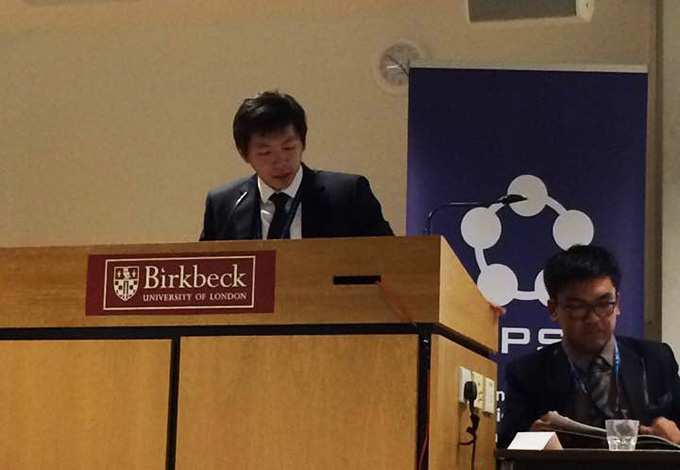
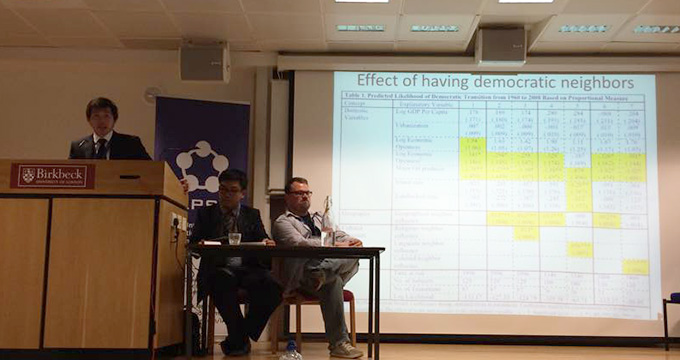
In April this year, David Wong presented his NUS undergraduate thesis — entitled ‘Who is My Neighbour? Cultural Proximity and the Diffusion of Democracy’ — at the International Association for Political Science Students (IAPSS) World Congress 2015.
The IAPSS is a worldwide representation of students in political science and related studies, with 1,200 individual and more than 11,000 collective members from over 95 countries. The IAPSS World Congress is the flagship event for the association and is organised annually in a different city. The programme encompasses lectures and expert panels by leading professors and practitioners, as well as student panels. This year’s congress — themed ‘The Politics of Conflict and Cooperation’ — was attended by over 400 students, with over 100 students presenting their research in London.
In a statement describing their response to David’s paper, judging panel note: “The Committee agreed that the paper demonstrated an exemplary standard of research, analysis and writing skill. David Wong De-Wei’s paper is a sophistically elaborated text of high academic quality. The paper combines qualitative and quantitative analytical approaches in a well structured manner and is a great example of successful methodological triangulation. Strong theoretical anchoring is coupled with confident application of empirical data and results in convincing arguments and research conclusions.”
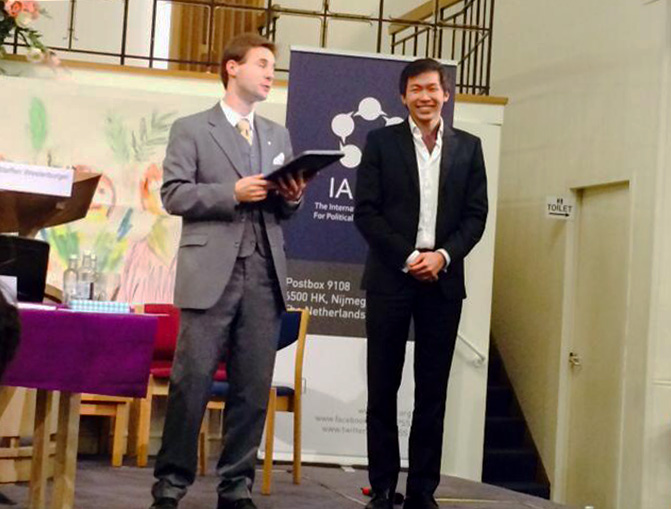
David was awarded the IAPSS Award for Academic Excellency 2015 for the best paper presented.
It was the first time the award was given out.
David is currently reading an MSc in Global Governance and Diplomacy at the University of Oxford. And he has kindly uploaded the paper, and other papers he has worked on, at his Academia.edu page which can be found at https://oxford.academia.edu/DWong
We, at Tembusu College, would like to congratulate David on his wonderful achievement; and we wish him the best in his future endeavours.
1. Mr President, D.P.M Teo Chee Hean, Pro-Chancellors Po’ad Mattar and Ngiam Tong Dow, Mr Wong Ngit Liong, NUS Trustees, Prof Tan Chorh Chuan, Prof Tan Eng Chye, Prof Shen Zuowei, Prof Leo Tan, Prof Peter Ng, Dr Lee Seng Tee, former CJ Dr Yong Pung How, Dr Della Lee, Mr Mok Wei Wei and his team from W Architect, Ms Laura Miotto and Ms Fiona Ng and their team from GSM, Distinguished Guests, Ladies and Gentlemen. I want to tell Wei Wei and his team that they have lived up to our expectations. I want also to tell the designers from GSM that they have done a very good job.
2. This is a very happy occasion. I wish, however, to begin on a slightly sombre note by referring to our founding Prime Minister, Mr Lee Kuan Yew. One lesson we should learn from Mr Lee is to love nature and to aspire to live in harmony in nature. Because of his vision, we have one of the greenest cities in the world and a city which is rich in biodiversity. In recent years, the horn bill bird, the otter and the wild boar, which have been working abroad have returned to our shores.
3. Eleven years ago, in 2004, I was the Chairman of the Natural Heritage Board. After visiting the Raffles Museum of Biodiversity Research, I wrote to the then NUS President, Prof Shih Choon Fong, and requested the University to consider building a natural history museum in order to display its priceless collections of fauna and flora. I am very grateful to President Tan Chorh Chuan and his predecessor, Prof Shih Choon Fong, for responding positively to my proposal. However, the proposal would not have taken off if not for the indefatigable efforts of Professor Leo Tan and Professor Peter Ng. Let us give Leo and Peter and the members of their team a big round of applause.
4. Mr President, Singapore lies at the heart of Southeast Asia. Our region has one of the richest biodiversities in the world. It is only right that Singapore should build Southeast Asia’s first world class museum of natural history.
5. My vision for the museum is that it will attract many visitors, especially students and young people. The museum will share with them its message of loving nature and conserving nature. We should work with the various stakeholders to ensure the survival of the endangered species of fauna and flora of Southeast Asia, including the 5 charismatic animals, namely, the tiger, elephant, rhino, orang utan and the sea turtle. I would also like to ring the alarm bell on another threatened animal, the pangolin. Some misguided people are eating this animal to the brink of extinction. It is, however, just as important to conserve the non-charismatic species, such as Peter’s crabs and my banded-leaf monkey, because all living things are connected to one another in the web of life.
6. The museum will also be a centre of teaching, research and intellectual discourse. My hope is that, one day, this museum will gain the same stature and excellence as the American Museum of Natural History in New York. My children grew up in New York. My wife and I had taken them many times to visit this great Museum. I hope that we will establish links between this museum and other great museums of natural history in the world.
7. We are celebrating this year, the 50th Anniversary of Singapore’s independence. I consider this museum as a gift by NUS to the people of Singapore. It is another jewel in our cultural crown. I wish the museum great success. I also wish Dr Kevin Tan’s interesting book, of Whales and Dinosaurs – The Story of Singapore’s Natural History Museum, great success.
8. Thank you very much.
. . . . . .
Salutations
1. Dr Jeremy Lim, the US Under-Secretary for Public Diplomacy and Public Affairs, Richard Stengel, the US Ambassador to Singapore, Kirk Wagar, fellow Fulbrights, Ladies and Gentlemen.
2. I would like to begin by thanking the United States for sending a distinguished delegation, consisting of former President, Bill Clinton, former Secretary of State, Henry Kissinger, former National Security Adviser, Tom Donilon and former Ambassador to Singapore, Steve Green, to attend the State Funeral of our founding Prime Minister, Lee Kuan Yew.
3. In accordance with my wife’s advice, I will make three points in my response to Richard and Kirk.
In Praise of the Fulbright Program
4. First, I wish to praise the Fulbright Program. In 1963, I was awarded a Fulbright Fellowship and a Harvard Law School Fellowship. I was the first Singaporean to study at Harvard Law School. Last year, on the happy occasion of the 50th anniversary of my graduation, Harvard awarded me the Great Negotiator Award. In 1976, on the occasion of America’s bi-centennial, the Fulbright Program put the names of all the Fulbright scholars into a jackpot. In a lottery, 20 names were picked. I was one of the lucky winners. I was at that time serving as Singapore’s Ambassador to the United Nations. I was sent on an attachment with the Scripps Institute of Oceanography in San Diego. The 20 lucky winners were then brought to Washington, DC, were we met the great man, Senator Fulbright, and brainstormed about the future directions of the Fulbright Program. I told Senator Fulbright that the program had two important benefits for the world. It has enabled thousands of young men and women to gain knowledge from studying at America’s leading universities. Equally importantly, it has enabled the foreign scholars in America, and American scholars in foreign countries, to gain a better understanding of one another’s countries. There is an African saying that knowledge leads to understanding and understanding to respect. We desperately need greater understanding and mutual respect between countries and peoples in this troubled world.
5. Second, I wish to praise America. Mr Lee Kuan Yew was an admirer of the United States which he regarded as a benign superpower. He also regarded the US as a Pacific power. He was an eloquent advocate of the view that as the centre of gravity of the world has shifted from the Atlantic to the Pacific, the United States should give a higher priority in its foreign policy to the Asia Pacific. It is also in Asia’s interests that the United States should continue to play a leading role in the affairs of the region. The US has contributed positively to the peace, prosperity and security of the region. We therefore support President Obama’s pivot to Asia or rebalancing with Asia.
6. Third, as a former Ambassador to the US, I am happy to report that the US-Singapore relationship is in very good shape. It is substantive, comprehensive and mutually beneficial. I was Singapore’s chief negotiator in the negotiations to conclude the US-Singapore Free Trade Agreement. Ten years have passed since the agreement came into force. Trade between our countries is booming. The investment story is truly remarkable. By the end of 2013, US investment in Singapore reached US$154 billion. The US has more investments in Singapore than in any other country in Asia. It is a sign of US confidence in Singapore and recognition of our strong rule of law.
My Three Wishes
7. On that happy note, I shall conclude my remarks with 3 wishes. First, I wish that the US will recover fully from the recession of 2008 and be once again, a strong, prosperous and confident country. Second, I wish that the relations between the US and Asia will remain close, cooperative and collegial. Third, I wish that the excellent relations between the US and Singapore will continue to expand and deepen.
8. Thank you very much.
. . . . . . .
Thank You India
The founding Prime Minister of Singapore, Lee Kuan Yew, passed
away on the 23rd of March 2015. His State Funeral was held on the 29th of March. The Government of India declared the 29th of March as a day of national mourning and the Indian flag was flown at half-mast throughout India. The Prime Minister of India, Sri Narendra Modi, came personally to attend Mr Lee’s funeral.
I am sure that all Singaporeans will join me in thanking the Government and people of India for these extraordinary acts of friendship and solidarity. In this essay, I wish to reflect on the reasons for the very close relationship which exists between India and Singapore.
History and Culture
First, I want to refer to our historical and cultural links. Singapore lies at the heart of Southeast Asia. Historically, Southeast Asia was a sphere of influence of the Indian civilization. Hinduism and Buddhism were exported from India to the region. We see this in the great temples of Angkor Wat. We also see this in the inspiring Buddhist temple in Borobudur and the Hindu temple in Prambanan. There is evidence that Indian traders and seafarers were present in and around Singapore from the 9th century.
India’s influence is present in the lives of contemporary Southeast Asia. Some of our languages are based on Sanskrit or Pali. A former capital of Thailand is named Ayuthia and the present King is also known as Rama IX. The national airline of Indonesia is called Garuda, from the Indian epic, Ramayana. Generations of Javanese have been brought up watching wayang kulit and listening to the stories from Ramayana and Mahabharata. The Indian influence is reflected in the languages we speak, the religions we practise, the food we eat, the clothes we wear and the music we listen to.
Singapore and British India
In the case of Singapore, Raffles brought with him Indian soldiers, traders and workers when he arrived in 1819. Several of the iconic buildings of Singapore, such as, the Istana and the Saint Andrew’s Cathedral, were built by Indian labour. From 1819 to 1867, Singapore was administered by the British from Calcutta (Kolkata). Many of our laws, such as, our Penal Code, the law of evidence, etc. are based on Indian laws. As a result, there are many commonalities between our two legal systems and the public administration. A new Indian Heritage Centre will be opened later this year. It will showcase the historical, cultural and people-to-people links between our two countries.
Gandhi and Nehru
Second, the founding father of India is Mahatma Gandhi. Many Singaporeans admired his moral crusade against the British for the independence of India by non-violent means. They also admired his life-long campaign for amity between the followers of the different religions in India. There is a Gandhi Memorial Hall in Singapore.
Pandit Nehru, the founding Prime Minister of India was another heroic figure for many Singaporeans. The founding Prime Minister of Singapore, Lee Kuan Yew, was an admirer of Nehru and often sought his advice. When Nehru passed away in 1964, Lee Kuan Yew spoke at a condolence service held on 30 May 1964. In November 2011, then PM Manmohan Singh and Singapore’s former PM, Goh Chok Tong, unveiled a marker and bust to honour the memory of Nehru at the Asian Civilizations Museum.
Defence Cooperation
Third, Singapore has close defence cooperation with India. We have bilateral agreements between our two armies and air forces. The strong military ties between the two countries reflect the mutual trust and high comfort level which exist between the leaders of the two countries.
Comprehensive Economic Partnership Agreement
Fourth, in 2005, India and Singapore concluded the Comprehensive Economic Partnership Agreement (CECA). CECA was a milestone for both countries. It represented Singapore’s first agreement with a country in South Asia. It was India’s first agreement with any trade partner and a model for other free trade agreements. Since CECA came into force, the volumes of trade and investment between India and Singapore have continued to grow. Last year, Singapore became India’s largest foreign investor. India’s investment and corporate presence in Singapore have scaled new heights. Tata, Punj Lloyd, Infosys, NatSteel, Voltas, Ramco and Tech Mahindra are some of the leading Indian companies with a major presence in Singapore.
Singapore Companies In India
Fifth, there are over 500 Singapore companies which are operating in India. They are active in the following industries:
· telecommunications (Singtel)
· industrial parks, real estate and urban solutions (Ascendas, Capitaland, Surbana and Jurong Consultants)
· ports (PSA International)
· power generation (Semcorp)
· logistics and distriparks (YCH Logistics and Gateway)
· financial services (DBS)
· civil aviation (SIA and Tata)
· water and waste management (Hyflux)
Confidence in PM Narendra Modi
Sixth, the Singapore Government and private sector have confidence in the leadership of Prime Minister Narendra Modi. This confidence is based on his good track record as the Chief Minister of Gujarat.
The 2015 Union Budget has been well received. It contains a roadmap and is focused on the ease of doing business and radically improving India’s infrastructure.
We share the confidence of our Indian friends that the Indian economy will grow by more than 7 percent this year and by more than 8 percent next year. We intend to participate in the Indian growth story.
Iconic Project In Andra Pradesh
Seventh, we thank the Chief Minister of Andra Pradesh, Chandrababu Naidu, for requesting Singapore in helping to master plan the new capital of his state. This is a once in a life-time opportunity and we are determined to live up to India’s expectations.
Conclusion
In conclusion, I wish to reiterate our thanks to the people and government of India for honouring our founding Prime Minister, Lee Kuan Yew. Our relationship is comprehensive and substantial. Our friendship is anchored in both our heads and our hearts. Singapore is and will always be India’s champion and dependable friend in ASEAN.
Tommy Koh
Ambassador-At-Large
Co-Chairman, ISSD
The worst riots in Singapore happened 161 years ago. They were between Hokkien and Teochew groups and killed 600 people. Such dialect wars seem unthinkable today due to concerted efforts to rein in the tribal instinct. Racial and tribal harmony need vigilance to maintain.
By Tommy Koh For The Straits Times
IN MY last column, "Miracle on Waterloo Street" (Feb 21), I described our religious harmony as one of Singapore's greatest achievements of the past 50 years. In this column, I want to highlight another great achievement: our racial and tribal harmony. I want also to say that they are part of the legacy of our founding Prime Minister Lee Kuan Yew.
Racism and tribalism are two of the world's evils. Discrimination against persons on the basis of their race has ancient roots. It had led to many human tragedies, such as slavery and the Holocaust. Although racial discrimination has been repudiated by the UN Charter, the Universal Declaration of Human Rights and other instruments of international law, it still exists in many parts of the world.
In recent months, in the United States, several unarmed black men and boys had been killed by police officers. The US Justice Department has accused the police in Ferguson, Missouri, of racism.
On the occasion of the 50th anniversary of the Selma civil rights march in Alabama, President Barack Obama observed: "This nation's long racial history still casts its long shadow upon us. We know the march is not yet over, the race is not yet won."
I can't help thinking that some of the Obama haters are racists who reject him because of the colour of his skin and not his policies.
Tribalism is as ancient as racism. Discrimination against persons based on their tribe is practised universally but has a special virulence in Africa. The hatred between the Hutus and Tutsis led to a genocide in Rwanda and Burundi. Kenya was nearly torn apart by the rivalry between the Kikuyus and the Luos.
Worst riots in Singapore's history
I SHALL use the word "tribe" in the Singapore context to refer to the intra-ethnic groups, for example, the Chinese clans.
Relations between the clans are so good today most readers will be shocked to learn the worst riots in Singapore's history were between the Hokkiens and Teochews. They occurred in 1854, lasted 10 days and killed 600 people.
Singapore's population consists of people of many races and tribes. Seventy-six per cent are Chinese. However, the Chinese come from different clans and dialect groups. A further 14 per cent are Malays.
Apart from the orang Melayu, they include the Javanese, Sundanese, Minang, Boyanese, Acehnese, Bataks, Bugis, etc. Seven per cent are Indians. The Indians comprise Tamils, Malayalees, Bengalis, Sikhs, Punjabis, Gujaratis, Sindhis, etc.
The remaining 3 per cent of the population consists of Eurasians, Jews, Arabs, Armenians and many others. The population of Singapore is therefore one of the most diverse in the world.
Maintaining unity and harmony
IN 1965, newly independent Singapore was faced with the enormous challenge of uniting this microcosm of humanity into one nation and maintaining peace and harmony among the different races and tribes.
The prospects were not promising because a year earlier, on July 21, 1964, during the celebration of Prophet Muhammad's birthday, an incident turned into a riot between the Malays and the Chinese.
Twenty-three people were killed and 454 were injured. Later that year, on Sept 2, another riot occurred. This one killed 13 people and injured 106 others. These two racial riots of 1964 were seared into the collective memories of Singaporeans who were determined to prevent their recurrence. What are the most important steps which Singapore has taken to secure racial and tribal harmony?
· Equal protection and nondiscrimination
First, Singapore has used its Constitution and legal system to prohibit racial discrimination and to ensure that all persons are equal before the law and entitled to the equal protection of the law. No one in Singapore has any doubt that the law in the books is the law in practice.
· Presidential Council for Minority Rights
Second, the rights of minorities are protected by the Presidential Council for Minority Rights. The council has the power to scrutinise all proposed legislation in order to ensure that it does not discriminate against the members of any minority.
The council has been criticised for not having issued any adverse report to date. I think we should be pleased because there has been no need for it to do so.
· Ethnic quotas
Third, the State has taken a proactive and interventionist policy on encouraging citizens of different races to live together and not in racial ghettos.
Since 1989, the Housing and Development Board (HDB) has implemented a policy to ensure that the population in each block and each neighbourhood of public housing estates is made up of Chinese, Malays, Indians and others in the same ratios as in the general population.
Since 85 per cent of Singaporeans live in HDB housing, this means that a whole generation of Singaporeans has grown up living next door or in close proximity to neighbours of different races. HDB is therefore not just a developer and landlord. It has also played a significant role in nation-building.
· National service
Fourth, I believe that national service has played a very important role in nation-building. In Singapore, national service is compulsory and universal. All young men have to spend two years in national service. The experience of training and living together with comrades of different races in their platoons, sections and companies is a life-changing experience.
When they complete their training, they not only feel more patriotic but also more bonded as fellow Singaporeans. NS has probably contributed more than any other experience to the rapid evolution of our common identity as Singaporeans and to mutual understanding between Singaporeans of different races.
· Racial Harmony Day
Fifth, the first racial riot of 1964 was on July 21. Each year, students in all our schools celebrate Racial Harmony Day on July 21. We also have formed inter-racial confidence circles and harmony circles to promote inter-racial understanding and reduce mistrust, especially between Malays and non-Malays. Due to these initiatives, Singapore has developed a strong cultural norm in favour of such understanding. This is why the public reacted so strongly to Ms Amy Cheong when she made a pejorative comment about Malay weddings.
· Meritocracy
Sixth, the meritocratic system in Singapore is the best assurance to minorities that they compete with the majority on equal terms. A Malaysian friend once asked me why there were so many Indians in high places in Singapore. My answer was that they were there on merit and it was proof that Singapore is not a racist country.
We live in a troubled world. Racism and tribalism continue to bedevil many countries. We are very fortunate that we have enjoyed 50 years of racial and tribal peace and harmony.
We must treasure this precious achievement.
stopinion@sph.com.sg
The writer is special adviser, Institute of Policy Studies, of the Lee Kuan Yew School of Public Policy at the National University of Singapore.