Salutations
Professor Wang Yizhou, Ambassador Ashok Mirpuri, distinguished members of the Chinese and Singapore delegations to the 10th China-Singapore Forum, professors and students of Peking University, ladies and gentlemen.
A Historic Year
2015 is a historic year. We mark the 70th anniversary of the end of the Second World War and the Pacific War. We celebrate the 70th anniversary of the founding of the United Nations. We also celebrate the 25th Anniversary of the establishment of diplomatic relations between China and Singapore. I led the Singapore delegation to negotiate with a distinguished Chinese delegation led by the then Vice-Minister for Foreign Affairs, Xu Dunxin, on a Memorandum of Understanding to establish formal diplomatic relations. Twenty five years later, relations between our two countries are warm, comprehensive and substantive, anchored on a high degree of mutual trust and confidence. To celebrate this happy occasion, the President of Singapore, Dr Tony Tan Keng Yam, had a very successful State Visit to China in July. We eagerly await the visit of President Xi Jinping to Singapore in November.
Topic of the Forum
The topic of our forum consists of two parts. My colleague, Professor Tan Kong Yam, has focused his remarks on China’s comprehensive reforms. I will focus on the second part: “The building of an inclusive Asian community of shared future”. This topic is taken from the theme of the Boao Forum’s Asia Annual Conference for 2015, which is “Asia’s New Future: Towards a Community of Common Destiny”.
I have read carefully the keynote address delivered by President Xi Jinping at the Boao Forum. President Xi’s key message is that China wishes to work with other Asian countries in order to build a community of common destiny and usher in a new future for Asia.
Honouring Deng Xiaoping
I met President Xi Jinping, when he was serving as China’s Vice-President, in November 2010, in Singapore. I was the Chairman of Singapore’s National Heritage Board. We had put up a marker and a bust to honour Deng Xiaoping, who had visited Singapore twice in his life time. We had invited our founding Prime Minister, Mr Lee Kuan Yew and Vice-President Xi Jinping to be the joint Guests-of-Honour, at the unveiling ceremony. I will always treasure the memory of that occasion. I invite friends from China to visit the marker and the bust of Deng Xiaoping, which is located in front of the Asian Civilizations Museum, on the banks of the Singapore River.
ASEAN’s Vision
Let me now turn to the topic of our forum. ASEAN has been working very hard, for many years, to bring the countries of Asia and the Asia-Pacific, together, both economically and politically. What is our goal? Our goal is to build a region of peace, stability and prosperity.
Economically, ASEAN has taken the initiative in linking our economies to one another and in integrating the region. ASEAN has concluded free trade or comprehensive economic partnership agreements with China, Japan, South Korea, India, Australia, New Zealand, etc. ASEAN is also driving the negotiations for the Regional Comprehensive Economic Partnership Agreement, involving 16 countries. Hopefully with the recent conclusion of the TPP, the RCEP negotiations will pick up speed.
Politically, ASEAN recognises that there is a deficit of trust between and among many of the countries in the region. This is a threat to peace and stability and an obstacle to our goal of building an inclusive Asian community. We have therefore created the ASEAN Regional Forum, ASEAN Plus Three and the East Asia Summit, in order to increase mutual trust and to grow a culture of cooperation for mutual benefit.
ASEAN’s Principles
ASEAN’s vision of building an inclusive Asian community is based upon the following principles:
(i) The sovereign equality of States.
(ii) Non-interference in the internal affairs of States.
(iii) Good neighbourliness.
(iv) Respect for the international Rule of Law.
(v) Disputes should be settled peacefully and in accordance with international law.
(vi) The regional architecture should be open and inclusive.
From Vision to Reality
How to turn our vision to reality? We have to be frank and acknowledge the challenges. For example, there is a deficit of trust between China and the US, and between China and Japan, Vietnam, the Philippines and India. There is also a deficit of trust between Japan and Korea and between India and Pakistan. The status quo is however not immutable. We can change the status quo if we have the political will to do so. It is ASEAN’s mission to replace distrust with trust, suspicion with mutual confidence and discomfort with comfort. I invite China to join ASEAN in this mission.
Thank you.
. . . . . . . .
Salutations
Mr Koh Choon Hui, Prof John Elliot, Mr Alfred Tan, Ms Sue Cheng and Ms Lin Xiaoling from the Children’s Society.
Madam Speaker, Minister Vivian Balakrishnan, Professor Ann Wee, Professor Aline Wong, Professor Leong Wai Kum and Mr Janadas Devan, six of the eight thought leaders whose lectures are contained in the book.
Distinguished guests, ladies and gentlemen.
Thank The Children’s Society
I would like to begin by thanking the Children’s Society for inviting me to launch this important book. In 2007, the Society inaugurated an annual lecture on children. The book contains the text of the first 8 lectures. I have read each of the lectures with admiration and have learned something new from each lecture.
The Society invited me to deliver the sixth lecture in 2012. I declined on the ground that, according to my wife, I am not a good father. She said that I was too liberal and forgiving, had wrongly opposed to her strong belief in corporal punishment and was not sufficiently demanding. I belong to the Kahlil Gibran school of parenting. Since my wife is always right, I accepted her judgement. I therefore persuaded my friend, Professor Leong Wai Kum, our leading authority on family law, to deliver the lecture in my place.
Singapore And USA
My two sons grew up in America. The Children’s Society has asked me to reflect on the biggest difference between the two countries for children. I think the biggest difference is that there is no such thing as private-tuition in America. In fact, I recall that the teachers at the UN International School pleading with my wife not to help our children with their homework. They said that, otherwise, they could not accurately assess the children’s educational progress.
In contrast, 70 percent of parents in Singapore send their children to private tuition. The private tuition industry is a billion dollar industry. This phenomenon is not unique to Singapore. The same situation exists in China, Japan, Korea, Hong Kong and Taiwan, all the so-called Confucianist societies. The explanation is probably to be found in our profound respect for education, our obsession with passing examinations and our belief that education is the passport to success in life.
My wife is very against private tuition. She wants the government to abolish the industry. I have told her that this cannot be done. Having met two of the so-called super-tutors, Anthony Fok and Laura Oh, recently, I can understand why parents send their children to them. Anthony and Laura are not only great teachers but they are also wonderful human beings; warm, caring and inspiring.
Praising The Children’s Society
I would like to praise the Children’s Society which is one of Singapore’s oldest and best managed volunteer welfare organisations (VWOs). In 2014, the Society reached out to a total of 68,000 beneficiaries. About 17,000 were served directly by the Society and the remainder benefitted through public education and targeted programmes.
A Good Place To Be Born In
Singapore is a good place to be born in. We have the lowest infant mortality rate in the world. Children are generally loved and well cared for. There are no street children or homeless children in Singapore. Our schools are good and our students regularly emerge at the top or among the top in PISA tests and ranking. Unlike many other countries, including those in the West, there is no youth unemployment in Singapore.
A Puzzling Contradiction
Singapore seems like a paradise for children. Why does “paradise” still need the Children’s Society and the Straits Times Pocket Money Fund?
We need the Children’s Society because there are vulnerable children who need protection, counselling and help. We have children and youth who have developmental problems. And we certainly have troubled families and dysfunctional families.
ST Pocket Money Fund
The ST Pocket Money Funds is helping about 14,000 students this year. I asked the outgoing chairman of the fund, Mr Han Fook Kwang, for his reflections. He replied as follows:
“Still too many children and their families in households with meager, barely subsistence incomes …… we are helping the bottom 13 per cent. Numbers applying have gone up every year. One worrying trend, the majority are Malay families: many dysfunctional, one parent or absent spouse or without employment, with long-term illnesses, etc. No easy solutions”.
Mr Han’s final comment is this:
“The number of children needing support is huge and I am not sure even with more VWOs involved we’re making a big enough impact”.
I think we should reflect on Mr Han’s sober words.
Thank you.
. . . . . . . .
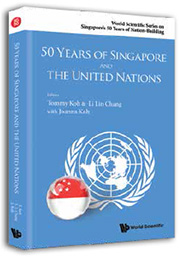
Prof Koh would dearly like to invite the Tembusu community to the launch of his new co-edited collection, 50 Years of Singapore & the United Nations, on Friday, 30 October 2015. Due to limited seating capacity, registration is required at the following link:
50 YEARS OF SINGAPORE AND THE UNITED NATIONS World Scientific Series on Singapore’s 50 Years of Nation-Building | |||||||||||||||||||||||||
|  | ||||||||||||||||||||||||
Dress code: Business attire Please contact Cynthia Lye for more information Photographs, videos and other recordings, as well as information from name cards or forms collected at this function may be respectively used for newsletters or marketing purposes. | |||||||||||||||||||||||||
Salutations
1. Judge of Appeal, Chao Hick Tin, The Attorney-General, Mr V K Rajah, Justices Vinodh Coomaraswamy and Lee Seiu Kin, Judicial Commissioners Valerie Thiam, Debbie Ong and Hoo Sheau Peng, Michael Hwang, Mr Pang Khang Chau, Prof Locknie Hsu, Mr Thio Shen Yi, President of the Singapore Law Society, Mr Lok Vi-Ming, fellow lawyers, ladies and gentlemen.
Thank You
2. I wish to begin by thanking the Law Society for inviting me to deliver the Biennial Lecture for 2015. When Mr Lok first invited me, I declined the invitation on the ground that I am not qualified to speak to the legal profession. Although I was admitted to the Bar and joined the Law Society in 1962, 53 years ago, my career has been spent in legal education and in diplomacy. Mr Lok is a very persuasive man and would not take no for an answer.
A Small State In A Dangerous World
3. Singapore has existed as a sovereign and independent state for 50 years. Small States cannot take their security and existence for granted. History is replete with examples of small states which had fallen victim to the aggression of their bigger neighbours. Some small States have disappeared. Others have been dismembered. Historically, the world had always been a dangerous place for small States.
The UN And The Rule Of Law
4. Following the Second World War, the United Nations was created to usher in a different world, a world based on the Rule of Law and on collective security. The Security Council lies at the heart of the UN. Decisions of the council require a majority of nine votes out of fifteen. However, each of the five permanent members of the council has a veto and can block a decision of the council. This is the fatal but necessary flaw of the UN collective security system. Without the veto, the US and the Soviet Union would have refused to join the UN.
5. Because of the veto, the Security Council is powerless to act against Russia when she invaded Ukraine and incorporated Crimea into the Russian Federation. Because of the veto, the Security Council is unable to act in the disastrous civil war in Syria, which has already generated millions of refugees and is destroying the country.
6. The bottom-line is this. Although the UN cannot guarantee the security of small states, it has helped to create a world which is less dangerous for small states than the pre-1945 world. The UN General Assembly is like the parliament of the world. There is no veto in the Assembly. Small States can hold big States to account in the Assembly. However, unlike the Security Council, the Assembly’s decisions are not binding.
Singapore’s Foreign Policy
7. Singaporeans are a realistic people. We have no illusions about the world. We believe that we must be strong, economically and militarily so that we cannot be bullied or intimidated by bigger countries. I would call this the first principle of our foreign policy.
Lee Kuan Yew’s Seminal Influence
8. Our founding Prime Minister, Mr Lee Kuan Yew, was a lawyer by training. I am sure that this had influenced his worldview. He believed that small countries are better off in a world governed by the Rule of Law than one governed by the rule that might is right. He insisted that Singapore should always abide by international law.
9. In his foreword for a book on the Pedra Branca case, co-written by Prof S Jayakumar and me, Mr Lee wrote:-
“Singapore must remain committed to upholding the rule of law in relations between states. If a dispute cannot be resolved by negotiation, it is better to refer it to a third party dispute settlement mechanism, than to allow it to fester and sour bilateral relations. This was my approach and subsequent Singapore Prime Ministers have continued to subscribe to it.”
Puzzle Explained
10. Mr Lee Kuan Yew’s attachment to international law was a puzzle to many political scientists. They regarded him as a Realist. Dr Henry Kissinger once said that Mr Lee had a “cold-blooded” attitude towards the realities of international politics. How could a Realist attach so much weight to international law? The answer is that Mr Lee was not an ideologue but a pragmatist. He would have approved of Mr Deng Xiaoping’s famous saying that it does not matter whether the cat is black or white as long as it catches mice. Pragmatism is the Tao of Singapore.
The Sword and the Shield
11. My thesis this morning is that Singapore has no illusions about the nature of the world we live in We know that the International Rule of Law is weak and cannot deter an aggressive big power, such as, Russia, from using its superior military force to secure its strategic objectives. We acknowledge that, at the end of the day, Singapore must look to the SAF to defend it against any external threat.
12. Our belief in international law is therefore not based on blind faith. We accept the reality that when there is a collision between law and military power, the latter usually prevails. At least, in the short term. There is therefore a limit to the efficacy of international law.
13. Within those limits, Singapore has sought to use international law as a sword to advance our aggressive interests and as a shield to protect our defensive interests. Let me now turn to discuss the case law. Let me begin with the two Water Agreements and the Separation Agreement.
Water Agreements and Separation Agreements
14. Singapore used to be critically dependent on Malaysia for water. For this reason, the two Water Agreements which Singapore had concluded with Johor, in 1961 and 1962, were of the greatest importance. Johor was and is a constituent state of Malaysia. It did not and does not have the legal status to enter into an international treaty. The dilemma for Singapore was how to elevate those agreements to the status of an international treaty, so that the federal government of Malaysia would be bound by it.
15. The solution was to insert a so-called “water clause” in the Independence of Singapore Agreement. Article IV of the Separation Agreement required the Government of Malaysia to enact legislation in the form set out in Annex B of the Agreement. This took the form of the Constitution and Malaysia (Singapore Amendment) Act. Section 14 of the Act states:
“The Government of Malaysia shall guarantee that the Government of the State of Johore will on and after Singapore Day also abide by the terms and conditions of the said two Water Agreements”.
16. Singapore registered the Independence of Singapore Agreement with the United Nations as international treaty. This is an excellent example of how Singapore was able to use international law to protect a vital interest. I should add that today, Singapore is less dependent on Malaysian water for its survival. It has therefore allowed the 1961 Water Agreement to expire in 2011.
Trade Dispute With Malaysia
17. On 7 April, 1994, Malaysia imposed an import prohibition order on two types of petrochemicals, Poly-Ethylene (PE) and Poly-Propylene (PP) which are resins used to make products like plastic bags, moulded plastic containers and plastic pipes. A Malaysian importer of these products had to apply to the Ministry of Trade and Industry (MTI) for an Approved Permit. MTI’s policy was that only those petrochemical products not produced or available in Malaysia would be granted an Approved Permit.
18. The Malaysian measure was intended to protect a Malaysian company against competition from Singapore. Malaysia’s measure was a quantitative restriction on imports. Singapore felt that Malaysia had acted in contravention of her commitments under the General Agreement on Tariffs and Trade (GATT) and the World Trade Organisation (WTO).
19. Singapore tried to resolve the dispute with Malaysia through consultations and negotiations. When they proved to be fruitless, Singapore decided to invoke the newly established dispute settlement mechanism under the WTO. On 19 January 1995, Singapore formally requested for consultations with Malaysia. The two sides met on 13-14 February and 8-9 March but the consultations were unsuccessful. On 16 March, Singapore wrote to the Chairman of the Dispute Settlement Body (DSB) to request for the establishment of a panel to consider the dispute.
20. The two sides met again on 29 March with the DSB. Singapore reiterated its request for the establishment of a panel to consider the dispute. Following the meeting, Malaysia informed the DSB that it was modifying its measure and that import licences for PE and PP would be issued freely to all bona fide importers. On 19 July 1995, at a meeting of the DSB, Singapore announced that it was withdrawing its complaint against Malaysia under the WTO Dispute Settlement Procedures.
21. The moral of the story is that Singapore’s reliance on GATT and WTO law and its invocation of the compulsory dispute settlement procedures had persuaded Malaysia to rescind its protectionist trade measure.
Dispute With Indonesia Over The Dumping of Waste
22. On 29 July 2004, a Singapore company exported to Batam a consignment of compost which was intended to be used as a soil conditioner and fertilizer. Indonesia alleged that the organic material contained heavy metals and was classified as hazardous waste under Indonesian law. Singapore does not regard the material as a hazardous waste under Singapore’s law.
23. On 29 July 2004, Indonesia notified the Secretariat of the Basle Convention on the Control of Transboundary Movements of Hazardous Wastes and their Disposal (hereinafter referred to as the Basle Convention), based in Geneva, that it regarded the material to be a hazardous waste. On 17 August, the Secretariat transmitted Indonesia’s notification, to all States Parties, including Singapore. Singapore received the notification on 27 August 2004.
24. Singapore replied to Indonesia that the material exported to Batam was not a hazardous waste and Singapore had not contravened the Basle Convention. Indonesia insisted that Singapore should take the material back to Singapore. When Singapore refused, Indonesia threatened to do so unilaterally. This raised unnecessary tension and a group of demonstrators attacked the Singapore Embassy in Jakarta. To defuse the tension, the two Foreign Ministers, George Yeo and Hasan Wirajuda met in Jakarta. They agreed that both sides should seek an amicable and mutually acceptable solution under the framework of the Basle Convention.
25. The Secretariat of the Basle Convention invited the two parties to meet in Geneva. It also offered to recommend an independent expert to visit Batam and Singapore and to carry out an investigation. This was accepted by the two sides. The expert found that the material was not a hazardous waste and that Singapore had not contravened the Basle Convention. Having cleared its name, Singapore generously offered to take the material back to Singapore from Batam. This was the amicable agreement reached by the two sides when they met in Geneva on the 10 and 11 of May 2005.
26. What is the moral of this story? It is that we should abide scrupulously by international law, on the one hand, and, on the other, defend Singapore’s good reputation and its legal rights. The second lesson is to give face to our neighbours. This is why we agreed to take back the compost even though we were not legally obliged to do so.
The Land Reclamation Case
27. Singapore is a very small island. We have no choice but to reclaim land from the sea. This has been going on since the nineteenth century. This is why there is no beach on Beach Road. This also explains why the Thian Hock Keng Temple, on Telok Ayer Street, whose deity is Mazu, the guardian of seafarers, is located so far from the sea. When the temple was built it was by the sea.
28. Singapore has been undertaking two massive land reclamation projects in Pulau Tekong, in the east, and Tuas, in the west. The former Prime Minister of Malaysia, Dr Mahathir Mohamed, objected to Singapore’s land reclamation projects.
29. On the 28 of January 2002, Malaysia sent a diplomatic note to our High Commission in Kuala Lumpur, alleging that our land reclamation activities in Tuas had encroached into Malaysia’s territorial waters. In April 2002, Malaysia complained that the reclamation works in Pulau Tekong and Pulau Ubin had caused transboundary environmental harm to Malaysia’s waters.
30. Singapore asked Malaysia, on several occasions, for particulars of its allegations so that they could be looked into. Malaysia never responded to those requests. Instead, on 4 July 2003, Malaysia informed Singapore that it was unilaterally referring the dispute to arbitration under the UN Convention on the Law of the Sea. The diplomatic note was accompanied by a statement of claim and four technical reports.
31. It was at this point that the Singapore Government appointed me as its Agent. I should explain that, unlike other treaties, the UN Convention on the Law of the Sea has a compulsory dispute settlement system. States Parties may choose arbitration, the International Court of Justice or the International Tribunal For The Law Of The Sea, as its preferred modality. As neither Malaysia nor Singapore had expressed a preference, they are deemed to have accepted arbitration.
32. The Arbitral Tribunal would consist of 5 members. Malaysia appointed Dr Kamal Hossain of Bangladesh as its arbitrator. Singapore appointed Professor Bernard Oxman of the US. The two sides, in consultation with the President of ITLOS, chose three other arbitrators.
33. Malaysia also asked for 4 provisional measures, the most important of which was for Singapore to stop all reclamation activities until the Arbitral Tribunal had decided on the case.
34. In Singapore’s reply to Malaysia, we pointed out that the UN Convention required the parties to negotiate before referring their dispute to arbitration. The two parties met in Singapore on 13-14 August 2003. The meeting had gone well and the two sides had agreed to hold a second meeting. However, on 5 September 2003, Malaysia applied to ITLOS for provisional measures against Singapore.
35. Singapore had 15 days to submit its written response. The oral proceedings took place at the tribunal, in Hamburg, from 25 September to 27 September 2003. In my final submission to the tribunal, I pointed out that the fundamental conflict between the parties was not on the law but on the facts. In view of this, I proposed to the tribunal that it should consider ordering the two parties to jointly sponsor and fund a scientific study by independent experts, to verify the facts.
36. The tribunal’s judgement was delivered on 8 October 2003. It did not accede to Malaysia’s request to order Singapore to stop its land reclamation works at Tekong and Tuas. Instead, the tribunal prescribed that Malaysia and Singapore cooperate and establish a group of independent experts to conduct a joint study.
37. Singapore appointed two Dutch experts and Malaysia appointed two Welsh experts. Together, the four experts spent a year investigating the facts. They submitted an unanimous report to the two Governments on 5 November 2004.
38. The report largely exonerated Singapore. It did, however, require Singapore to modify the contour of the reclamation in Tekong, compensate Malaysia for the damage sustained by two of its jetties in the Straits of Johor and to pay some compensation to Johor fishermen for the reduction in their catch and increase in their expenditure for fuel. Singapore complied with all the recommendations.
39. On the basis of the facts established by the experts, the two delegations returned to the negotiating table. After two rounds of negotiations, they arrived at an amicable settlement. The agreement was signed at the Ministry of Foreign Affairs in Singapore, on 26 April 2005. The two parties requested the Arbitral Tribunal to adopt the text of the settlement agreement as the award of the tribunal. If you would like to know more about this case, may I refer you to the book which I have co-written with Dr Cheong Koon Hean, the CEO of HDB and Lionel Yee, the Solicitor-General. The book is entitled, Malaysia and Singapore: The Land Reclamation Case, From Dispute to Settlement.
The Pedra Branca Case
40. The Pedra Branca case is quite well known and I will not dwell at length with it. For those of you who would like to know about the case, I would recommend the book which Professor S Jayakumar and I have co-written, entitle Pedra Branca: The Road to the World Court.
41. The dispute between Malaysia and Singapore is a dispute about sovereignty over territory. Both Malaysia and Singapore claim sovereignty over Pedra Branca, Middle Rocks and South Ledge. The British had built a lighthouse, called the Horsburgh Lighthouse, in 1851. From 1851 until 1979, no one had questioned the sovereignty of the British and, subsequently, Singapore over these maritime features. In 1979, Malaysia published a new map which, inter alia, claimed for the first time that the island, rocks and lowtide elevation belonged to Malaysia.
42. Singapore did not behave as other countries do when they are in possession of disputed territory. For example, Japan denies that it has a dispute with China over Senkaku/Diaoyu. For example, South Korea denies that it has a dispute with Japan over Dokdo/Takeshima. In the case of Pedra Branca, Singapore was not only willing to acknowledge Malaysia’s claim as constituting a dispute but it also suggested that the two countries refer the dispute to the International Court of Justice.
43. Professor Jayakumar and I were involved in the case from 1979 until 23 May 2008, when the International Court of Justice delivered its judgement in the case. I was the Agent of Singapore and Professor Jayakumar was the Foreign Minister. We were, of course, relieved that the ICJ had ruled in favour of Singapore on Pedra Branca but, rather disappointed that the Court had ruled in favour of Malaysia, in the case of Middle Rocks.
44. The Governments of Malaysia and Singapore have accepted the judgement of the court. Pedra Branca is no longer a divisive issue in our bilateral relations. This is the justification for Singapore’s generosity in being willing to acknowledge that it has a dispute with Malaysia and for being willing to take the risk of losing the case in the I.C.J.
Conclusion
45. I shall bring my lecture to a conclusion. I have 3 key messages. First, Singapore must be strong economically and militarily in order to be able to defend its independence and territorial integrity. Second, we should work assiduously to strengthen the International Rule of Law because we want to live in a world which is ruled by law rather than by force. Third, where appropriate, we will use international law as our shield to defend our interests and as our sword to advance our interests. In order to do this successfully, we need good international lawyers, in the government, private sector and academia. This is why we have established the Centre for International Law at NUS.
46. Thank you very much.
. . . . . . . .
Salutations
Minister Josephine Teo, Mr Andrew Tan, distinguished colleagues from Indonesia and Malaysia, Ladies and Gentlemen.
I would like to begin by thanking the Maritime and Port Authority of Singapore for inviting me to share a few thoughts with you this morning. I was the President of the Third UN Conference on the Law of the Sea, during the final two years, 1981 and 1982. In September 2007, I was invited by IMO and the Government of Singapore to chair a meeting in Singapore which adopted the cooperative mechanism for the Straits of Malacca and Singapore. This occasion therefore brings back many happy memories for me.
My Three Points
I would like to do 3 things this morning. First, I would like to share with you some insights into the negotiating history of Part III of the 1982 UN Convention on the Law of the Sea, on Straits Used for International Navigation. Second, I would like to briefly recapitulate the consultations and negotiations which led to the breakthrough in 2007. Third, I would like to conclude by reviewing the progress which we have achieved in the past eight years and to look to the future.
Straits Used For International Navigation
International law used to recognise 3 miles as the breadth of the Territorial Sea. This consensus began to break down after World War II. At the 3rd UN Conference on the Law of the Sea, the coastal States demanded that the territorial sea breadth should be expanded from 3 to 12 miles. There are many important straits in the world which serve as vital shipping lanes. 116 of them are narrower than 24 miles in breadth. When the Territorial Sea was 3 miles, there was a high seas corridor in those Straits. Those corridors would disappear if the Territorial Sea were expanded to 12 miles. With the disappearance of the high seas corridor, the regime of passage for ships and aircraft would be reduced to that of innocent passage. The 2 superpowers and other major maritime powers could not accept such an outcome.
To break the impasse, it was agreed that there would be a special regime for ships going through, and aircraft flying over, straits used for international navigation. It was also agreed to call this special regime, Transit Passage.
Transit Passage is neither Innocent Passage nor High Seas Freedom of navigation and overflight. It is a new concept in international law. Transit Passage recognises, on the one hand, the sovereignty and territorial integrity of the coastal States, and, on the other hand, the rights and interests of the international community. A ship or aircraft has to proceed without delay through or over the strait. The coastal State may not impede the passage of the ship or aircraft.
The sovereignty and jurisdiction of the coastal State is exercised subject to Part III of the Convention and other rules of international law. My interpretation of the Convention is that a coastal State may not, for example, impose compulsory pilotage on or demand tolls from, ships in transit passage.
Although many years have passed since the Convention was adopted in 1982, it continues to serve the international community very well. We should therefore be faithful to the letter and spirit of the convention and continue to honour the carefully balanced compromises which were agreed upon and embodied in the convention. I regret to say that, in recent years, some States have acted in ways which are not consistent with the convention. If disputes arise over the interpretation and application of the convention, which is bound to happen, I hope that State Parties to the Convention will refer such disputes to the International Tribunal For The Law of the Sea, which was established for this purpose, or other fora. Disputes should be resolved peacefully and in accordance with international law, including the UN Convention on the Law of the Sea.
Article 43 of the Convention
During the conference, we realised that we must find a way to encourage user States to assist the straits States in ensuring the safety of navigation and protecting the marine environment in the straits. This is only fair since the user States benefit from the use of the straits. The straits States have to install and maintain aids to navigation, undertake hydrographical surveys and dredging, if necessary, and prepare themselves to prevent and combat pollution from ships.
The text of Article 43 is a compromise text. User States and straits States are exhorted to agree to cooperate. Article 43 can only be implemented if there is an agreement between the straits States and the user States. Agreement to cooperate is consensual and not mandatory.
What would they agree to cooperate on? First, on “the establishment and maintenance in a strait of necessary navigational and safety aids or other improvements in aid of international navigation”. Second, “for the prevention, reduction and control of pollution from ships”.
The UN Convention on the Law of the Sea came into force in 1994. Two years later, in 1996, as the director of a Singapore think-tank, the Institute of Policy Studies, I co-convened with the I.M.O., a conference on Navigational Safety and the Control of Pollution in the Straits of Malacca and Singapore: Modalities of International Cooperation. In 1999, I co-convened another Conference with the IMO, on “Towards Implementation of Article 43 of the Law of the Sea Convention for the Straits of Malacca and Singapore.” The Secretary-General of the IMO, at that time, was William O’Neill. We served as the co-chairmen of the two conferences.
Although a lot of progress was made at the two conferences, the political will on the part of the three straits States, especially one of them, to implement Article 43 was still deficient. During all this time, the only user State which had been helping the straits States was Japan. It had contributed over US$100 million to this effort. However, by 2004, Japan had indicated that it could no longer bear this burden alone. This point was noted by the straits States.
The next development was an initiative taken by the IMO, in 2004, on the protection of vital shipping lanes. The sixth Secretary-General of the IMO, Admiral EE Mitropoulos, pursued this initiative with great energy and imagination. He chose the Straits of Malacca and Singapore as his No. 1 priority. He managed to persuade Indonesia to host a meeting, in September 2005, involving the straits States, user States and other stakeholders on how to enhance the safety of navigation, environmental protection and overall security of the straits.
In anticipation of the Jakarta meeting, the Foreign Ministers of Indonesia, Malaysia and Singapore held a critical meeting in Batam. The Batam Statement issued by the three Ministers reaffirmed that the straits States have sovereignty and sovereign rights in the Straits and have the primary responsibility for the safety of navigation, environmental protection and maritime security in the straits. At the same time, the Statement acknowledges the interests of user States and relevant international organizations and the role they could play in respect of the straits. It also states that any cooperative measures taken in the straits must be in conformity with international law, including the UN Convention on the Law of the Sea.
With the Batam Statement as the compass, the Jakarta meeting had a positive outcome. This was followed by another IMO meeting in Kuala Lumpur in September 2006. It was in Kuala Lumpur that the three straits States and the user States agreed to launch a cooperative mechanism. Although the parties had agreed to marry in Kuala Lumpur, the wedding took place a year later, in Singapore, in September 2007. I had the pleasure of officiating at the wedding. I described the nuptial agreement as a historic breakthrough.
To date, the Straits of Malacca and Singapore are the only straits which has implemented Article 43 of the Convention. What lessons can the world learn from us? I suggest the following 5 lessons:
(i) The 3 straits States have been able to work closely together, since the 1970s, through the Tripartite Technical Experts Group;
(ii) The 3 straits States are committed to upholding and applying the relevant international law, including the UN Convention on the Law of the Sea;
(iii) The 3 straits States share a worldview that the cooperative mechanism should be open and inclusive, one which acknowledges the legitimate interests of the user States, while upholding the sovereignty and territorial integrity of the straits States;
(iv) IMO played an indispensable role as facilitator and convenor; and
(v) There is a convergence of interests between the straits States and the user States, in enhancing the navigational safety and environmental protection of the straits.
CONCLUSION
Eight years have passed since that historic meeting in 2007. We can look back on the past 8 years with enormous satisfaction. The Cooperation Mechanism has worked well and is a success story. Under it, we have the Cooperation Forum, the Project Coordination Committee and the Aids to Navigation Fund.
The Aids to Navigation Fund has received over US$20 million in contributions. Five of the ten projects approved by the Project Coordination Committee have been completed. The Cooperation Forum is very well attended by the straits States, user States, the shipping industry, the IMO and other stakeholders. I am gratified that the IMO continues to play a central role in the process.
I continue to hope that other straits will emulate our good example and agree on similar cooperation mechanisms with the user States. Our achievement is a triumph for the international community in implementing the Rule of Law through International Cooperation.
. . . . . . .