On 10 November 2013, students from Tembusu College as well as artists-in-residence Catherine Young and Michael Zick Doherty held an exhibition called Sunday Showcase in the ArtScience Museum at Marina Bay Sands.
Both Young and Doherty were in Singapore for four months as part of the 2013 Art/Science Residency Programme. The programme was a partnership between the ArtScience Museum, the National University of Singapore (NUS) Arts & Creativity Laboratory, Tembusu College, and the Singapore-ETH Centre’s Future Cities Laboratory.
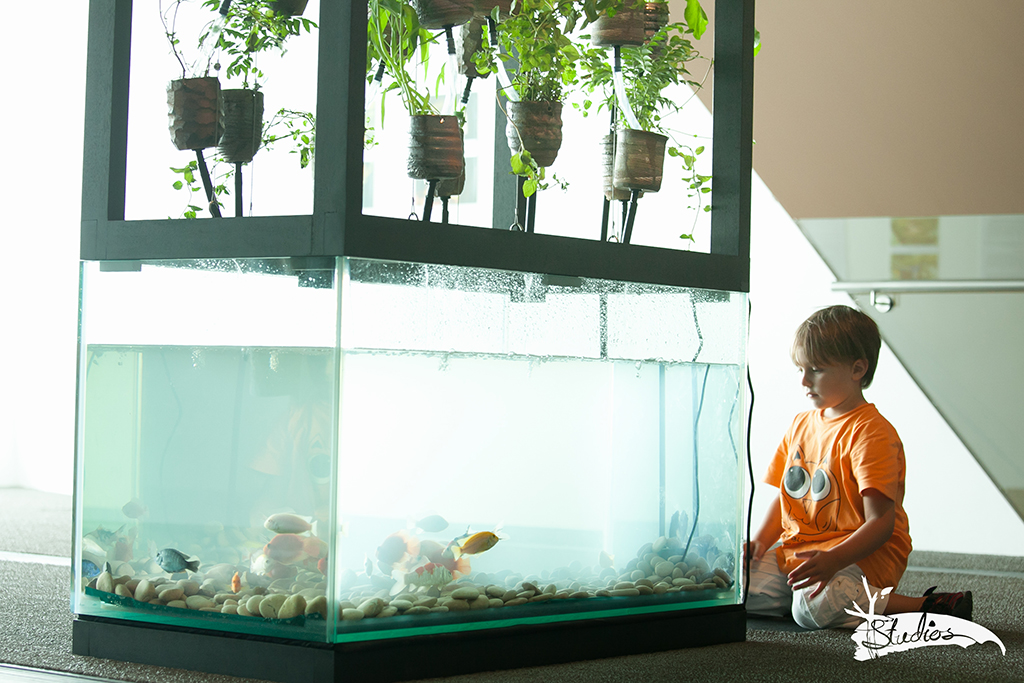
Urban Food Growing Lab
Doherty presented his Urban Food Growing Lab, an aquaponics system that attempts to capture the aesthetics and culture of Singapore through his collaboration with the residents of the Thow Kwang pottery jungle. According to Doherty, the primary goal of the project is to reconnect the community with the process of growing food by providing growing systems that can be implemented in virtually any space.
A time-lapse video of Doherty’s exhibition can be found at https://www.youtube.com/watch?v=1rQCyC6Vhlg]
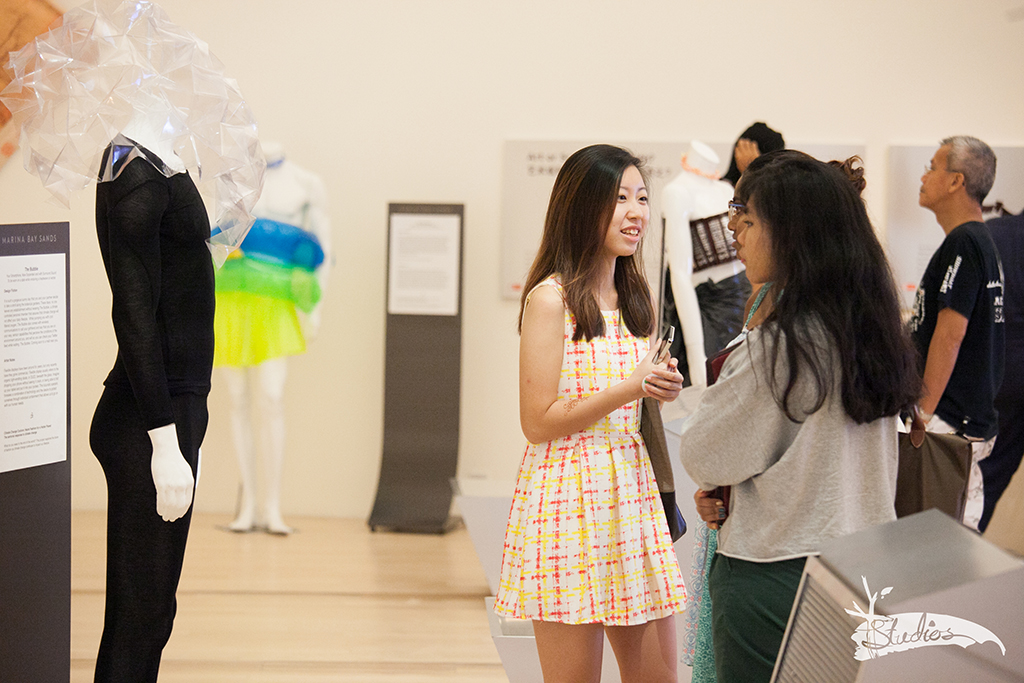
The Apocalypse Project
Young’s The Apocalypse Project is a speculative design research inquiry, exploring our possible lifestyles in a future affected by continued climate change. It comprises three projects that explore different aspects of the topic – Climate Change Couture: Haute Fashion for a Hotter Planet, Planet Earth vs. Humanity: The Court Trial, and The Apocalypse Workshop. More information on her work can be found at her website http://apocalypse.cc/.
A time-lapse video of Young’s exhibition can be found at https://www.youtube.com/watch?v=-IsWFSsthiI
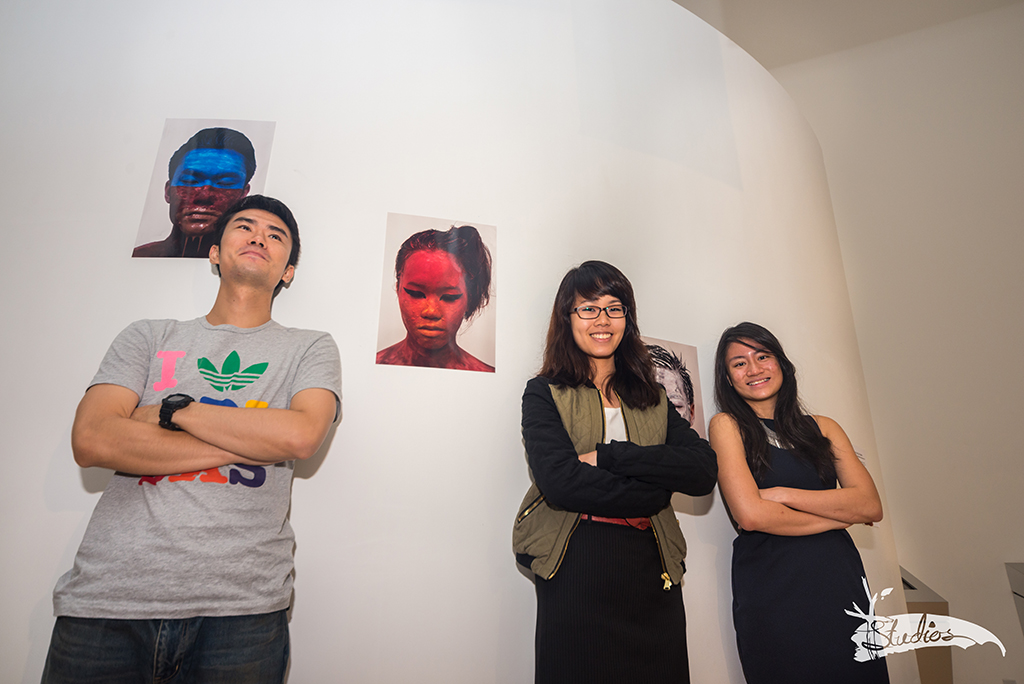
The Face of Earth, a Climate Change exhibition
Students’ works were selected from Tembusu College’s two Senior Seminars: Climate Change and Singapore as ‘Model’ City?
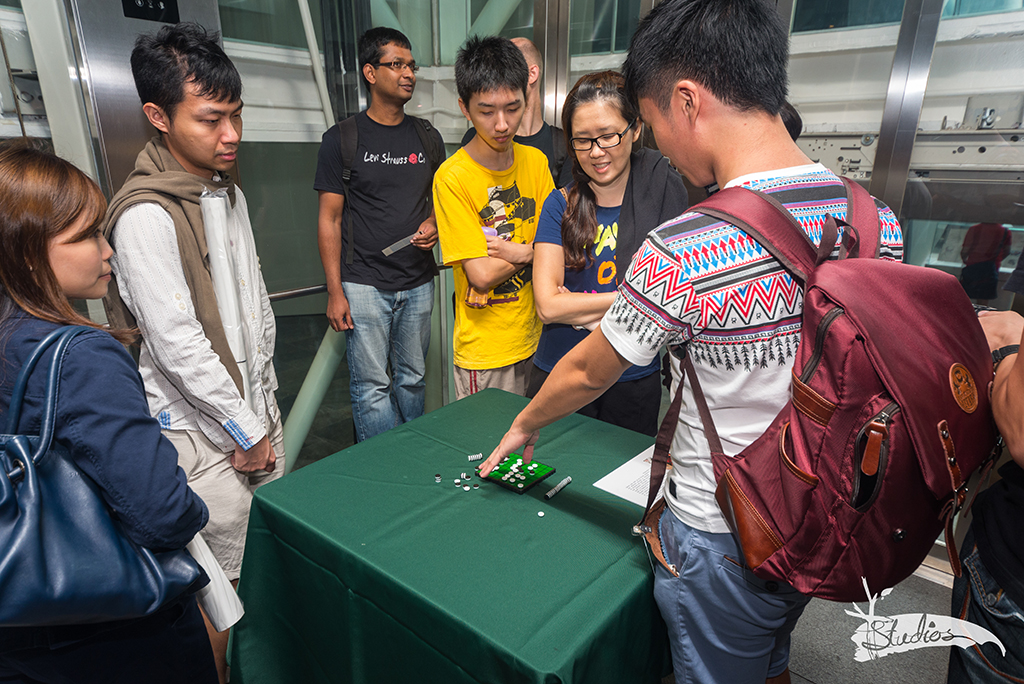
Elevated Ideas, a Model City exhibition
HopScotch!
Projects from the Climate Change Senior Seminar involved imaginative, hand-built models meant to provoke a critical reflection on the many possibilities climate change may bring around the world. The module prompts students to rethink climate change not just as an environmental issue, but through an interdisciplinary lens involving sociological, technological, philosophical, poetical, and historical lines of inquiry, among others.
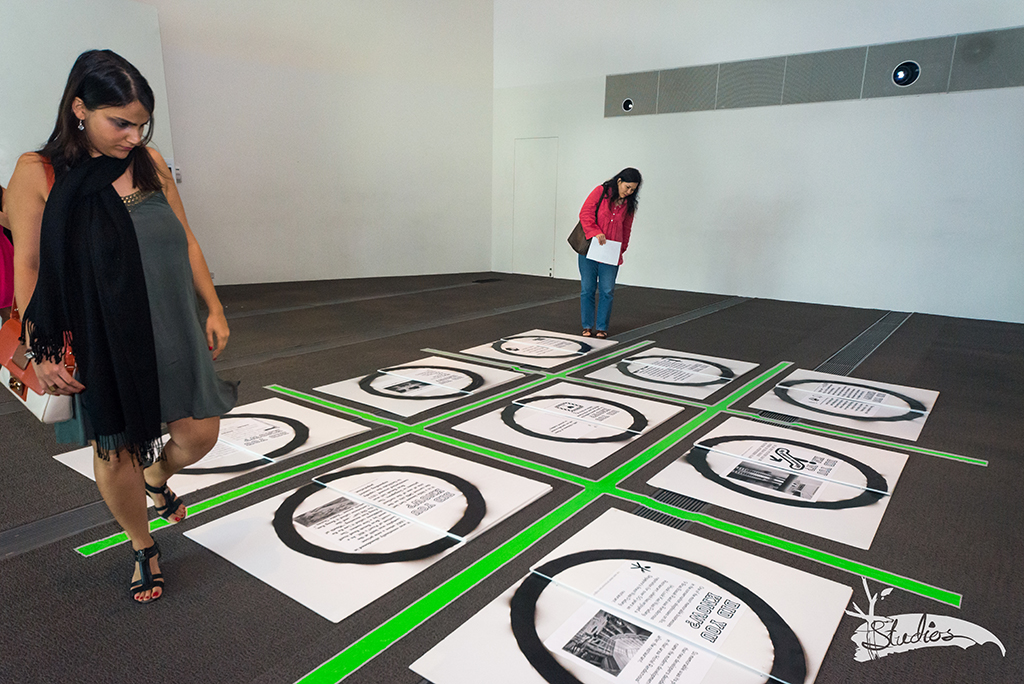
Tic Tac Toe
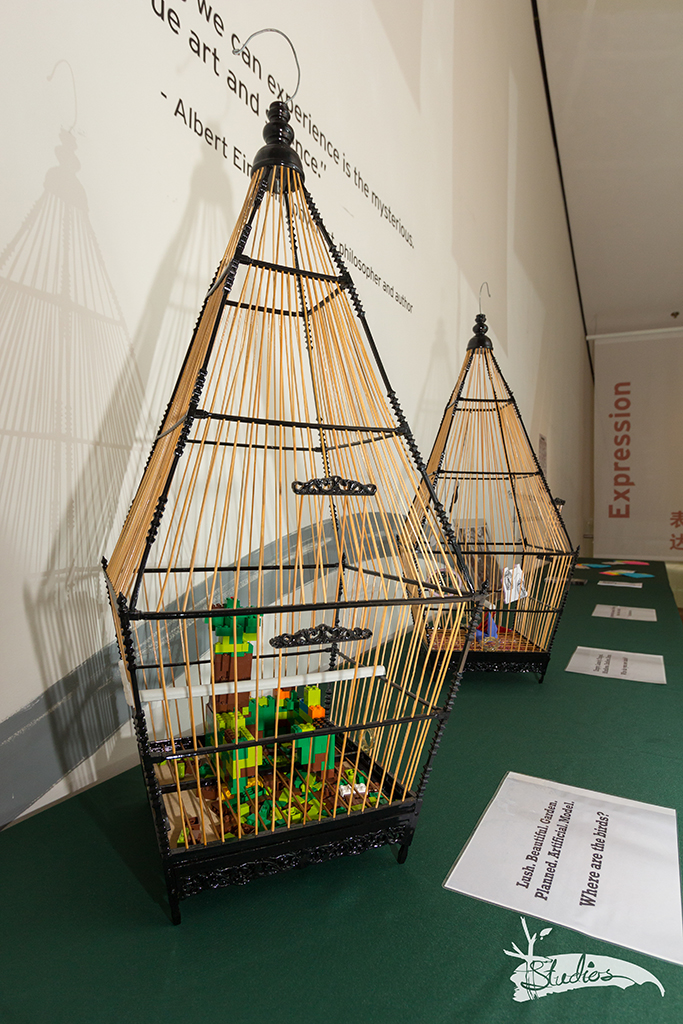
Singapore: Model City or Model Cage?
The Singapore as ‘Model’ City? Senior Seminar produced urban intervention projects that engaged with research conducted by Future Cities Laboratory Module X on the interrelation between density, public space and the quality of life in HDB precincts. The works were inspired by the interplay between fine art, architecture, performance, installation, street art, activism and urbanism. Fundamentally, they were grounded in the understanding that the city’s façade is not a permanent fact, but a work in progress.
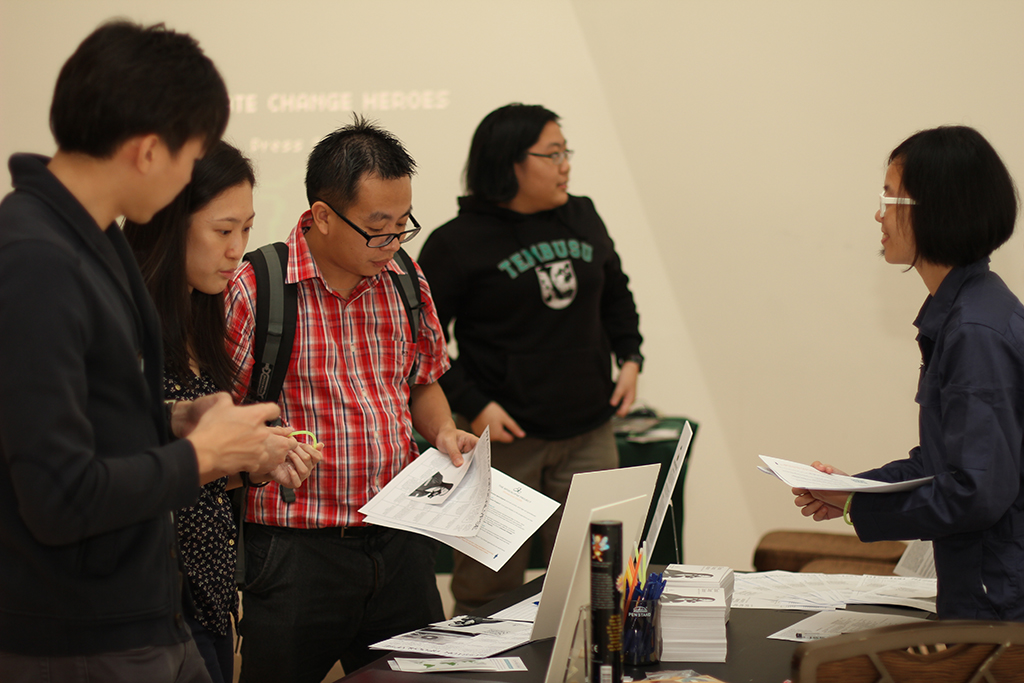
Visitors getting to know more about the projects

Doherty engages visitors on his work
There were a total of nine works presented at the exhibition, which saw over a hundred visitors that busy Sunday.
One of the projects, a video game entitled Climate Change Heroes!, was featured in the thematic magazine One Imperative and can be found here: http://www.oneimperative.com/2013/12/11-replay/.
By Salima Nadira
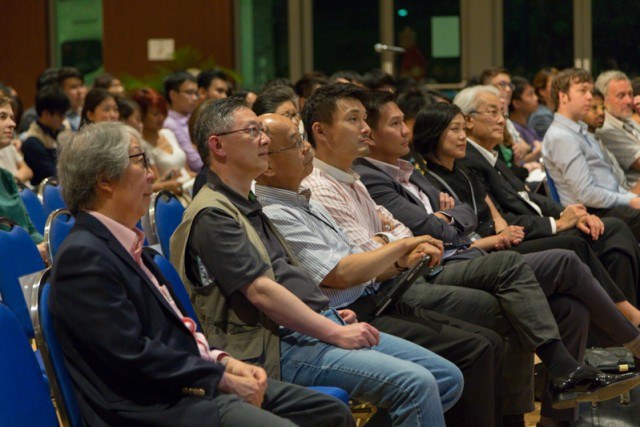
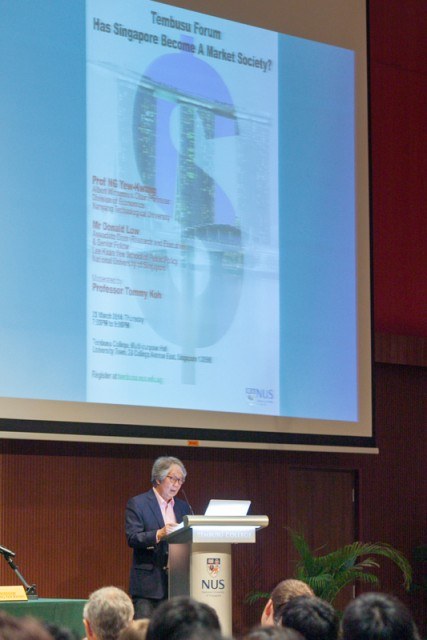
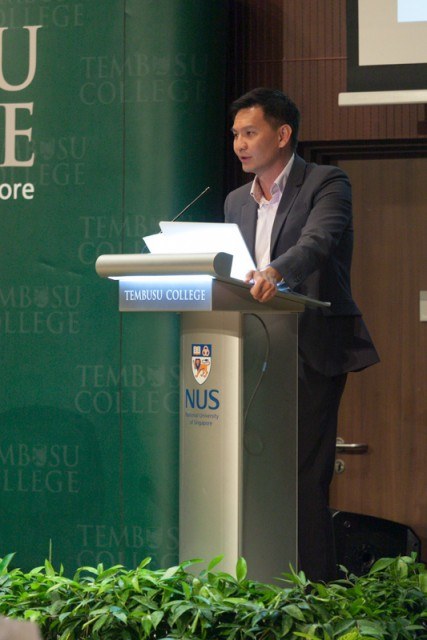
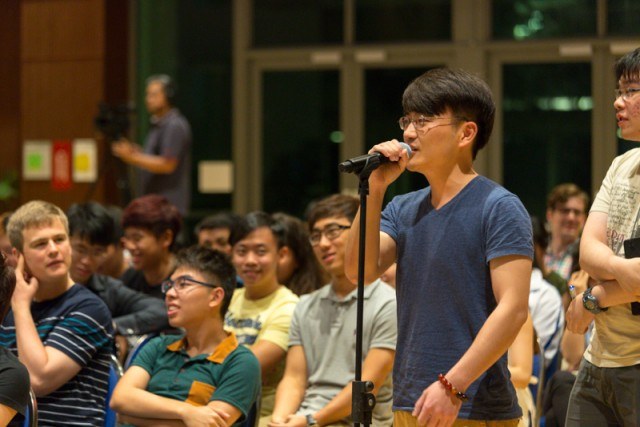
Several Tembusians stepped up to the microphone and asked critical and insightful questions at the last Tembusu Forum on 20 Feb.
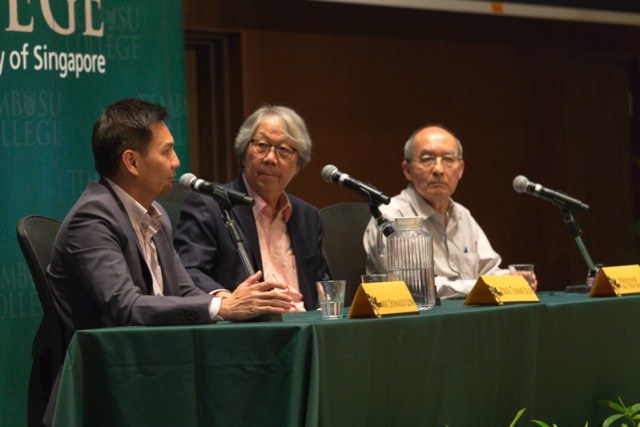
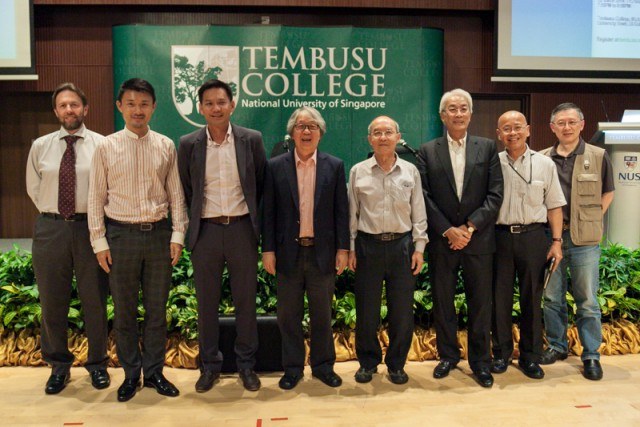
Entitled “Will there be another Sino-Japanese War?”, the forum, held at the Tembusu Multi-Purpose Hall, was moderated by the College’s Rector, Professor Tommy Koh. The panelists were Professor Wang Gungwu, chairman of the East Asia Institute, Dr Kei Koga, assistant professor at the Nanyang Technological University’s School of Humanities and Social Sciences, and Mr Peh Shing Huei, deputy news editor with the Straits Times.
Mr Peh, who had served as the bureau chief in China from 2008 to 2012, shared anecdotes of instances where China had shown itself behaving assertively, such as their demand for a formal apology from Japan even after the release of Zhan Qixiong in 2010, who had been detained for two weeks in Okinawa after his trawler collided with two Japanese patrol vessels near disputed islands in the East China Sea.
Dr Koga, who is also a Japan-U.S. Partnership Fellow at the Research Institute for Peace and Security in Tokyo, looked at cases of misperception or miscalculation in Sino-Japanese issues, the image of Japan’s political trend, and the strategic trend in the balance of power between Japan, China and the United States.
Prof. Wang spoke took a step back to critically examine the role of history in shaping the future. He said that historians may make predictions “just for fun” to see if things could have been done a different way. “Unfortunately,” he added, “there are many, many examples I can think of where we don’t learn [from history]”. He also noted the potential use of history as a tool by those who know more than others, which can give rise to abuse of power.
During the question and answer session at the end, several Tembusians asked noteworthy questions that added new dimensions to the topic. One Tembusian asked how propaganda distribution in China has changed now with the Internet, prompting Prof. Koh to ask Mr Peh if Chinese netizens tended to be nationalistic. Mr Peh, who noted that social media does improve the reach of extremist views, felt that around 50 per cent of netizens in China expressed angry views.
Another Tembusian raised the interesting possibility of other countries forming a bloc in response to an increasingly aggressive China. Prof. Wang observed that in a maritime world, China is continent-bound, with potential enemies on all its borders, and is unable to consolidate power anywhere in the world like the U.S. can. China, therefore, is highly conscious of threats to their land.
Another question compared the situations between U.S.-Japan and Japan-China relations, noting that US and Japan have reconciled after the Second World War, but China and Japan are still enemies. Prof. Wang responded by observing that the U.S. had had no intentions of making permanent enemies with the Emperor, a strategy which aided the reconciliation. However, Prof. Koh noted, this does not mean that Americans have forgotten what happened during the war.
As to the overall question of the forum, Prof. Koh summed it up as: nobody believed that a Sino-Japanese war was on the charts. Mr Peh felt it all boiled down to the tussle between the extremists and the more rational actors in any situation involving Sino-Japanese relations. Dr. Koga emphasised the importance of open channels of communication between the two nations; while he said they currently lacked such open communication, he also felt that there was no political will for either party to engage in battle. Prof. Wang felt there could be lessons learnt from the Cold War, and chances were that the U.S. would not engage as a third party. But as Prof Koh mentioned, other countries could do their part in a small way to encourage China and Japan to stop demonizing each other. Otherwise, Prof. Koh concluded, the ASEAN project of peace and prosperity in Asia could never be achieved.
While the topic may have been moot, the forum was certainly engaging in terms of eliciting thought-provoking questions from the floor. Furthermore, each panelist brought a different perspective to the table, showing that no matter which way one looks at it, it is ultimately best for everyone if there was no new Sino-Japanese war.
By Salima Nadira
Tembusu College recently hosted two prominent Japanese figures in conversation sessions known as Master’s Teas. Famed hairstylist Shunji Matsuo, who incidentally held a hair show in Tembusu two years ago, returned to Tembusu on 22 January. Shunji, who has over 40 years of international hairstyling experience, used to work in the major fashion capitals of Japan, Europe and the United States. He arrived in Singapore from Jakarta in 1999, and is now a Permanent Resident of Singapore, with 15 salons around the region in Singapore, Malaysia, Vietnam, Philippines and Indonesia under his eponymous group. The very next day Tembusu hosted Takaaki Kojima, who was Japan’s Ambassador to Singapore from 2004 to 2007. He was also Ambassador to Australia (2007-2010), and then Ambassador in charge of international counter-terrorism cooperation from 2010 until he retired from public service in 2011. He is currently a Visiting Senior Research Fellow at the Institute of Southeast Asian Studies (ISEAS).
Kojima’s session was dominated by questions on the China-Japan territorial tussle over the Diaoyu/Senkaku islands – a particularly relevant topic, especially coming off the Regional Outlook Forum organized on 9 January by ISEAS. Associate Professor Gregory Clancey, Master of the College, opened the discussion by asking for Mr. Kojima's views on Professor Tommy Koh’s suggestion that China and Japan take their dispute to the International Court of Justice. Kojima does not think that likely to happen due to differing interpretations of history.
Having been based in Beijing from 1989 to 1992, Kojima noted that history education in Chinese schools had intensified since he left, and that younger people tended to hold more anti-Japanese sentiments than those who had actually been through the Second World War. He gave the reason for this as being a push to reclaim the legitimacy of the CCP after the fall of the USSR in 1991.
The former Japanese ambassador laid out the Japanese perspective: Japan had incorporated the Senkaku Islands in 1885, following surveys conducted in 1884 showing that the islands were terra nullius, or belonging to no one. They had done so before the Treaty of Shimonoseki, which ended the First Sino-Japanese War. He noted that China did not subsequently claim the islands (as it had claimed Formosa, now known as Taiwan) until much later, in 1971, following another survey which showed the islands having resources of potential benefit to China. “The past behaviour is very important,” he said. “Up to the early 1970s, they had not laid any claim, even after the defeat of Japan.” Japan, therefore, feels itself in no position to bring the case to the ICJ as a dispute, and China in turn seems unlikely to do so.
Another question asked was whether having no standing army made the Japanese felt like second-class world citizens. Kojima did not think so, noting that the Japanese people accept the constitution (which prohibits a military) and can revise if they wish with a two-thirds majority vote. So far, there has been no successful effort to revise this aspect of the constitution, though Japan has a strong self-defence force. However, one area the constitution leaves unclear is whether or not Japan is allowed to participate in collective defence – defending a country that is being attacked by a third party – in the face of the rising military strength of China.
Kojima also addressed other issues such as pressures for additional Japanese apologies for the Second World War, among others. He also spoke about his recent book, entitled ASEAN-Japan Relations, published by ISEAS, which he co-edited with Professor Takashi Shiraishi from the Center for Southeast Asian Studies at Kyoto University.
Shunji Matsuo deals with negotiations of style. Having worked in New York for 22 years, and styled the likes of Donna Karan and Madonna, he has plenty of experience under his belt. In fact, responding to the opening question by Assoc. Prof. Clancey about his experiences as a young man striking out in a foreign land, Matsuo showed great humility in deferring to his mentor, Suga Yusuke. Yusuke’s was the first salon Matsuo worked at in New York, launching his career as a celebrity hairstylist. Yusuke enjoyed great fame for his styling of 1976 Olympic figure skating gold medalist Dorothy Hamill’s hair – her “wedge” haircut became a huge hit all over America and the world. “There is only one star" he said of Yusuke, "there cannot be another”.
Asked about how he negotiates disputes with his customers, he gave the example of a lady who was unhappy with his styling as she had wanted something simpler. “I was very sad for the whole day,” he recalled. “But the next day, you wake up, you forget.” The celebrity stylist claims he “knows what women want”, and how to make them look good – a claim that few would dispute. He describes the negotiation of style with his customers as “initially tense”, due to the personal nature of one’s hairstyle. But he is steadfast about not wanting to do a simple trim. “For me, I like to change [people’s hairstyles]. This is my specialty,” he said. As for his personal style, he has a preferred stylist of his own, and also gets his inspiration mostly from fashion magazines or the streets of Japan, in cities like Tokyo and Osaka.
Recently Matsuo has launched a new project encouraging stylishness in older people. “There are so many others who can take care of young people,” he said. “I will take care of older people.” 25 per cent of Japan’s population is 65 years old and above, and too many are drab, he believes. In contrast, older people in New York he describes as colourful and independent. “I want to change this slowly, make them happy,” he said.
There was media coverage of the session by NHK, the Japanese national broadcaster, which was in Singapore to film a programme on Matsuo's life and career. This is the first time a Tembusu College Master's Tea will be featured in a national television broadcast.
Matsuo also gave some business advice. “You have to sell yourself,” he advised the young entrepreneurs among the Tembusu College students in the room. He used a public relations company to spread news about his salon to more people in the early days, letting him concentrate on cutting hair and running the shop. He also gave three other pieces of advice: don’t overstock, let queues form, and it’s better to be understaffed than overstaffed. In other words, less is more.
During their respective sessions, both Matsuo and Kojima expressed their fondness for Singapore. Matsuo credited much of his current success to his being in Singapore. Kojima declared that out of the 25 countries he had been to, he was particularly fond of Singapore, and would visit ISEAS every two months. “When we are in Changi Airport, we don’t feel like we’re in a foreign airport,” he said.