Student’s Tea with Mr Jefferson Soh

Click to enlarge

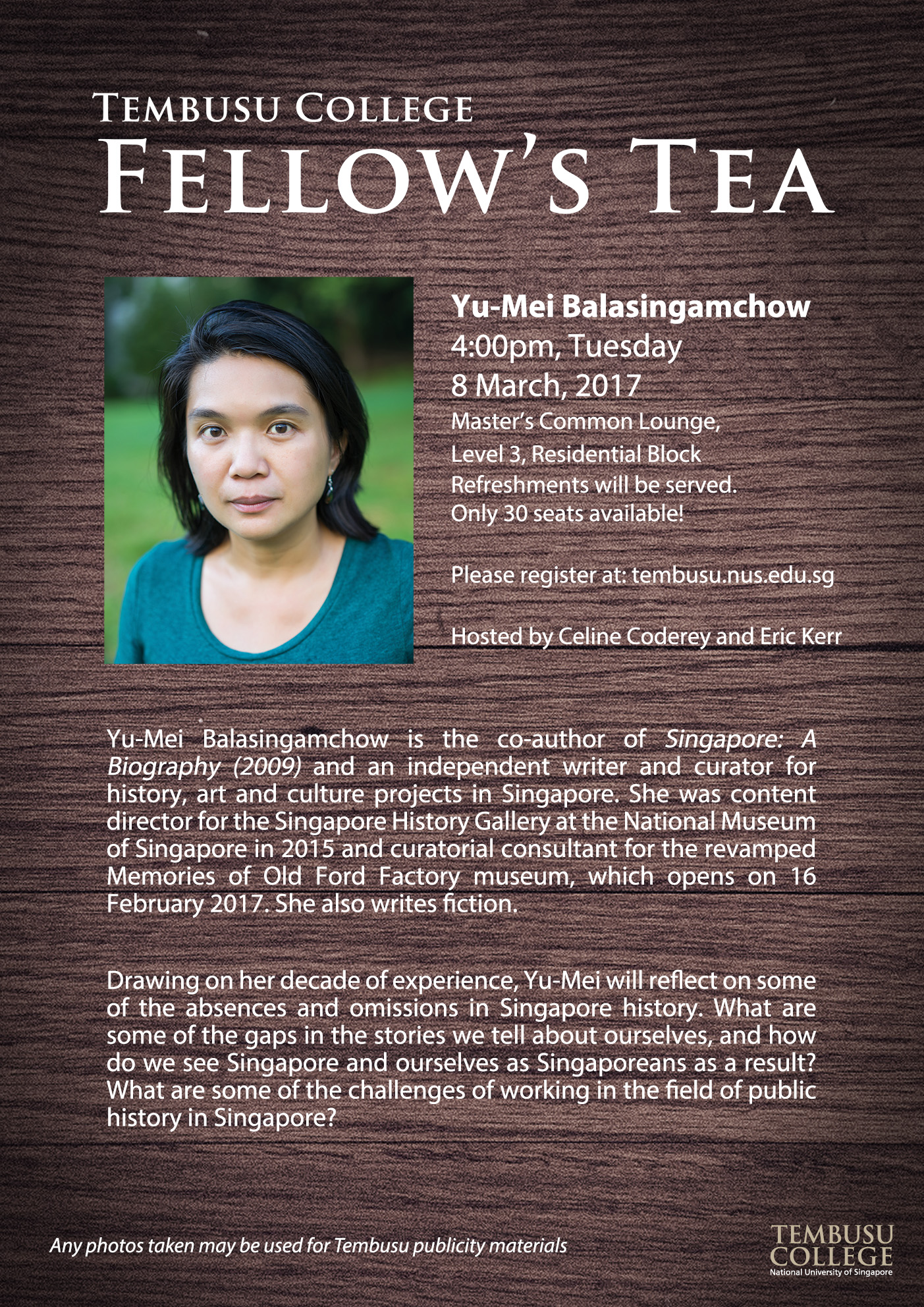
Student’s Tea with Mr Jefferson Soh

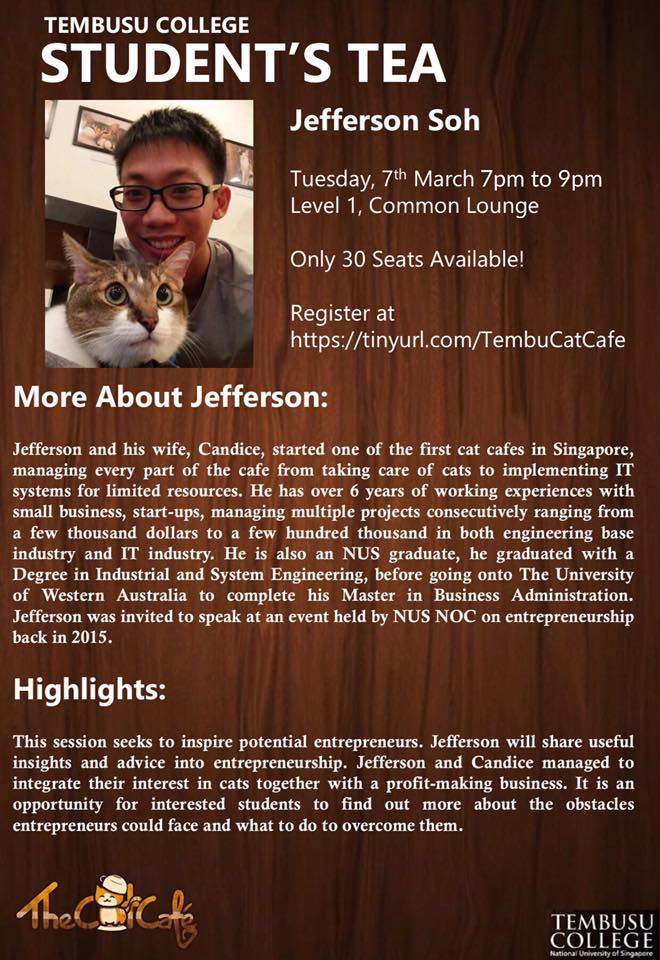
Host: Wayne Wee

Jefferson together with his wife, Candice, started one of the first cat cafes in Singapore, managing every part of the cafe from taking care of cats to implementing IT systems for limited resources.

Jefferson has over 6 years of working experiences with small business, start-ups, managing multiple projects consecutively ranging from a few thousand dollars to a few hundred thousand in both engineering base industry and IT industry.

He is also an NUS graduate, he graduated with a Degree in Industrial and System Engineering, before going onto The University of Western Australia to complete his Master in Business Administration.

Jefferson was invited to speak at an event held by NUS NOC on entrepreneurship back in 2015. He will be able to give useful advice and insight to potential entrepreneurs in Tembusu. For Jefferson and Candice, they managed to integrate their interest in cats together with a profit-making business. He will share on the obstacles they faced and what they did to overcome them. From this talk, students will be inspired to chase their own passion and dreams.

7 March 2017, 7pm – 9pm

Common Lounge, Tembusu College

Student’s Tea with Mr Sazzad Hossain

Click to enlarge
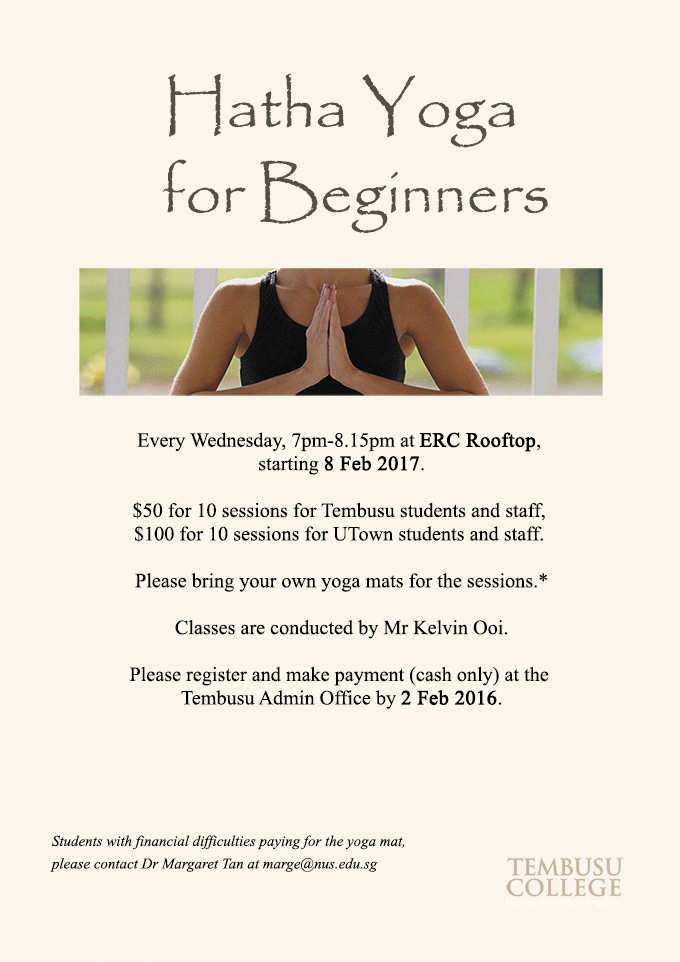
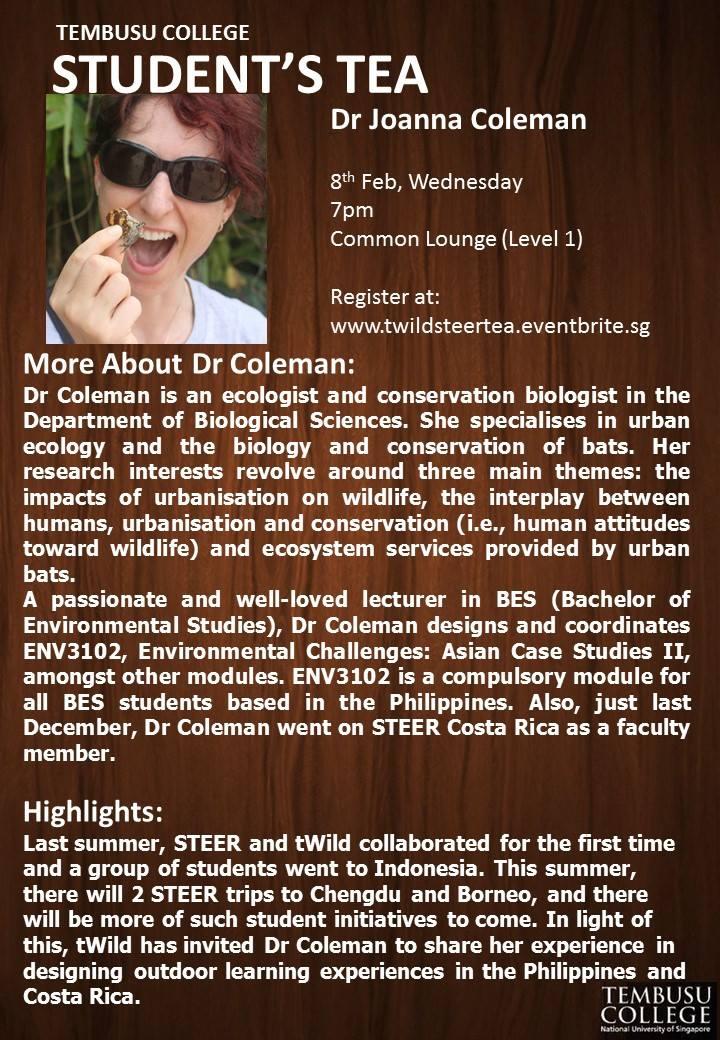
STUDENT’S TEA WITH MR SAZZAD HOSSAIN

Host: Ho Khin Wai

Sazzad is the founder and CEO of SDI Academy, a social enterprise that provides affordable English communication and computer programmes to migrant workers in their native language.

Till date, SDI Academy has helped over 300 migrant workers from the construction, shipping and manufacturing industries get over challenges they faced in their daily lives due to their poor command of English.

Sazzad’s startup has been featured in The Straits Times, Channel News Asia, and was even mentioned in a speech by Prime Minister Lee Hsien Loong. In 2015, he was invited to give a TEDx talk about his work on social entrepreneurship.

He currently runs his workshops at Yale-NUS College, along with two Yale-NUS students who are part of his core team.

7 February 2017, 7.30pm – 9pm

Level 1 Common Lounge, Tembusu College

By Professor Tommy Koh: ASEAN and the European Union

This is a big year for ASEAN and the EU.  ASEAN is celebrating its 50th anniversary.  The EU is celebrating its 60th anniversary.  The EU, notwithstanding the decision by the UK to leave the union, is often referred to as the most successful regional organization in the world.  ASEAN is often referred to as the second most successful regional organization.

In this essay, I would like to compare and contrast the similarities and differences between ASEAN and the EU.  I will begin with the similarities.

Similarities

The first similarity is that both are regional organizations with legal personalities.  The EU has 28 members and will have 27 in March 2019.  ASEAN has 10 members with Timor Leste knocking on the door.

The second similarity is that both were founded to promote peace.  The EU was founded, after two disastrous world wars, to prevent the recurrence of war in Europe and to institutionalize peace through economic integration.  ASEAN was founded to create a peaceful environment in Southeast Asia so that the ASEAN countries could focus their energies on their economic development.

The third similarity is that both seek to integrate the economies of their member states into a single market and production platform.  In the case of the EU, there is freedom of movement of goods, services, capital and labour.  In the case of ASEAN, the movement labour is not free.  The ASEAN Charter only obliges the member states to facilitate the movement of business persons, professionals, talents and labour.  This is a major difference between ASEAN and the EU.

The fourth similarity is that both organizations share a commitment to human rights.  The EU has a Charter of Fundamental Rights and ASEAN has a Declaration of Human Rights.  The ASEAN Charter contains several provisions in its Preamble, Purposes and Principles, on human rights.  ASEAN has two commissions on human rights:  (1)  the ASEAN Intergovernmental Commission on Human Rights;  and (2)  the Commission on the Rights of Women and Children.  However, the EU has a Court of Human Rights, in addition to the Court of Justice and Court of Auditors.  ASEAN does not have a court.

The fifth similarity is that both ASEAN and the EU have concluded many free trade agreements or comprehensive economic partnership agreements with other countries.  For example, the EU and Singapore have concluded a free trade agreement which is pending ratification.  ASEAN has concluded such agreements with China, Japan, South Korea, India, Australia and New Zealand but not with the EU.

The sixth similarity is that both ASEAN and the EU hold regular political and economic dialogues with important external partners.  The EU holds annual summits with the US, China, Japan, Russia, etc.  ASEAN has created three forums to engage its external partners, namely, the ASEAN Regional Forum, ASEAN Plus Three and the East Asia Summit.  In addition, ASEAN holds bilateral dialogues with its 10 Dialogue Partners.  Finally, ASEAN holds an annual summit with the US, China, India, Japan and South Korea.

Differences

There are several important differences between ASEAN and the EU.  The first difference is that ASEAN is an intergovernmental organization.  The EU, in contrast, is a supranational organization in which its member states have agreed, in certain areas, such as trade, to pool their sovereignties.  In other words, the member states have voluntarily agreed to give up part of their sovereignty.  The pooled sovereignty is exercised by the European Commission on behalf of the member states.

The second difference is that the EU has a common currency called the euro.  Only 19 of the EU’s 28 members are members of the Eurozone.  ASEAN does not have a common currency and has no plans to do so.  However, in the aftermath of the 1997 Asian Financial Crisis, ASEAN together with China, Japan and South Korea launched the so-called Chiang Mai Initiative.  The project brings together the 13 Finance Ministers and Central Bank Governors.  Their agenda is to promote greater financial cooperation among the 13 countries.

The third difference is that the EU has a Parliament and ASEAN does not.  The European Parliament has the power to legislate as well as the power to veto budgets and appointments.  ASEAN has the ASEAN Inter-Parliamentary Assembly which has only the power of moral suasion.

The fourth difference is that the EU has a very powerful Secretariat called the European Commission and ASEAN has a relatively small and weak Secretariat.  The European Commission acts like a government and is entitled to enter into treaties.  The Commission has the power to put forward proposals for legislation.  The ASEAN Charter has enhanced the power of the Secretary-General.  One of his most important responsibilities is to issue an annual report card on each member state’s compliance with its obligations.

The fifth difference is in the decision-making process.  ASEAN takes all its decisions by consensus.  The EU can decide by taking votes.  There is a system of weighted voting, with different countries being given different numbers of votes.  However, in the area of common foreign and security policy, decisions are based on unanimity.  In ASEAN’s case, there is an exception to the consensus rule:  economic agreements can be adopted by a majority, using the “ASEAN minus X” formula.  The logic is that the majority can proceed first and the minority will catch up later.

The sixth difference is on language policy.  The EU has 23 official languages.  In the cast of ASEAN, English is used as the sole medium for meetings and communications.

Conclusion

I want to conclude by expressing my confidence in the EU.  I believe that the EU, without the UK, will be stronger and not weaker because it will be more cohesive.  I do not believe that the EU will break up or that the euro will fail.  In the same way, I believe that ASEAN will overcome its challenges and remain united and independent.  Learning from the experience of the EU, ASEAN will redouble its efforts to ensure that it is not viewed as an elitist project.  Instead, ASEAN must ensure that it enjoys the support of the 625 million citizens of ASEAN.

Into the heart of Borneo

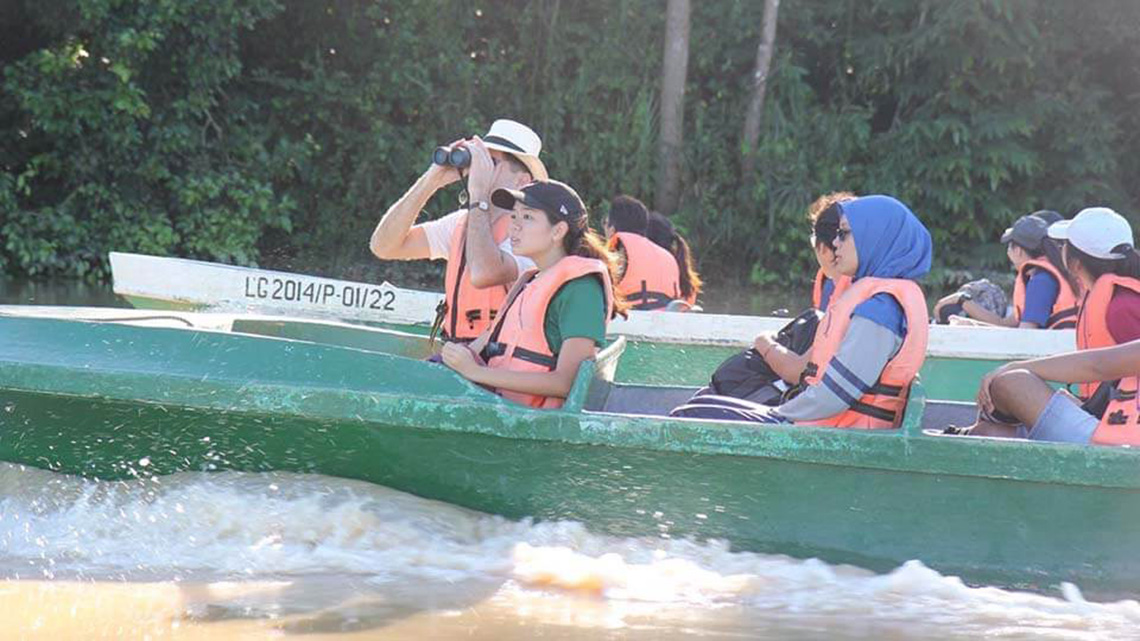
The group spotted a myriad of species on a cruise down the Kinabatangan River in Sabah

A group of 14 NUS students, led by historian of science Dr John van Wyhe from Tembusu College and NUS Biological Sciences, undertook an extraordinary expedition through Borneo from 8 to 20 May under the Study Trips for Engagement and EnRichment (STEER) programme to study the state of nature conservation on the world’s third-largest island.

The first stop was Kuching, the capital of Sarawak, Malaysia, where the team toured the historic city centre, including the Brooke Gallery housed in the 1880 Fort Margherita. They also visited Matang Wildlife Centre, home to hundreds of rescued animals including orangutans, sun bears, gibbons, hornbills, crocodiles and leopard cats, and learnt about the difficulties in rehabilitating wild animals that have spent too much time with humans, as pets for example.

The group then travelled by sea to Bako National Park under the expert guidance of a representative of the Malaysian Nature Society (Kuching Branch). Along the beaches and in the forests of Bako, they had close encounters with Langur monkeys, the bright-eyed Bornean bearded pig, fat-bellied Proboscis monkeys, a large tree snake, flying geckos and the strange Colugo or flying lemur, as well as many unique species of pitcher plants.

An unexpected flight cancellation left them stranded overnight in Kuching. However, the students managed to salvage the expedition by splitting into groups to book accommodation and a next-day flight to Mulu on a small twin-engine aircraft. As they flew over Sarawak, they saw vast geometric blocks of oil palm plantations rapidly replacing Borneo’s native forest, which gave way to a multicoloured carpet of virgin forest as they briefly crossed the Bruneian border.  

At Gunung Mulu National Park in Sarawak, the group visited the village of Batu Bungan, accompanied by a local Penan guide. The Penan were, until recently, hunter gatherers in the forests of Borneo and, remarkably, there are still about 300 Penan living as nomads in the area. It was here also that Dr van Wyhe was particularly excited to spot one of the most beautiful insects in the world, the Rajah Brooke butterfly, first discovered in Sarawak by famed naturalist Alfred Russel Wallace in 1855.  

The beautiful Rajah Brooke butterfly in Sarawak

Next up were the famous limestone caves, nesting place of millions of birds and bats. That evening, the group caught a breathtaking display of the nightly exodus of millions of bats spiralling up into the sky.

The expedition travelled next to Brunei where they were hosted by staff and students of the Universiti Brunei Darussalam. After a long boat voyage to the Kuala Belalong field studies centre deep in the jungle, they saw more unique wildlife and had the opportunity to meet modern-day Wallaces — researchers discovering and collecting new species. They also met Mr Lim Hong Huai and Mr Raymond Chew, Singapore’s High Commissioner and Deputy High Commissioner to Negara Brunei Darussalam respectively.

The group then flew to Kota Kinabalu in Sabah where they toured the Sabah Museum, a natural history and cultural museum, before heading to Sandakan and meeting members of the eco-tourism and conservation group APE Malaysia. Under their guidance, the group visited the Sepilok Orangutan Rehabilitation Centre within the Kabili-Sepilok Forest Reserve, where they got up close and personal with orangutans, sun bears and brightly-coloured short-tailed macaques.

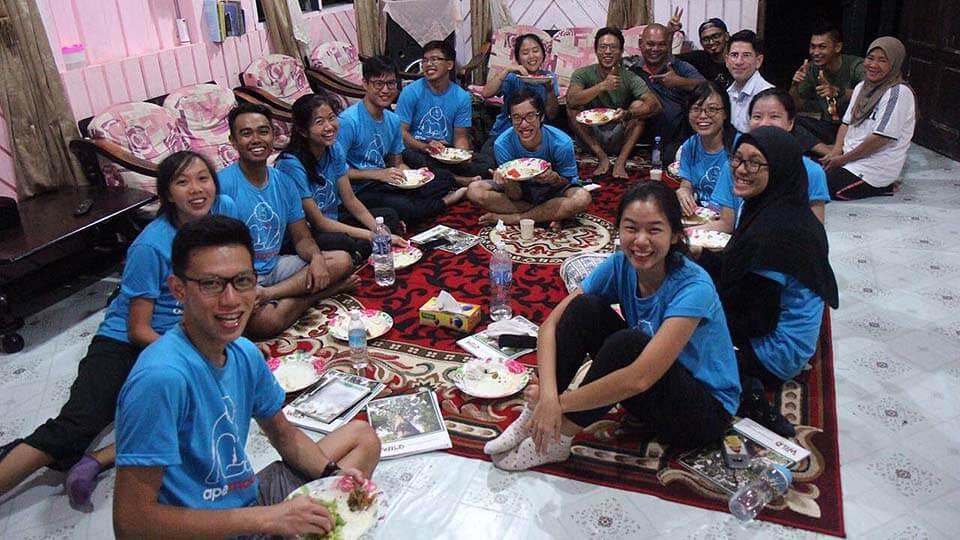
At the tiny village of Sukau along the Kinabatangan River, they spotted a myriad of beautiful species such as the Serpent eagle, Black eagle, Purple heron, Stork-billed kingfisher, and the giant Storm stork, of which less than 500 survive in the wild. The group also helped to plant 100 native tree saplings in a part of the forest destroyed by logging, and were treated to dinner in a house on stilts by a local family.

Having a meal with a local family in Sukau

A highlight of the trip happened on the final river cruise, where the students witnessed, from only a few meters away, a group of Pygmy elephants feeding by the water’s edge, and heard the distinctive trumpeting emanating from the nearby forest. They also observed, enthralled, a wild female orangutan and her child high up in the branches.

Save for a few bumps, bites and bruises, the team returned safely to Singapore with experiences of the region to last a lifetime.

Island adventurer: Alfred Russel Wallace and the quest for the origin of species

Catch the video of Dr John van Wyhe on BBC Travel here

In honour of the centenary of the great Victorian naturalist, Alfred Russel Wallace, John van Wyhe wrote and curated the Wallace exhibition at Science Centre Singapore, co-sponsored by the Faculty of Science, NUS. This animated biography of Wallace was made for the exhibition.

The opening title sound recording of the song of Wallace’s standard wing bird of paradise was recorded on Halmahera by John van Wyhe.